

Imagine standing before a finished structure that appears flawless from the street, yet the foundation is shifting quietly beneath your feet. Many Buffalo business owners face this exact dissonance when they review a profitable income statement only to find their bank account empty. It's a common, unsettling experience to see high sales numbers while feeling the weight of anxiety during a payroll cycle. You are not alone in wondering why your tax bill seems higher than the cash you have available to pay it.
Understanding business cash flow vs profit is the architecture of financial clarity. While profit represents the blueprint of your success, cash flow is the oxygen that allows the building to stand. This guide provides a clear framework to distinguish between your earnings and your actual liquidity. We will examine how Buffalo-specific factors, such as regional seasonality and 2026 tax shifts under the One Big Beautiful Bill Act, impact your bottom line. By the end, you'll have actionable steps to improve your cash position and ensure your business remains both sustainable and solvent through every season.
Key Takeaways
- Distinguish between profit as a measure of design efficiency and cash flow as the rhythmic movement of capital through your organization.
- Deepen your understanding business cash flow vs profit to navigate the "timing gap," where accrued expenses often outpace realized client payments.
- Construct a "Clarity Dashboard" that moves beyond the income statement to reveal the true liquidity of your Western New York business.
- Align your tax obligations with actual cash availability through the discipline of a rolling 13-week forecast.
- Explore how intentional financial architecture and fixed-fee structures provide the predictability necessary for long-term sustainability.
The Dualities of Finance: Defining Profit and Cash Flow
In the discipline of architecture, we distinguish between the structural blueprint and the lived experience of the building. Business finance requires a similar discernment. Profit and cash flow are not interchangeable terms; they are dualities that describe different states of your firm's existence. Understanding business cash flow vs profit is essential for any owner who wishes to build a structure that is both beautiful on paper and resilient in practice. This distinction ensures that your financial architecture is not just a static drawing, but a functional, living environment.
Your Profit & Loss statement (P&L) provides a narrative of efficiency. It measures whether your business model functions effectively over a specific period. However, it's only half of the story. A firm can appear highly efficient while starving for the liquid capital required to sustain its daily operations. The Cash Flow Statement acts as the restorative element, providing the financial breathing room necessary to manage the literal movement of funds. This breathing room allows for a steady, unhurried approach to growth. It ensures that the design of your business doesn't collapse under the weight of its own success.
Profit: The Blueprint of Success
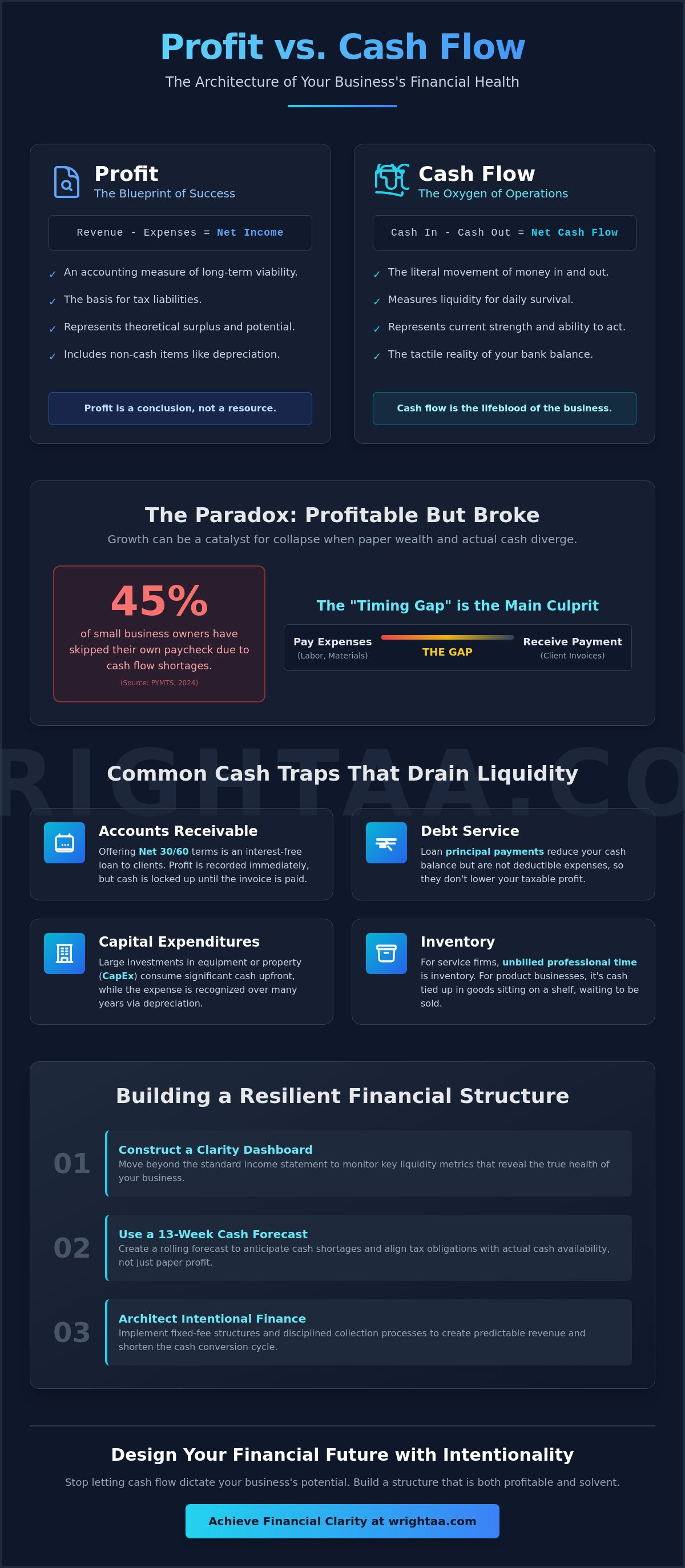
Profit, or net income, represents the theoretical surplus remaining after all expenses are subtracted from revenue. It's the primary metric for long-term viability and the basis for tax liabilities in Buffalo. Under the One Big Beautiful Bill Act of 2025, business owners must navigate complex expensing rules, such as the $2.56 million Section 179 limit for 2026. These regulations often create a gap between paper profit and actual bank balances. Non-cash items like depreciation reduce your taxable profit without removing a single dollar from your account, illustrating why profit is a measure of design rather than immediate utility. It reflects the potential of your site, but it's not the material required to build upon it.
Cash Flow: The Pulse of Daily Operations
If profit is the blueprint, cash flow is the oxygen. It's the literal movement of liquid capital into and out of your firm. This pulse is categorized into operating, investing, and financing activities. Each category reveals how money is actually behaving. Revenue is merely a promise of future utility; cash on hand is the reality of your current strength. In the Western New York market, liquidity determines your ability to seize sudden opportunities, whether it's acquiring a competitor or investing in new equipment during an inflationary period where the annual rate reached 4.2% in May 2026. Without a healthy pulse, even the most elegantly designed business model will eventually fail to sustain itself. It's the tactile reality of your daily survival.
The Paradox: Why Profitable Businesses Go Broke
Growth is often viewed as the ultimate sign of health, yet it can be the very catalyst for collapse. A business may show a healthy net income on its Profit & Loss statement while its bank account sits empty. This is the paradox of paper wealth. Understanding business cash flow vs profit requires recognizing that profit is an accounting conclusion, while cash is a physical reality. When these two metrics drift apart, the structural integrity of your firm is at risk.
The "Timing Gap" is the most frequent culprit. It occurs when the materials and labor for a project are paid for long before the client settles the invoice. A 2024 survey by PYMTS revealed that 45% of small business owners have had to forgo their own paychecks due to such cash flow shortages. This gap isn't a sign of failure, but it's a structural flaw that must be managed with precision. Without a steady supply of liquid capital, the most profitable design remains nothing more than a theoretical exercise.
Inventory and Accounts Receivable Traps
For service businesses and law firms, professional time is the inventory. When you offer Net 30 or Net 60 terms, you're essentially providing an interest-free loan to your clients. This creates a cash vacuum. A key difference between cash flow and profit is that profit records the sale the moment the contract is signed or the work is done, while cash flow waits for the deposit to clear. Managing the AR lifecycle is an act of preserving your firm's foundation. It requires a disciplined approach to collections to ensure that "revenue" eventually becomes "cash."
Debt Service and Capital Expenditures
Debt service presents another layer of complexity. While interest payments are deductible on your P&L, loan principal payments are not. They are silent consumers of liquidity. With SBA 7(a) variable rates reaching approximately 9.0% to 11.5% in June 2026, the cost of carrying debt is significant. Purchasing Buffalo real estate or heavy equipment may increase your long-term assets, but it immediately depletes your cash reserves. Capital investments create a divergence because they require an immediate outflow of cash while the associated expense is recognized slowly over years through depreciation. Implementing professional cash flow management ensures that your growth is supported by actual liquidity rather than theoretical earnings.
Evaluating Business Health: A Framework for Western New York Owners
A clarity dashboard is the site survey of your financial health. It provides a real-time view of the environment in which your business operates. For Western New York owners, this means looking past the surface level of the income statement. Understanding business cash flow vs profit requires a more granular approach to data. You must evaluate whether your firm is truly gaining ground or simply accumulating paper gains that cannot be deployed. When the foundation is obscured by complex reporting, the structural integrity of the entire enterprise is at risk.
Comparing your Net Profit Margin against your Cash Flow Margin reveals the efficiency of your capital. A high profit margin suggests a well-designed model, but a low cash flow margin indicates that the model isn't breathing. This divergence often signals "false profits," where earnings exist on a screen but never materialize in the bank. In an economy where inflation reached 4.2% in May 2026, the purchasing power of trapped profit diminishes daily. True health is found when these two metrics move in harmony.
Key Performance Indicators (KPIs) for Clarity
Monitoring specific financial kpis for small business provides the precision needed to maintain stability. The Quick Ratio is a vital tool. It measures your ability to meet immediate obligations without relying on the sale of inventory. Additionally, tracking Days Sales Outstanding (DSO) reveals the velocity of your cash. If your DSO is rising, your capital is trapped in your clients' bank accounts rather than your own. Finally, your Burn Rate acts as a countdown. It tells you exactly how many months your structure can stand if the external flow of revenue were to cease.
The Seasonal Rhythm of WNY Businesses
In cities like Buffalo and Rochester, the environment dictates the pace of commerce. Exterior-focused firms often face a quiet winter, making the creation of a "cash fortress" during the warmer months essential. This fortress is not a luxury; it's a structural requirement. A key difference between cash flow and profit becomes apparent during these cycles. A firm may show a profit for the year, yet fail in February because it didn't respect the seasonal rhythm. Retailers and service providers in Syracuse must also navigate these cycles, adjusting their inventory and payroll to match the local pulse. Strategic planning ensures that the winter months are a time for quiet reflection and preparation rather than financial distress.
Strategic Management: Designing a Resilient Financial Structure
Strategy is the bridge between the conceptual and the material. In finance, this means moving beyond the static nature of the P&L to manage the dynamic reality of liquidity. A resilient structure requires more than just high sales; it demands a disciplined approach to timing. Understanding business cash flow vs profit is the first step toward building a firm that can withstand economic shifts, such as the 4.2% inflation rate noted in May 2026. It's about ensuring your vision has the resources it needs to be realized.
Implementing a rolling 13-week cash flow forecast is like conducting a continuous site survey. It allows you to see the terrain ahead before you commit your materials. By projecting your cash position three months into the future, you can identify potential shortfalls before they become structural crises. This foresight enables you to negotiate better terms with vendors, syncing your outflows with your natural collection cycles. It transforms your financial management from a reactive exercise into a deliberate act of design.
Proactive Tax and Cash Alignment
A common failure in financial architecture is the disconnect between earnings and tax obligations. High paper profit often leads to significant tax bills that arrive when cash is least available. Integrating business tax planning in Buffalo, NY into your monthly routine prevents these shocks. With the revival of 100% bonus depreciation under the One Big Beautiful Bill Act of 2025, your tax strategy must be precise to avoid cash traps. Setting aside cash for quarterly estimated taxes preserves your firm's liquidity and provides peace of mind. This is vital for S-Corp owners, where the duality of personal distributions and business reinvestment can easily become blurred.
Refining Your Billing and Collection Process
The speed at which revenue converts to cash is the velocity of your business. To stabilize this flow, consider transitioning to fixed-fee accounting. This model removes the volatility of hourly billing and creates a predictable rhythm for your outflows. Upfront deposits and automated reminders further refine this process. There's a profound psychological shift when a firm moves from "billing tomorrow" to "getting paid today." It replaces the anxiety of the unknown with the calm of a well-ordered environment. To begin designing a more intentional financial future, explore our professional CFO services.
Designing Financial Intentionality with Wright CPAs, LLC
Financial clarity isn't a static achievement. It's a continuous state of awareness that requires both a visionary perspective and grounded execution. At Wright CPAs, LLC, we bridge the distance between your accounting records and your bank balance. Deepening your understanding business cash flow vs profit is the cornerstone of this awareness. It allows you to move from a place of constant reaction to one of quiet confidence. We don't just record history; we help you design the future of your enterprise through meticulous financial architecture.
Our fixed-fee model is a deliberate choice. It removes the friction of unpredictable costs, allowing your own cash flow to remain steady and unhurried. This predictability is essential for maintaining the structural integrity of your firm. Whether you're starting a business in Buffalo or scaling a national operation, our approach remains rooted in the same principles of financial intentionality. We provide the tools to ensure your growth is both sustainable and poetic, reflecting the true potential of your business design.
CFO-Level Strategy for Growing Firms
As your firm expands, the complexity of your financial environment increases. We provide the "Architecture of Finance" through outsourced CFO services. This guidance goes beyond basic bookkeeping. We analyze your business structure for maximum cash retention, ensuring that your tax strategy aligns with your actual liquidity. Our customized reporting speaks to your specific goals. It provides the tactile data you need to make decisions with precision and purpose, ensuring every intervention in your business is thoughtful and well-timed.
A Partner in Your Long-Term Success
We believe that every business is a unique intervention within its community. Our commitment is rooted in deep listening and contextual awareness. We take the time to understand the nuances of your industry and the specific challenges of the Western New York market. Buffalo businesses trust Wright CPAs, LLC because we value substance over spectacle. We're here to ensure that your financial foundation is as enduring as the structures you build. Our process is patient and methodical, designed to improve your daily life through superior financial management. Take the first step toward a more intentional future. Book a consultation today with Wright CPAs, LLC to begin the process of designing your financial clarity.
Building a Foundation of Financial Resilience
True financial clarity is found at the intersection of vision and liquidity. By mastering the nuance of understanding business cash flow vs profit, you ensure that your firm's architecture is as functional as it is ambitious. You've explored how the timing gap can destabilize a profitable business and how seasonal rhythms in Western New York require a disciplined cash fortress. These aren't merely technical hurdles; they're the essential elements of a sustainable business design that respects both your goals and your environment.
Since 2012, Wright CPAs, LLC has provided the specialized CFO-level guidance necessary to navigate these dualities with precision. Our fixed-fee monthly advisory retainers are designed to provide predictability, allowing you to focus on the creative growth of your enterprise without the distraction of administrative friction. It's time to move beyond reactive bookkeeping toward a more intentional financial future. We invite you to design your path to financial clarity with a Wright CPAs, LLC consultation. Your business deserves a foundation that's built to endure every season.
Frequently Asked Questions
Can a business be profitable but have a negative cash flow?
Yes, a business can easily be profitable while experiencing negative cash flow. Profit is an accounting measure of efficiency recorded when a sale is made, but cash flow only changes when the payment is actually received. If your clients are slow to settle their invoices, your Profit & Loss statement will show revenue that hasn't yet reached your bank account to cover your immediate expenses.
Which is more important for a startup in Buffalo: profit or cash flow?
Cash flow is the paramount concern for any startup in Buffalo. While profit indicates a viable long-term design, cash flow is the immediate material required to keep the doors open and meet payroll. Many young firms fail not because they lack sales, but because they run out of liquidity before those sales convert to usable funds during the region's seasonal shifts.
How does depreciation affect my profit vs. my actual cash?
Depreciation reduces your paper profit but has no immediate effect on your cash. It's a technical acknowledgment that your physical assets, such as equipment or property, lose value over time. For the 2026 tax year, the Section 179 expensing limit of $2.56 million allows you to significantly lower your taxable income without spending any additional cash beyond the initial investment.
What is the best way to forecast my cash flow for the next 90 days?
The most effective method is a rolling 13-week forecast. This framework projects your cash position by analyzing expected deposits against both fixed and variable outflows. It functions as a site survey for your finances. By looking 90 days ahead, you can identify potential gaps and adjust your spending or collection efforts before they become structural crises.
How do taxes impact my cash flow if I am an LLC in New York?
Taxes are calculated based on your net profit, regardless of how much cash you've actually withdrawn from the business. For a New York LLC, this means you may owe taxes on income that is still trapped in accounts receivable. Understanding business cash flow vs profit is essential for planning these quarterly estimated tax payments to avoid a sudden drain on your liquidity.
Why does my bank balance never match the "Net Income" on my P&L?
Your bank balance and Net Income rarely align because they measure different financial states. Net Income includes non-cash expenses like depreciation and excludes cash outflows like loan principal payments. While you see a profit on your statement, the cash used to pay down debt or purchase inventory has already left your account, creating a disconnect between paper wealth and actual liquidity.
Is it better to have high profit or high cash flow during an economic downturn?
High cash flow is generally more valuable during an economic downturn. Liquidity provides the flexibility to navigate uncertainty and high borrowing costs, such as the 9.0% to 11.5% SBA 7(a) rates seen in June 2026. While profit is necessary for long-term health, cash flow is the structural reinforcement that prevents collapse when the external economic environment becomes volatile.
How can an outsourced CFO help me manage the cash flow vs. profit gap?
An outsourced CFO provides the strategic oversight needed to align your earnings with your actual liquidity. They help you move from reactive bookkeeping to proactive financial architecture. By analyzing the specific gap between your P&L and your bank balance, they design systems that ensure your firm remains solvent and resilient as it scales toward its long-term goals.


