

A tax payment is not a loss of capital; it is the structural reinforcement of your business's foundation. For many entrepreneurs, the rhythm of quarterly tax estimates for self-employed Rochester feels like a disruption to their creative flow rather than a part of it. It's natural to feel a sense of apprehension when faced with the duality of Federal and New York State obligations. The fear of a sudden year-end bill or an unplanned penalty can quiet even the most visionary ambitions.
We believe that financial clarity is a form of architectural discipline. This guide will help you master the structure of your 2026 obligations, ensuring that your cash flow remains steady and predictable. We'll explore the specific 2026 thresholds, including the 15.3% self-employment tax rate and the $184,500 Social Security wage base. By aligning your payments with your actual growth, you'll eliminate the friction of underpayment penalties and build a business that is as resilient as it is inspired. Understanding these requirements is the first step toward a more intentional financial future.
Key Takeaways
- Understand the fundamental structure of self-employment taxes, replacing traditional withholding with a disciplined and intentional system.
- Navigate the 2026 deadlines for quarterly tax estimates for self-employed Rochester to maintain cash flow clarity and avoid unnecessary penalties.
- Learn to calculate your liability with a methodical approach that accounts for the 15.3% self-employment tax before income brackets are applied.
- Integrate tax payments into your business architecture by establishing a holding environment that separates operating capital from future obligations.
- Move beyond simple compliance toward a proactive strategy that aligns your tax rhythm with your specific lifestyle and professional goals.
Understanding the Structure of Estimated Taxes for Rochester Professionals
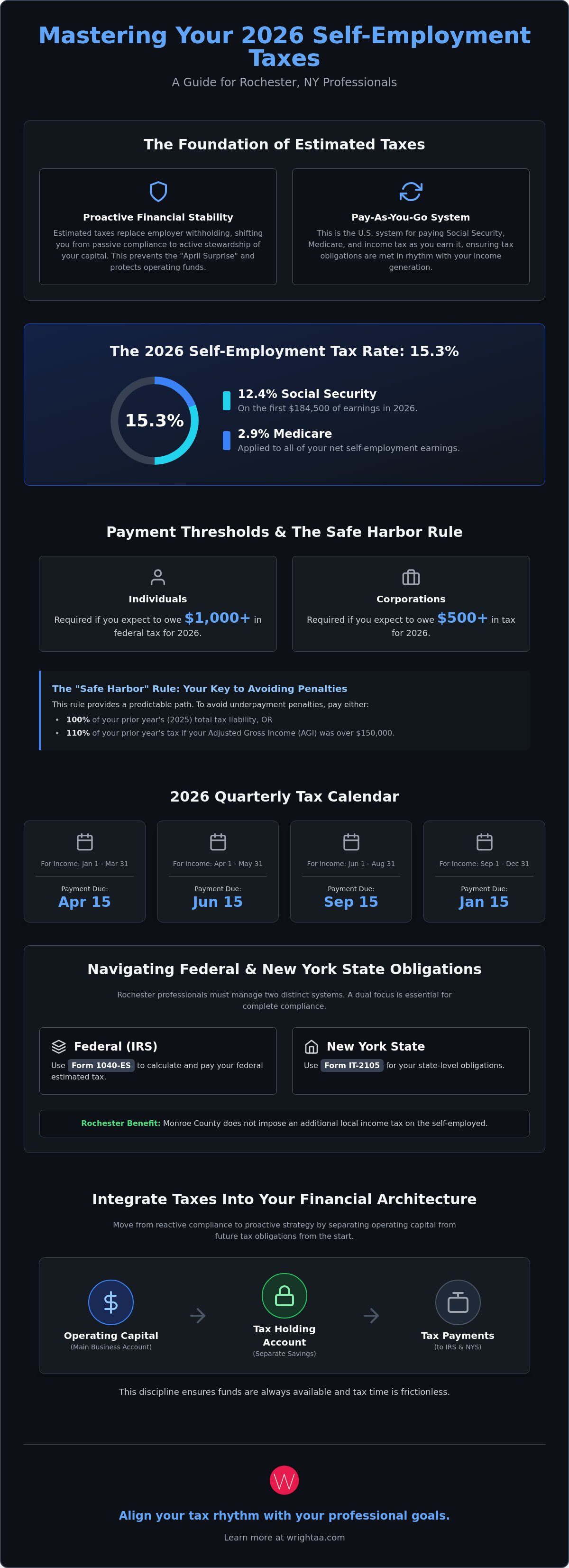
Estimated tax is the method used to pay Social Security, Medicare, and income tax as you earn it. It functions as a proactive structural component of cash flow. For those managing their own ventures, quarterly tax estimates for self-employed Rochester serve as the cornerstone of financial stability. This system replaces the automatic withholding once managed by an employer, shifting the responsibility of balance and timing to the individual. It's a transition from passive compliance to active stewardship of your business capital.
Approaching these payments with intentionality prevents the "April Surprise," a common point of friction that can deplete essential operating funds. By treating tax obligations as a rhythmic part of your business environment, you preserve the integrity of your long-term vision. This practice is part of the larger U.S. income tax system, which operates on a pay-as-you-go philosophy. It ensures that the state and federal government receive their dues in alignment with your income generation.
Who Must Pay Estimated Taxes in New York State?
The requirement to pay is dictated by specific financial thresholds. Individuals who expect to owe $1,000 or more in federal tax after credits must engage with this process. Corporations based in Rochester face a lower threshold, generally required to make payments if they expect to owe $500 or more. To avoid underpayment penalties, many professionals utilize the "Safe Harbor" rule. This involves paying 100% of last year's total tax liability, or 110% if your income exceeds certain levels. It provides a predictable path through the fiscal year.
The Intersection of Federal and State Obligations
Managing these obligations requires a dual focus. Rochester residents must navigate two distinct systems: the IRS for federal dues and New York State for local requirements. This involves distinguishing between IRS Form 1040-ES and NYS Form IT-2105. Each has its own nuances, deadlines, and calculation methods. While Monroe County does not impose a local income tax on the self-employed, tracking these separate payment streams is vital. It creates a comprehensive view of your financial health, ensuring that no element of your business architecture is left to chance.
Calculating Your Liability: A Methodical Approach to the Numbers
Calculating your tax liability is an exercise in precision. It requires a clear view of your financial horizon. For those managing quarterly tax estimates for self-employed Rochester, the process begins with an accurate projection of your 2026 adjusted gross income. This figure serves as the raw material for your fiscal structure. It represents the total volume of your earnings before the refining process of deductions begins.
Before applying standard income tax brackets, you must account for the self-employment tax. This 15.3% rate covers Social Security and Medicare obligations. It's a foundational cost of doing business independently. Once this is established, you refine the numbers by subtracting valid business deductions. These deductions reduce your taxable base, ensuring you only pay on your true profit. According to IRS guidelines on estimated taxes, this methodical subtraction is essential for maintaining accuracy. It ensures that your tax payments remain proportional to your actual business performance.
Utilizing your prior year's data acts as a reliable blueprint. It provides a historical context for your current projections. While your business evolves, these past patterns offer a grounded starting point for future estimations. You can adjust this blueprint as new contracts are signed or expenses shift, allowing your financial plan to breathe and adapt. This iterative process is the hallmark of a disciplined entrepreneur.
Projecting Income with Precision
Western New York's economy often dictates a specific rhythm. Seasonal fluctuations are common in Rochester's professional services and creative industries. If your income arrives in waves, the "Annualized Income Installment Method" allows you to align your payments with your actual earnings. This prevents the strain of paying high estimates during leaner months. Integrating these projections into your small business accounting Buffalo NY practices ensures that your tax strategy remains in harmony with your cash flow. This method requires meticulous tracking, but it offers a level of financial equilibrium that standard quarterly payments cannot match.
Factoring in New York State Specifics
The New York State tax landscape has its own unique geometry. NYS income tax rates differ significantly from federal brackets, and the state offers specific credits that can reduce your total obligation. Precision here is not just about compliance; it's about protection. Subtle errors in NYS estimates can often trigger state-level audits, disrupting your business's peace. A refined tax strategy can help you navigate these nuances with confidence. By mastering these state-level details, you ensure that your financial architecture remains both compliant and efficient. This attention to detail is what separates a standard business from a truly intentional one. It allows you to manage quarterly tax estimates for self-employed Rochester with the same care you apply to your primary craft.
The 2026 Quarterly Tax Calendar for Rochester Business Owners
A well-designed business requires a reliable schedule. The fiscal year is punctuated by four specific milestones that dictate the flow of capital from your accounts to the state and federal government. For those managing quarterly tax estimates for self-employed Rochester, these dates are not suggestions. They are the structural beams that support your financial integrity. Missing a deadline can result in penalties that erode your hard-earned growth, much like a hairline fracture in a building's foundation.
- Quarter 1: April 15, 2026. This payment covers income earned between January 1 and March 31.
- Quarter 2: June 15, 2026. This payment addresses earnings from April 1 through May 31.
- Quarter 3: September 15, 2026. This period encompasses income generated from June 1 to August 31.
- Quarter 4: January 15, 2027. The final installment accounts for the remaining months of September through December.
If a deadline falls on a weekend or a legal holiday, the payment is typically considered timely if it's made on the next business day. This nuance is vital for maintaining a clean record with the IRS and New York State. Following a comprehensive guide to filing self-employment taxes can help you stay aligned with these recurring expectations. It ensures that your focus remains on your craft rather than on administrative recovery.
Why the Second Quarter is Frequently Overlooked
The second quarter is often a source of confusion because it's a "short quarter." While Q1 and Q3 cover three months of income, Q2 only accounts for April and May. This two-month window requires a subtle adjustment in your calculations. If you base your June 15 payment on a full three months of projected earnings, you may inadvertently overpay. Conversely, ignoring this compressed timeframe can lead to cash flow friction during the Q2/Q3 transition. In Rochester, where summer projects often begin in earnest during these months, planning your liquidity around this shorter window preserves your ability to invest in new opportunities.
Submission Methods: IRS Direct Pay and NYS Web File
The method of delivery is as important as the amount paid. Electronic systems like IRS Direct Pay and the NYS Web File portal offer immediate verification of your transaction. This digital paper trail is a modern necessity. Setting up recurring transfers can automate your quarterly tax estimates for self-employed Rochester, removing the risk of human error. Mailing paper checks through the USPS in Monroe County introduces unnecessary variables. Delays or lost mail can lead to late fees that serve no purpose in a curated financial plan. Choosing the efficiency of electronic transfers reflects a commitment to precision and professional discipline.
Integrating Tax Estimates into Your Financial Architecture
A resilient business requires a dedicated space for its obligations. Treating your tax account as a non-operating "holding" environment is a fundamental design choice. It separates your liquid working capital from the funds that belong to the future. By moving a percentage of your revenue into this environment weekly, you create a psychological rhythm of discipline. This practice feels less like a loss and more like "paying yourself" for the security of a debt-free year-end. It ensures that your quarterly tax estimates for self-employed Rochester are never a source of panic, but a quiet, scheduled transfer of resources.
Some professionals hesitate to pay estimates, believing they can achieve a better ROI by keeping the cash in their own accounts. This is often a structural error. The penalties for underpayment frequently outweigh the modest interest earned in a standard business account. When you align your payments with your actual income, you preserve your business's credit and reputation. Regular quarterly reviews serve as a vital health check for your business tax planning Buffalo NY. They allow you to see if your financial structure is still supporting your lifestyle goals or if it requires a renovation.
The Role of Bookkeeping in Tax Accuracy
Clean books are the prerequisite for any accurate estimation. Real-time data entry replaces the chaotic end-of-quarter scrambling that leads to errors. When your records are sensory and precise, you can leverage technology to automate the calculation process. This automation creates a steady flow of information, making the act of calculating quarterly tax estimates for self-employed Rochester a matter of confirmation rather than discovery. It turns a technical burden into a serene administrative habit.
Adjusting for Growth and Change
A business is a living entity, and its needs shift as it grows. A sudden windfall month in Rochester can easily push you into a higher tax bracket, requiring an immediate adjustment to your Q3 and Q4 projections. If you wait until April to address this growth, you risk a significant penalty. For those navigating high-growth scaling, consulting with a fractional CFO Buffalo NY provides the visionary oversight needed to manage complex cash flows. This strategic partnership ensures your tax rhythm remains in harmony with your expanding ambitions. If you're ready to design a more intentional financial future, our team can help you refine your Cash Flow Management today.
The Wright Approach: Sophisticated Tax Strategy in Rochester
True financial stewardship begins when compliance becomes secondary to preservation. We don't view taxes as a seasonal hurdle. Instead, we see them as a rhythmic element of your broader business architecture. Our approach to quarterly tax estimates for self-employed Rochester is designed to align with your specific lifestyle and long-term goals. This isn't just about meeting a deadline. It's about creating a permanent, thoughtful intervention that protects your wealth and ensures your business remains a source of stability rather than stress.
At Wright CPAs, LLC, we combine the rigor of traditional accounting with the clarity of modern financial guidance. This duality ensures that your business remains grounded while your vision remains expansive. By mastering the technical properties of your tax obligations, we reduce the mental load of uncertainty. Tax anxiety is often the result of a fractured financial structure. When the structure is sound, the anxiety dissipates. You're left with the space to focus on your primary work, knowing that your fiscal foundation is resilient and well-maintained.
Why Specialized Guidance Matters for the Self-Employed
Specific industries require specific textures of oversight. The nuances of law firm accounting or managing closely held businesses in Rochester demand a precise touch. During our quarterly review process, we look for the subtle details that others might miss. We identify overlooked deductions that can significantly alter your taxable base, ensuring that your quarterly tax estimates for self-employed Rochester are as efficient as possible. This level of detail isn't just about savings; it's about the integrity of your financial environment. It's a commitment to quality over spectacle, focusing on the long-term health of your professional life.
Your Next Step Toward Financial Clarity
Transitioning from reactive tax preparation to proactive financial architecture is a deliberate choice. A fixed-fee monthly advisory retainer provides the steady, unhurried oversight needed for year-round clarity. It removes the friction of hourly billing and replaces it with a constant, supportive presence. This model allows Wright CPAs, LLC to adjust your strategy in real-time as your business evolves, ensuring that your tax payments always reflect your current reality. We invite you to Schedule a consultation with Wright CPAs, LLC to design your 2026 tax strategy. Let's build a foundation that supports your growth and your peace of mind with the same care you apply to your own craft.
Designing Your Financial Resilience
A sound financial structure is never accidental; it's the result of deliberate choices and rhythmic discipline. By mastering the 2026 calendar and refining your calculation methods, you transform a technical obligation into a source of business clarity. Managing quarterly tax estimates for self-employed Rochester becomes a predictable element of your professional life, allowing you to invest in your growth without the friction of unexpected penalties. This intentionality ensures that your capital remains aligned with your long-term vision.
Wright CPAs, LLC provides the specialized oversight needed for complex environments, offering proactive CFO-level financial guidance and law firm accounting tailored to your unique needs. Our fixed-fee monthly advisory retainers provide predictable costs and year-round peace of mind, ensuring that your financial architecture remains sound. When your fiscal foundation is secure, you can focus on the work that truly inspires you. Design your proactive tax strategy with Wright CPAs, LLC and begin building a more resilient future today. Your journey toward financial harmony is well within reach.
Financial Clarity: Frequently Asked Questions
What happens if I miss a quarterly tax deadline in Rochester?
Missing a deadline triggers interest and penalties that accrue daily. It disrupts the financial integrity of your business. The IRS and New York State view these delays as a deviation from the required pay-as-you-go structure. Making the payment as soon as possible limits the cumulative impact on your capital and restores your standing with tax authorities.
Can I pay my quarterly taxes all at once at the end of the year?
You can't wait until the end of the year to pay your obligations without incurring costs. The U.S. tax system requires payments as income is earned. Postponing these payments until April creates a significant underpayment penalty. It also creates a massive cash flow burden that can destabilize your business's seasonal rhythm and overall financial health.
How much should I set aside from each paycheck for self-employment taxes?
Most professionals set aside 25% to 30% of their net earnings to ensure complete coverage. This percentage accounts for the 15.3% self-employment tax and the applicable federal and state income tax brackets. Consistently reserving these funds for quarterly tax estimates for self-employed Rochester prevents the erosion of your operating budget and ensures a serene tax season.
Do I need to pay quarterly estimates if this is my first year being self-employed?
New business owners must pay estimates if they expect to owe at least $1,000 in federal taxes. There's no exception for the first year of operation. If your venture is profitable from its inception, the requirement to contribute to the system begins immediately. This early discipline sets a foundational standard for your business's financial architecture.
Is the Rochester city tax included in my New York State estimated payments?
Rochester doesn't impose a local income tax on self-employed individuals. Your payments to New York State cover your state-level obligations only. Unlike some other municipalities, Monroe County residents don't need to account for a city-specific income tax layer within their quarterly tax estimates for self-employed Rochester. This simplifies your local compliance requirements significantly.
What is the underpayment penalty for self-employed individuals in 2026?
The underpayment penalty is a variable rate calculated on the amount of tax you failed to pay. It functions similarly to interest on a loan. For 2026, the IRS applies this rate to the period the tax remains unpaid. Maintaining a precise payment schedule is the only way to ensure this unnecessary cost doesn't impact your business's return on investment.
How do I know if my income qualifies as self-employment income?
Income qualifies as self-employment income if your net earnings reach $400 or more. This includes work as a sole proprietor, an independent contractor, or a member of a partnership. It's the result of a trade or business carried on with the intent of making a profit. This threshold marks the transition from a personal hobby to a professional enterprise.
What forms do I need to file for Rochester-based small business quarterly taxes?
You primarily need IRS Form 1040-ES and NYS Form IT-2105. These documents are the blueprints for your quarterly contributions. While the forms themselves are technical, they serve to organize your income and deductions into a coherent submission. Using electronic portals for these forms provides immediate confirmation and a secure digital record for your long-term files.


