

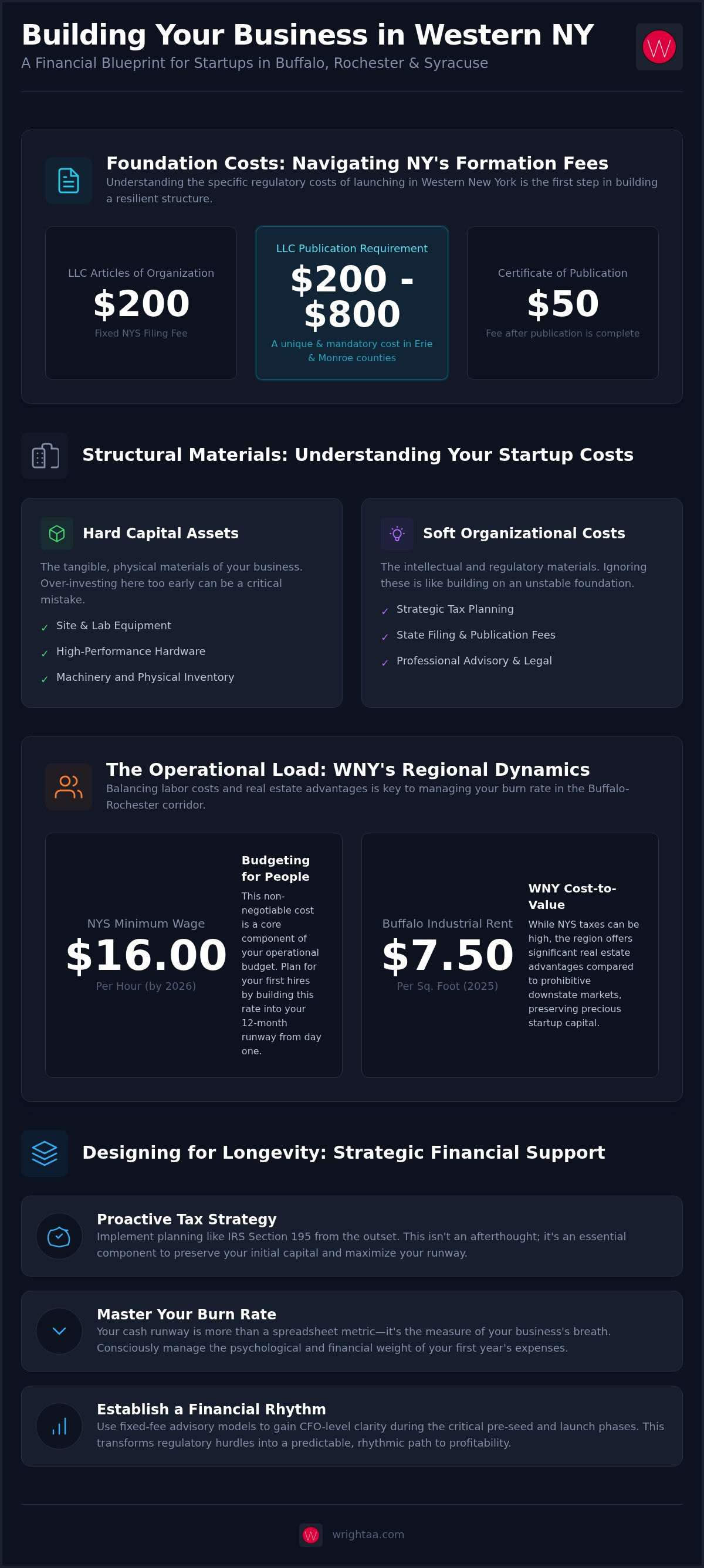
Building a business in the Buffalo-Niagara region is less like an abstract digital exercise and more like the restoration of a historic local warehouse; it requires a deep understanding of the ground beneath you. Effective startup financial planning Western New York isn't just about managing spreadsheets. It's about navigating the $200 filing fees and the unique, often overlooked, LLC publication costs that can reach $800 in our local counties. These initial investments are the raw materials of your corporate structure, requiring the same precision as a load-bearing beam.
You likely feel the weight of opaque New York State regulations and the pressure of balancing a $16.00 per hour minimum wage with a lean operational burn rate. It's common to worry that hidden costs might erode your capital before you've even broken ground. This guide provides a clear-eyed look at the financial tectonics of launching in Buffalo, Rochester, or Syracuse, ensuring your entity selection and tax strategy are optimized for resilience. We'll map out a site-specific blueprint that transforms regulatory hurdles into a predictable, rhythmic path toward profitability.
Key Takeaways
- Distinguish between hard capital assets and soft organizational costs to master the psychological and financial weight of your first year's burn rate.
- Navigate the specific geography of New York’s formation requirements, including the mandatory publication fees unique to Erie and Monroe counties.
- Evaluate the regional dynamics of labor and real estate to select an operational model that aligns with the evolving markets in Buffalo and Rochester.
- Implement proactive tax strategy and IRS Section 195 planning as essential components of startup financial planning Western New York to preserve initial capital.
- Establish a predictable financial rhythm through fixed-fee advisory models that provide CFO-level clarity during the critical pre-seed and launch phases.
The Materiality of Launch: Defining Startup Costs in WNY
In the Buffalo market, launch costs are the physical and intellectual materials used to build a lasting structure. We distinguish between hard capital assets, like the machinery in a Rochester medical lab, and soft organizational costs, such as the strategic tax planning required to survive the first year. Effective startup financial planning Western New York demands an appreciation for the region's unique cost-to-value ratio. While the state's overall tax burden remains high, the 2025 Buffalo industrial rental rate of $7.50 per square foot offers a significant advantage over the prohibitive costs of downstate markets. A comprehensive financial plan serves as the structural foundation for this growth, allowing founders to allocate resources with precision rather than guesswork.
The burn rate is the steady exhale of a new venture. It carries a psychological weight that many founders underestimate. In the first twelve months, your cash runway isn't just a metric on a spreadsheet; it's the measure of your business's breath. For a Buffalo-based service firm, minimum viable capital must account for the $200 filing fee and the mandatory publication costs. These publication fees, which can range from $200 to $800 in upstate counties, are the first tangible signs of the regulatory environment you're entering. Ignoring these soft costs is like failing to account for the soil composition before pouring a foundation.
Capital Assets vs. Operating Materiality
Site equipment for a digital venture might be minimalist, focusing on high-performance hardware and secure cloud architecture. For physical ventures, the danger lies in over-capitalization before revenue flows. In Rochester, many startups falter by over-investing in static assets while neglecting the human experience of their first hires. You must allocate funds for the people who will breathe life into the space. Budgeting for the $16.00 per hour minimum wage in 2026 is a non-negotiable element of your operational materiality.
The Intentionality of the Launch Budget
A budget is more than a list of expenses. It's a structural blueprint. A 12-month runway in the Buffalo-Rochester corridor must be resilient enough to handle unexpected regulatory shifts. Unlike generic templates that focus solely on permits and zoning, a sophisticated budget accounts for proactive tax strategy and professional advisory. Startup materiality in the context of WNY market entry is the precise calibration of capital to withstand the regulatory and environmental pressures of the local landscape. Every dollar spent is a deliberate choice about the shape and permanence of the final structure.
Regulatory Tectonics: Navigating New York's Formation Fees
The ground upon which a business stands is rarely level; in New York, it's shaped by precise regulatory layers. Formation is the first act of construction. The $200 filing fee for the Articles of Organization is a fixed entry point, a mandatory cost of breaking ground. However, the true complexity of startup financial planning Western New York lies in the secondary layers of compliance that follow. These requirements aren't merely administrative chores. They are the structural joints that ensure your business remains standing under the scrutiny of state law. Mapping these costs early prevents the structural cracks that form when capital is misallocated.
In Syracuse and surrounding Onondaga County, the 'Doing Business As' (DBA) filing serves as a simpler, county-level entry point, yet it carries its own hidden costs in terms of name protection and recurring maintenance. For those building law firms or specialized consultancies in Buffalo, professional licensing fees represent a sensory, technical cost of entry. These fees are not optional; they are the permits required to practice your craft within the state's borders. We view these costs as the necessary investment in the site preparation of your professional life, requiring the same foresight as any physical build.
The LLC Publication Hurdle
Section 206 of the New York LLC Law presents a unique challenge for founders in Erie and Monroe counties. This publication requirement mandates that a notice of formation appear in two newspapers for six consecutive weeks. In the Buffalo-Niagara region, 2026 estimates for these notices typically range from $200 to $800, depending on the circulation of the chosen weeklies and the Buffalo News. You have 120 days from formation to complete this process. Failure to file the subsequent $50 Certificate of Publication can lead to the suspension of your authority to do business. Resources like the New York Small Business Development Centers offer preliminary guidance, but the financial execution requires a disciplined budget to navigate these site-specific costs.
Entity Selection: The Tectonic Choice
Choosing an entity is a choice of material. While an LLC offers simplicity, corporations avoid the publication hurdle entirely, though they introduce different tax complexities. This distinction is critical when balancing initial capital against long-term tax optimization. Consult our Starting a Business in Buffalo, NY: A Checklist for Financial Intentionality to see how these choices intersect with your broader goals. The choice between an S-Corp or an LLC isn't just about liability; it's about the recurring costs of maintenance, such as the $9 biennial statement or the annual filing fees that scale with your gross income. If you're ready to lay a permanent foundation, our team specializes in new business formation that prioritizes structural integrity from day one.
Operational Vernacular: Labor, Real Estate, and WNY Dynamics
Operational reality is the daily friction of a business meeting its environment. In the context of startup financial planning Western New York, this friction is most visible in the dualities of labor and space. Human capital is the pulse of any new venture. In 2026, the Western New York minimum wage reached $16.00 per hour, a figure that serves as the baseline for your organizational rhythm. Beyond the base salary, founders must account for the state's significant employer-side tax burden, including NYS unemployment insurance and the nation's highest per capita local tax collections. These are the recurring, invisible materials that sustain your team's presence.
Success in this region often depends on how well a founder articulates their vision within the local ecosystem. Resources like the financial advisory services of Wright CPAs, LLC provide a platform to refine this narrative while seeking capital for these operational demands. Managing the complexities of payroll and tax compliance requires more than just a ledger. It demands small business accounting in Buffalo, NY that is proactive and intentional, ensuring that the human element of your business remains a source of strength rather than a point of structural failure.
The Cost of Hiring in WNY
Hiring in Syracuse or Buffalo requires a precise understanding of the New York landscape. Employer-side taxes and mandatory disability insurance are the structural supports for your workforce. These are not mere line items; they are the social contracts of the built business environment. Benchmarking administrative roles against the 3.4% national increase in compensation costs ensures your offers are competitive yet sustainable. It's about finding the balance between fair compensation and the lean operational burn rate required for a startup to survive its first winter.
Space and Infrastructure
The choice of a physical site in Buffalo's Tech Hub or Rochester's Downtown is a statement of intent. Commercial real estate in Buffalo currently sees an average asking rent of $7.50 per square foot for industrial spaces, but the Triple Net (NNN) lease adds layers of responsibility for taxes, insurance, and maintenance. Buffalo winters introduce a seasonal vernacular to your budget. Heating costs and infrastructure demands are environmental factors that must be anticipated. Digital infrastructure is equally tactile; SaaS subscriptions and cybersecurity are the hidden site costs of the modern era, protecting the intellectual interior of your firm as surely as a roof protects the physical one. Just as digital infrastructure protects your internal assets, professional outreach builds your external presence; you can discover Fuhrman Creative, LLC to see how marketing strategies can be integrated into your startup's structural design.
Designing for Longevity: Tax Strategy as a Structural Support
Tax strategy is the invisible framework that determines the permanence of your venture. It's far more than a seasonal compliance ritual. In the context of startup financial planning Western New York, proactive planning functions as a mechanism for capital preservation. For founders in Buffalo and Rochester, the New York State corporate franchise tax remains a primary consideration. For businesses with income at or below $5 million, the rate is 6.50%. Integrating strategic business tax planning in Buffalo, NY into your initial design ensures that your capital remains focused on growth rather than being eroded by unmanaged tax burn.
A well-constructed financial architecture treats every dollar as a building block. By aligning your entity choice with state-specific incentives, you create a structure capable of weathering economic shifts. This isn't about aggressive avoidance. It's about deep listening to the regulatory environment and responding with a disciplined, methodical approach. When you treat tax planning as a structural joint, you ensure the entire business remains balanced and resilient from its very first year.
The $5,000 Threshold
IRS Section 195 governs how you recover the costs of bringing your vision to life. The law allows for an immediate deduction of up to $5,000 in startup costs and an additional $5,000 in organizational costs. You must distinguish between investigatory expenses, such as market analysis in the Buffalo-Niagara region, and organizational costs like legal fees for drafting an operating agreement. Expenses that exceed the initial deduction limit must be recovered through straight-line amortization over a 180-month period. This 15-year timeline requires a long-term view of your firm's materiality and financial health.
Strategic Accounting for Startups
DIY accounting often creates structural cracks that don't appear until the first tax season. A professional Chart of Accounts should reflect the specific materiality of your industry, whether you're building a law firm in Syracuse or a tech startup in Buffalo. We believe in the serenity of fixed-fee advisory models. This approach eliminates the shock of hourly billing and year-end surprises, providing the rhythmic clarity needed for predictable cash flow. If you're ready to build on a foundation of professional expertise, our tax strategy services provide the intentionality your growth requires.
The Wright CPAs, LLC Approach: Building a Resilient Financial Foundation
Building a venture in Buffalo, Rochester, or Syracuse is a permanent intervention in our regional landscape. It requires more than a casual observation of market trends; it demands a rigorous commitment to design excellence. Our approach to startup financial planning Western New York treats your balance sheet like a structural blueprint, allowing us to identify the specific economic pressures unique to this region. We provide CFO-level guidance during the pre-seed and launch phases, ensuring that every financial decision aligns with the specific materiality of your goals. By moving beyond the reactive nature of traditional accounting, Wright CPAs, LLC helps you transition from the initial rush of a launch to the steady endurance of a legacy.
We believe in the serenity of a fixed-fee monthly advisory model. This structure eliminates the friction of hourly billing, allowing for a steady and unhurried dialogue between founder and advisor. It provides the predictable cash flow necessary for a startup to breathe. In a state where tax collections per capita are among the highest in the nation, having a fixed point of financial reference is not just a convenience. It's a necessity for capital preservation. Our firm aligns your venture with the unique geographic and cultural context of the region, ensuring your financial design is as grounded as the historic architecture of Western New York itself.
Our New Business Formation Suite
The process of formation is where the first tectonics of business occur. We handle the complexities of filing and publication compliance, navigating the specific requirements of Erie and Monroe counties so you don't have to. Our team develops proactive tax strategies tailored for Buffalo law firms and closely held businesses, focusing on structural integrity from day one. We begin with a calm, unhurried consultation. This allows us to map your financial site and strategy with the precision of a master builder, ensuring no detail is overlooked in the pursuit of a resilient foundation. This specialized startup financial planning Western New York ensures that your organizational documents and tax elections are optimized before the first brick is laid.
Next Steps: Your Site-Specific Consult
As you move into 2026, the transition from abstract ideas to a concrete financial blueprint is the most critical phase of your journey. We invite you to experience the Architecture of Finance with Wright CPAs, LLC, a team that values substance over spectacle. Our deep expertise in New York-specific business formation ensures that your path to profitability is both predictable and rhythmic. Don't leave the integrity of your venture to chance. Schedule a consultation to architect your WNY startup’s foundation and begin the process of intentional financial design today.
Architecting a Permanent Presence in Western New York
Launching a venture in Buffalo, Rochester, or Syracuse is a deliberate act of creation. It requires an intimate understanding of the region's specific regulatory tectonics, from the nuances of LLC publication fees to the rhythm of the local labor market. We've explored how treating your budget as a structural blueprint ensures that your capital remains focused on growth rather than being depleted by hidden costs. Sophisticated startup financial planning Western New York demands this level of intentionality; tax strategy and operational design must function as load-bearing joints for your future success.
Since 2012, Wright CPAs, LLC has provided the CFO-level strategy and proactive tax planning necessary to transform abstract ideas into resilient business structures. Our firm specializes in guidance for Buffalo law firms and closely held businesses, utilizing fixed-fee monthly retainers to provide the predictable cash flow startups require. This approach allows you to focus on your craft while we manage the complexities of the built financial environment. It's time to move from a transient launch to a permanent legacy. Design your financial foundation with Wright CPAs, LLC. Your vision deserves a foundation that is as enduring as the city you call home.
Frequently Asked Questions
How much does it cost to publish an LLC notice in Buffalo, NY?
In Buffalo and the surrounding Erie County, the cost to publish an LLC notice typically ranges between $200 and $800. This variance depends on the specific local weeklies you select alongside the mandatory notice in the Buffalo News. It's a six-week requirement that must be completed within 120 days of your initial filing to maintain the structural integrity of your entity.
Are startup costs tax-deductible in the first year of business?
Startup costs are partially deductible in your first year under IRS Section 195. You can generally deduct up to $5,000 of these expenses immediately if your total startup investment is $50,000 or less. If your costs exceed this threshold, the deduction is reduced dollar-for-dollar, and any remaining balance is recovered through amortization over a 15-year period.
What is the difference between startup costs and organizational costs for the IRS?
The IRS distinguishes between these costs based on their function in the business's creation. Startup costs are investigatory or operational expenses incurred before the doors open, such as market research or employee training. Organizational costs are the specific legal and state fees required to create the legal entity itself, including drafting an operating agreement or paying state filing fees.
Do I need a Buffalo-specific business license to operate?
Licensing requirements in Buffalo depend on the specific nature of your industry and commercial activity. While New York doesn't have a single universal business license, the City of Buffalo requires permits for specific trades, professional firms, and retail operations. You should verify your industry's requirements with the City’s Division of Licensing to ensure your site is fully compliant.
How much should I budget for accounting services in my first year?
Your budget for professional advisory should reflect the complexity of your financial architecture and the need for precision. For effective startup financial planning Western New York, many founders favor fixed-fee monthly models that provide CFO-level clarity without the volatility of hourly billing. This investment serves as a structural support, preventing costly regulatory errors during the critical launch phase.
Can I deduct the cost of my home office as a startup expense in New York?
Home office deductions are generally categorized as operational expenses rather than startup costs. Once your business is officially active and generating revenue, you can deduct the portion of your home used exclusively for business. During the pre-launch phase, these costs are typically viewed as personal expenses unless they directly relate to specific investigatory tasks.
What are the ongoing costs of maintaining a New York S-Corp vs an LLC?
Maintaining a New York LLC requires a $9 biennial statement and an annual filing fee that scales from $25 to $4,500 based on your previous year's gross income. An S-Corp involves more complex payroll requirements and the New York State corporate franchise tax, which starts at a minimum of $25 for many small firms. The choice is a trade-off between administrative simplicity and potential tax optimization.
How does the NYS minimum wage impact startup labor costs in 2026?
The $16.00 per hour minimum wage in 2026 serves as the baseline for labor materiality in Western New York. This rate directly increases your direct wage expenses and the associated payroll tax burdens, such as unemployment insurance and workers' compensation. When designing your initial burn rate, it's essential to account for this $16.00 floor to ensure your financial foundation remains resilient.


