

The most vital structure you will ever build is not a physical space; it is the financial foundation that sustains your life and your labor. For many entrepreneurs, the question of how much should I pay myself from my LLC feels less like a calculation and more like an intuition. You might feel a quiet anxiety over IRS reasonable compensation rules or a lingering guilt when you transfer funds to your personal account. These tensions often stem from a lack of clear design in the relationship between your business and your personal needs.
You likely believe that your business should serve your life, yet you find yourself serving the business instead. It's natural to fear New York State tax surprises or the weight of self-employment rates, which remain at 15.3% for the 2026 tax year. This article provides a structured, intentional approach to determining your compensation while balancing tax efficiency and growth. We will examine the duality of owner draws and W-2 wages, the strategic benefits of S-Corp elections, and a repeatable framework that brings serenity to your financial landscape.
Key Takeaways
- Distinguish between the fluid nature of an owner draw and the structural discipline of a W-2 salary. This distinction is the first step toward a stable financial foundation.
- Apply a rhythmic five-step framework to answer how much should I pay myself from my LLC. This process balances your personal baseline with sustainable net profits.
- Recognize the S-Corp election as a deliberate architectural upgrade. It allows you to navigate IRS reasonable compensation mandates with quiet confidence.
- Identify the specific financial markers that permit higher personal liquidity. This ensures your business has the spatial openness it needs to thrive.
The Intentionality of Compensation: Defining LLC Owner Pay
A building is only as stable as its foundation. In the context of your business, your personal compensation serves as that foundation. Many entrepreneurs treat their pay as a variable luxury, taking only what remains after every other vendor and utility has been satisfied. This "leftover" method is a structural weakness. It suggests that your labor is a secondary concern rather than a primary driver of the enterprise. When you begin to ask how much should I pay myself from my LLC, you're looking for the precise intersection where personal necessity meets business sustainability. It's a moment of deep intentionality.
You must view your pay as a fixed cost. It's a non-negotiable material, much like the steel or stone used in a permanent structure. If a business cannot afford to pay its creator a living wage, the underlying design is likely flawed. By shifting your perspective, you move away from a reactive mindset. You start to build a business that exists to support your life, rather than a life that exists to support a struggling business.
Owner Draws vs. Guaranteed Payments
Understanding the mechanics of a Limited Liability Company (LLC) is essential for clarity. For a single-member LLC, an owner draw is a simple reduction of your equity. It feels fluid, like water moving between two connected vessels. You're essentially taking back the value you've already created. In multi-member partnerships, the language shifts to "guaranteed payments." These are payments made to a partner for services or capital, regardless of whether the business is profitable that month. It provides a sense of steady rhythm in an otherwise variable environment.
There's a common misconception that these draws are "tax-free" events. In reality, they're pre-taxed. Because an LLC is a pass-through entity, you're taxed on the business's net income, not just the cash you move to your personal account. Whether you leave the money in the business or draw it out, the tax liability remains. This is why deciding how much should I pay myself from my LLC requires a keen eye on your total tax strategy.
The Structural Role of a Business Owner
You occupy two distinct roles: the investor and the operator. The investor provides the capital and takes the risk. The operator performs the daily labor. To find your ideal pay, you must look at the market value of your work. If you were to step away and hire a manager to take your place, what would that position cost? Your business should be able to sustain that market-rate salary. If it can't, you aren't yet running a fully realized business; you've created a job for yourself. True financial serenity comes from knowing your business is a permanent, thoughtful intervention that can eventually function independently of your constant physical presence.
Designing Your Salary: A 5-Step Framework for Financial Clarity
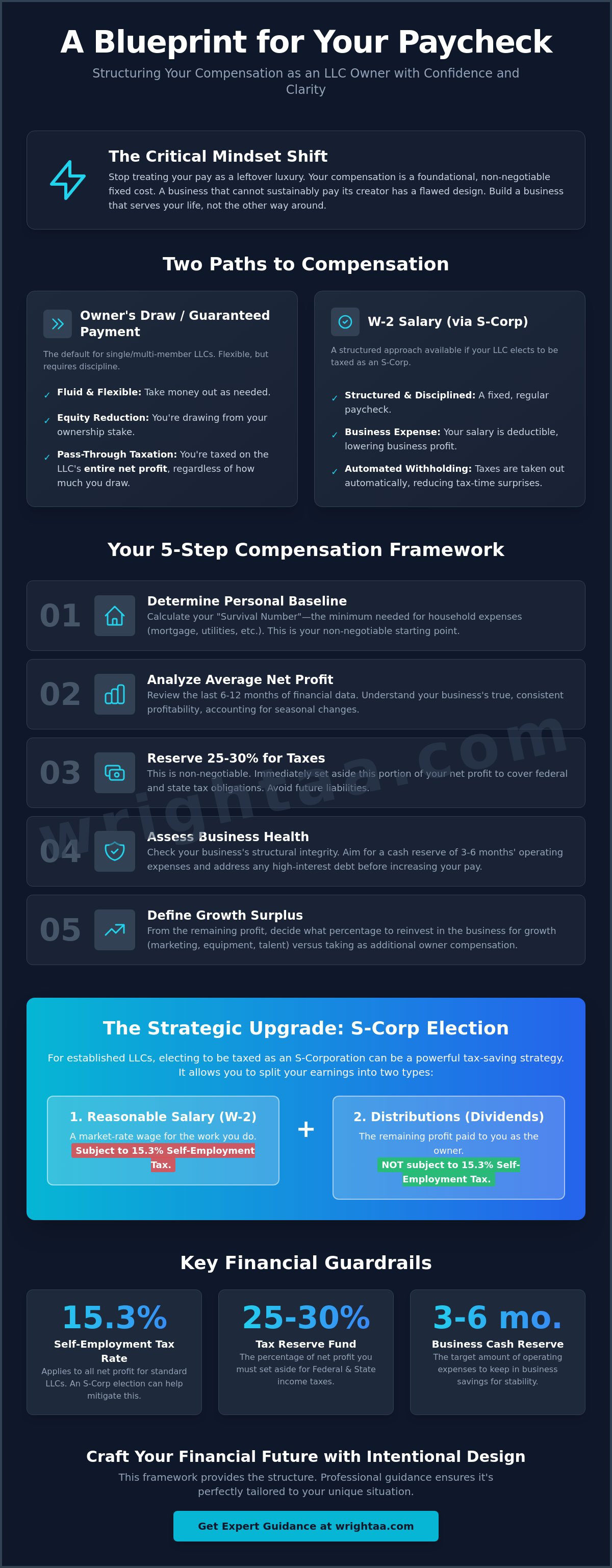
Determining your compensation requires a blueprint that balances your current needs with your future vision. It's a deliberate process of measuring the load your business can carry without compromising its structural integrity. When you evaluate how much should I pay myself from my LLC, you're essentially mapping out the circulation of capital through your life and your enterprise. This five-step framework provides the necessary rhythm for that calculation.
- Step 1: Determine your baseline personal "Survival Number." This is the minimum amount required to sustain your household. It includes your mortgage, utilities, and essential living expenses. It's the foundation upon which everything else is built.
- Step 2: Analyze the business’s average monthly net profit. Look back at the last six to twelve months of data. You need a clear view of the steady-state performance of your business, accounting for seasonal ebbs and flows.
- Step 3: Reserve 25–30% for federal and New York State taxes. This is non-negotiable capital. By setting this aside immediately, you ensure that your personal draws don't create a future liability you cannot meet.
- Step 4: Assess the "Structural Integrity" of your business savings and debt. Before increasing your personal pay, ensure your business has a sufficient cash reserve. Aim for three to six months of operating expenses. Address high-interest debt that might be eroding your equity.
- Step 5: Define the "Growth Surplus" for reinvestment. Determine what percentage of remaining profit should be funneled back into the business for new equipment, marketing, or talent.
The Personal Overhead Analysis
Your personal budget is the site plan for your life. It should be sensory and detailed, reflecting not just what you need to survive, but how you intend to live. Your personal financial health is a prerequisite for business success. If you're constantly stressed about personal bills, your decision-making within the business will become reactive and short-sighted. During the early foundation years, you may need to practice humility in your pay. However, this should always be a temporary phase of the design, not a permanent state of being.
Accounting for the Tax Environment
In Western New York, the tax landscape has its own specific contours. Visualizing your "tax bucket" as money that never truly belonged to the business is a helpful mental shift. This capital is merely passing through your accounts on its way to the authorities. Utilizing quarterly estimated taxes Buffalo NY is essential to avoid the friction of underpayment penalties. Local economic factors, such as specific New York credits or regional shifts, can influence your final numbers. The IRS maintains specific guidelines on Reasonable Compensation that become particularly relevant as your business matures. Our team can help you refine this blueprint through dedicated Tax Strategy sessions, ensuring your pay remains both compliant and purposeful.
By following this framework, you move away from the anxiety of the unknown. You gain a clear understanding of how much should I pay myself from my LLC while keeping your business's growth trajectory in sharp focus. It's about creating a sense of financial serenity that allows you to focus on the creative work you were meant to do.
The S-Corp Pivot: Navigating "Reasonable Compensation" in New York
As your business matures, the simple equity draw often gives way to a more sophisticated structure. Transitioning from a standard LLC to an S-Corporation election is a deliberate architectural upgrade. It's a move that introduces a duality into your financial life. You are no longer just an owner; you are also an employee of your own creation. This shift requires a new answer to the question of how much should I pay myself from my LLC, as the IRS mandates that owner-employees receive "reasonable compensation" before taking any profit distributions.
This mandate exists to ensure that business owners don't avoid self-employment taxes entirely. In 2026, the self-employment tax rate remains at 15.3%, covering Social Security and Medicare. By paying yourself a W-2 salary, you satisfy these obligations on a portion of your income. The remaining profits can then be taken as shareholder distributions, which are not subject to that 15.3% tax. It's a balance between contribution and reward, requiring a precise and defensible design.
What Defines "Reasonable" in Buffalo, NY?
In New York, tax authorities scrutinize owner-employee salaries with a keen eye. To define what is reasonable, you must look at the local labor market. A creative director in Buffalo or a lead attorney in Rochester faces different economic realities than one in Manhattan. We look at specific data points across Buffalo, Syracuse, and the surrounding regions to justify your numbers. If the IRS or New York State determines your salary is "unreasonably low," they may reclassify your distributions as wages, leading to back taxes and penalties. Documenting your salary justification within your corporate minutes is a vital step in maintaining your business's structural integrity.
Optimizing the Tax Split
The art of the S-Corp pivot lies in the split between W-2 wages and distributions. For example, an owner with $120,000 in net profit might save approximately $4,600 in self-employment taxes annually by taking a portion of earnings as distributions rather than a full salary. This isn't about evasion; it's about utilizing the tax code as it was designed. Distributions are the reward for the risk of ownership, while the salary is the payment for your daily labor. For professionals with entity-specific rules, such as those seeking a CPA for law firms Buffalo NY, this optimization requires even deeper intentionality. Consulting with an expert ensures that your pivot to an S-Corp is both a poetic and practical improvement to your financial future.
When you refine your approach to how much should I pay myself from my LLC through the lens of an S-Corp, you create spatial openness in your budget. You gain the confidence that your tax compliance is as solid as the buildings that define our New York landscape. It's a steady, unhurried process of building wealth with purpose.
Balancing the Scales: Reinvestment vs. Individual Liquidity
Equity is the primary material of your business. How you distribute this material determines the durability of the entire structure. A common error among founders is "The Martyr Syndrome," where an owner pays themselves nothing to fuel growth. This is a significant structural flaw. A building without a resident is merely a monument; a business that cannot sustain its creator is a hollow shell. When you ask how much should I pay myself from my LLC, you must prioritize your own sustainability to ensure the business’s longevity. Neglecting your own compensation creates a brittle foundation that eventually leads to burnout and operational collapse.
Strategic growth requires a "Profit First" mentality. This approach ensures that owner pay is not a residual calculation but a primary design element. By utilizing specific financial kpis for small business, you can establish objective triggers for pay increases. These metrics act like structural sensors. They alert you when the business has the capacity to support a higher draw without risking the integrity of your operations. It turns compensation into a predictable, rhythmic event rather than a source of constant anxiety.
The Rhythm of the Business Walkthrough
Each month, you should conduct a financial walkthrough of your accounts. This is a quiet, unhurried assessment of your current liquidity and projected cash flow. You need to identify your personal "break-even" point, which is the specific number that provides you with psychological and financial peace. For many entrepreneurs, maintaining this objective lens is difficult when they're deep in the daily labor of the business. Utilizing outsourced CFO services Buffalo NY provides the external perspective needed to balance reinvestment with your own liquidity needs. This professional oversight ensures that your draws are intentional and sustainable.
Building the Business Reserve
Consider your business as a "Site," a permanent and thoughtful intervention in the marketplace. Before taking aggressive distributions, this site must be stabilized. A three to six month operating reserve is the essential prerequisite. This reserve acts as the bedrock, allowing you to weather economic shifts or seasonal lulls without depleting your personal resources. A strong balance sheet is what permits confident distributions. It creates the spatial openness required for both business evolution and personal freedom. When the business is well-capitalized, your pay becomes a reflection of success rather than a cause of stress.
Refine your business blueprint today with the Cash Flow Management services at Wright CPAs, LLC to ensure your growth is as steady as it is purposeful.
Crafting Your Financial Future with Wright CPAs, LLC
Finance is often reduced to a series of technical exercises. At Wright CPAs, LLC, we believe it should be a poetic and purposeful strategy. Your business acts as a vessel for your ambition. It requires a steward who understands the weight of every decision and the texture of every transaction. When you determine how much should I pay myself from my LLC, you aren't just moving numbers across a digital ledger. You are defining the boundaries of your freedom and the long-term sustainability of your craft. Our small business accounting Buffalo NY services provide this spatial openness in your life, allowing you to breathe within your own financial structure.
We move beyond the reactive nature of traditional bookkeeping. Our firm offers proactive, fixed-fee advisory to ensure consistent financial oversight throughout the year. This structure allows you to view your business as a permanent, thoughtful intervention in the marketplace. It provides the clarity needed to make decisions with quiet, grounded confidence. By treating your compensation as a fundamental structural element rather than a residual luxury, we help you build a future that's both visionary and disciplined. The rhythm of your business should be unique, much like the flow of light through a well-designed room, and your pay is the energy that keeps that space inhabited.
A Partnership Rooted in Context
Our process begins with deep listening. We seek to understand the specific geographic and cultural context of your work before recommending a specific compensation structure. We value construction techniques in finance, blending traditional building methods with modern sensibilities to create a resilient framework. Whether you're currently starting a business in Buffalo NY or managing a mature enterprise, we offer the contextual awareness required for excellence. We support Buffalo entrepreneurs through every phase of their journey. We ensure their financial foundation remains as solid and enduring as the historic masonry of our city.
Next Steps for Financial Serenity
The transition from financial confusion to a curated, serene aesthetic is a deliberate one. It requires a partner who values quality over quantity and substance over spectacle. You can move away from the anxiety of "reasonable compensation" and toward a sense of financial purpose. Our Buffalo-based team is ready to guide you through a personalized walkthrough of your business's potential. This is the first step toward an intentional structure that serves both your daily life and your lasting legacy. We invite you to Schedule a Discovery Call with Wright CPAs, LLC to begin this unhurried, methodical journey toward financial serenity.
Designing a Sustainable Financial Legacy
The architecture of your business is now fully realized. You have moved beyond viewing pay as a residual calculation to seeing it as a primary structural element. By integrating the dualities of W-2 wages and shareholder distributions, you create a foundation that supports both your personal life and your business's labor. Determining how much should I pay myself from my LLC is no longer an exercise in guesswork; it is a process of deep listening to your site's specific needs and your own long-term vision.
Since 2012, Wright CPAs, LLC has supported Buffalo entrepreneurs through the complexities of proactive tax strategies and CFO-level guidance. Our fixed-fee monthly advisory provides predictable costs, allowing you to focus on the creative work that defines your purpose. This intentional approach ensures that your business remains a permanent, thoughtful intervention in the world. It is time to step into a curated financial landscape where every draw is made with serenity and purpose.
Design your financial clarity—book a consult with Wright CPAs, LLC
Frequently Asked Questions
Is an owner draw considered an expense on my LLC profit and loss statement?
No, an owner draw is not a business expense and does not reduce your taxable income. It is a distribution of equity, representing a transfer of value from the business entity to the individual owner. While it appears on your balance sheet as a reduction in owner's equity, it does not impact the net profit reflected on your profit and loss statement.
Can I pay myself a salary if my LLC is a single-member entity?
By default, a single-member LLC owner cannot pay themselves a formal W-2 salary. The IRS views a standard single-member LLC as a disregarded entity, meaning you are compensated through owner draws. You only transition to a formal salary structure if you choose to elect S-Corporation tax status, which reclassifies you as an owner-employee of the business.
How much should I set aside for self-employment tax in New York?
You should generally set aside 25% to 30% of your net profit to cover federal, state, and self-employment taxes. The self-employment tax rate for 2026 is 15.3%, which covers Social Security and Medicare. When determining how much should I pay myself from my LLC, remember that this tax is calculated on your total business profit, regardless of how much cash you actually draw.
What happens if I pay myself more than my LLC actually earns in profit?
Taking draws in excess of profit means you are withdrawing your original capital investment or previously earned equity. While this is permissible, it can create a fragile financial structure and lead to negative basis issues. It's essential to monitor your cash flow management to ensure you aren't depleting the business's necessary operating reserves for personal liquidity.
Do I need to issue myself a 1099 or a W-2 as an LLC owner?
You do not issue yourself a 1099 for owner draws, and you only issue a W-2 if your LLC has elected to be taxed as an S-Corporation. For standard LLCs, your income is reported via Schedule C or a K-1, depending on your specific structure. This distinction is a vital part of the architecture of your business and prevents unnecessary administrative friction with tax authorities.
How often should I review my owner compensation amount?
You should conduct a rhythmic review of your compensation at least once per quarter. This allows you to adjust your draws based on the actual net profit and seasonal performance of the business. When asking how much should I pay myself from my LLC, a quarterly walkthrough ensures your personal needs remain in harmony with the business’s current liquidity and growth objectives.
Are there specific Buffalo or NY State grants that affect how I can pay myself?
Many regional grants in Western New York include specific "use of funds" restrictions that may prohibit using grant capital for owner compensation. These programs often prioritize payroll for third-party employees or specific equipment purchases. Always review the grant's structural requirements to ensure your draws don't inadvertently violate the terms of your funding agreement.
Can my LLC pay for my personal health insurance instead of a salary?
An LLC can pay for your health insurance premiums, but the tax treatment depends on your entity's classification. For most LLC owners, these payments are treated as a draw or a guaranteed payment rather than a tax-free fringe benefit. This ensures that the deduction is captured correctly on your personal return, maintaining the integrity of your overall tax strategy.


