

Your bank balance is a poor architect. While it reveals the current volume of the reservoir, it says nothing of the structural integrity of the dam or the direction of the hidden currents. For many, the profit and loss statement for small business feels like a cold, retrospective autopsy rather than a living tool. You might see cash in the bank yet feel a lingering anxiety that the true health of your enterprise is obscured by complexity. It's a common dissonance to feel successful in your craft while remaining disconnected from the precise rhythm of your financial performance.
We believe that clarity is the foundation of every intentional decision. This guide transforms a standard financial report into a strategic blueprint, allowing you to move from reactive survival to proactive growth. You'll discover how to interpret these figures to gain a sense of calm regarding your tax liabilities and the confidence to invest in your future. We'll explore the essential components of the P&L, showing you how to read between the lines of revenue and expense to find the actual anatomy of your profit.
Key Takeaways
- View the P&L as a rhythmic summary of your business history, providing a necessary contrast to the static position of your balance sheet.
- Understand how to dissect a profit and loss statement for small business to reveal the true relationship between top-line revenue and net income.
- Employ horizontal and vertical analysis to identify subtle trends and ensure every expense serves a meaningful purpose within your operations.
- Establish a steady monthly rhythm for reconciling accounts, ensuring your financial foundation is both accurate and resilient.
- Transition from tax season anxiety to proactive clarity by using your P&L to forecast liabilities and identify strategic deductions early.
Understanding the Profit and Loss Statement as a Financial Foundation
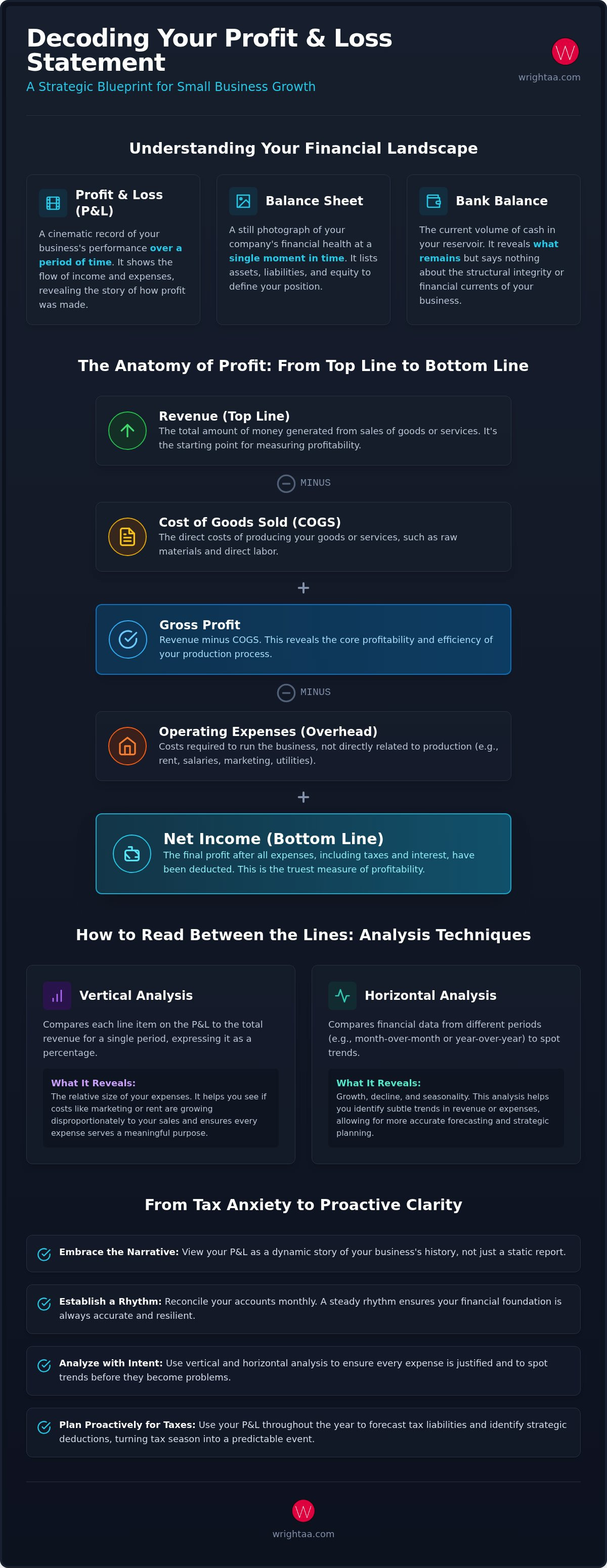
Every structure begins with a survey of the land. In the architecture of finance, the profit and loss statement for small business serves as this essential survey. It doesn't merely count coins; it records the movement of energy through your enterprise. While a bank statement shows what remains, the P&L shows how it arrived and where it departed. It's the rhythmic summary of your income and costs over a defined period, providing the necessary context for every dollar earned.
There is a vital duality between the P&L and the balance sheet. Think of the P&L as a cinematic record of a building's construction over time. It captures the labor, the materials, and the progress. Conversely, the balance sheet is a still photograph of the finished structure at a single moment. One describes history, while the other defines position. Understanding what is a profit and loss statement allows you to see the heartbeat of your operations. It reveals if your business model is breathing steadily or gasping for air.
Many owners confuse net income with cash flow. This is a dangerous displacement. Net income is a mathematical truth based on accounting principles, while cash flow is the physical presence of money. You can have a profitable profit and loss statement for small business and an empty bank account if your timing is misaligned. Distinguishing between the two is the first step toward financial maturity. It ensures you aren't building on shifting sands.
The Essential Purpose of the Income Statement
The P&L measures the efficiency of your business model with surgical precision. It shows whether the materials you use and the hours you invest yield a surplus or a deficit. By establishing this baseline, you can create projections for future growth that are grounded in reality rather than hope. The profit and loss statement is the master drawing for intentional business design.
Who Needs to See Your P&L?
External partners look to this document to verify the structural integrity of your business. Lenders and investors require it to prove that your enterprise can sustain itself and eventually scale. Tax authorities use it to establish the ground for proactive planning and annual obligations. Most importantly, internal leadership relies on it to guide the daily rhythm of operations. It turns vague intuition into a disciplined strategy for growth. When the P&L is accurate, it becomes a shared language for everyone invested in the business's longevity.
The Structural Components of Your P&L: From Revenue to Net Income
A profit and loss statement for small business is a tiered structure. Each level reveals a different layer of financial health, moving from the broad facade of revenue to the foundational reality of net profit. Revenue, or the top line, represents the total volume of your business activity. It's the raw material of your commerce before any pruning occurs. While a high revenue figure is evocative, it's merely the envelope of the building. It doesn't yet tell us if the structure is sound.
Cost of Goods Sold (COGS) represents the direct materials of your craft. These are the expenses that fluctuate in direct proportion to your production. Operating expenses follow, acting as the climate control that sustains your business environment. These overhead costs, such as rent and utilities, persist regardless of your daily output. Finally, we reach net profit. This is the final residue of value after every intervention and expense has been accounted for. It's the most honest measure of your business's ability to create and retain wealth.
Gross Profit vs. Operating Income
The relationship between production and profit is captured in the transition from gross profit to operating income. Gross profit is what remains after subtracting COGS from revenue. It reveals the efficiency of your direct labor and materials. For a law firm in Rochester or Syracuse, COGS might include specific court filing fees or direct paralegal labor tied to a case. In contrast, a product-based business in Buffalo would see raw materials and shipping costs here. Identifying your break-even point requires a deep understanding of these margins. It's the moment where your gross profit exactly covers your operating expenses, allowing the structure to stand without external support.
Categorizing Expenses with Intentionality
Clarity in your profit and loss statement for small business depends on how you categorize your costs. We distinguish between fixed and variable costs to understand which parts of your budget are rigid and which are flexible. Fixed costs, like a monthly retainer for bookkeeping services, provide predictability. Variable costs, such as seasonal marketing or materials, offer room for adjustment.
Precision in your ledger prevents the use of "Miscellaneous" as a junk drawer for uncategorized spending. This category is a sanctuary for inefficiency and obscures the path to growth. In Western New York, businesses must also be mindful of local nuances, such as specific New York State payroll tax line items or regional utility patterns. By categorizing with intentionality, you turn a simple list of costs into a map for strategic spending. This discipline ensures that your financial environment remains curated and purposeful.
Interpreting the Narrative: Analyzing Trends and Profitability Ratios
A profit and loss statement for small business isn't just a static record; it's a narrative of evolution. To understand this story, we use horizontal analysis to track the movement of your business month-over-month. This technique reveals the gradual ascent of revenue or the subtle expansion of costs. It allows you to see if your growth is sustainable or if your expenses are outpacing your progress. By comparing current periods to previous years, you gain a sense of the seasonal tide that governs your industry.
Vertical analysis provides a different dimension of clarity. It involves expressing each expense as a percentage of your total revenue. This perspective exposes the true weight of your overhead. It allows you to see if your rent or payroll is consuming a disproportionate share of your income. When you view your financial structure through this lens, the relationship between your efforts and your outcomes becomes visible. It transforms a long list of numbers into a curated set of relationships.
Two primary ratios serve as the pillars of this analysis. The gross margin is the metric of your core business health, measuring what remains after the direct costs of your craft are cleared. If this margin narrows, your fundamental model may be under stress. The operating margin then evaluates the efficiency of your management. It accounts for the indirect costs required to keep your environment functional. Together, these ratios provide a structural view of your profitability that raw numbers alone cannot convey.
Reading Between the Lines of Your Financial Reports
Identifying seasonal rhythms in the Buffalo and Rochester markets is essential for accurate interpretation. A dip in revenue during a lake-effect winter might be a predictable phase rather than a structural failure. However, you must remain vigilant for "red flags" before they become permanent cracks in your foundation. A declining gross margin despite rising sales often signals that your production costs are rising too fast. For a deeper exploration of these metrics, consult our guide on Financial KPIs for Small Business.
Benchmarking Against Your Industry
Industry benchmarks provide the necessary context for your performance. A law firm in Syracuse will view a healthy margin differently than a retail shop in the Elmwood Village. Service-based entities often carry higher labor costs but lower material overhead. Using industry data helps you refine your competitive stance and set realistic goals. A CFO-level perspective is invaluable here. It moves beyond mere comparison to provide a disciplined interpretation of how your specific context influences your numbers. This guidance ensures your business remains both visionary and grounded; for instance, you can learn more about The Bucket List Accountant to see how strategic advisory can help you connect your financial success to your lifestyle aspirations.
The integrity of a profit and loss statement for small business is not achieved in a single annual effort. It's the result of a disciplined, monthly cadence. Without this steady rhythm, your data becomes a historical artifact rather than a living guide. Consistency in your closing process ensures that the reports you review in July are as reliable as those you finalize in December. It turns financial reporting from an obligation into a curated habit. This regular attention allows you to spot deviations before they become structural flaws.
Accuracy depends on the rigorous reconciliation of every account. This process ensures that the profit and loss statement for small business reflects the physical reality of your bank balances and credit obligations. Modern accounting software provides the framework for this real-time visibility, yet technology is merely a tool. The true architect of your financial records is a professional who understands the nuances of your specific industry. A CPA ensures that the structure of your ledger supports your long-term vision. They provide the oversight necessary to transform raw data into actionable intelligence. For those seeking such expert guidance, you can learn more about Fair View Accounting Services.
A successful month-end close follows a logical sequence to preserve the purity of your data:
- Step 1: Reconcile all bank and credit card statements. This verifies that every transaction in your software matches the actual movement of funds.
- Step 2: Review accounts receivable for uncollected revenue. Ensure your income reflects work completed, identifying delays in the flow of capital.
- Step 3: Categorize expenses according to your strategic chart of accounts. This preserves the intentionality of your spending and ensures your ratios remain accurate.
The Role of Bookkeeping in Financial Integrity
Daily entries are the individual bricks that build the foundation of the annual P&L. When bookkeeping is neglected, the entire financial narrative becomes distorted. For owners seeking a more permanent solution, our guide on Small Business Accounting in Buffalo, NY explores how to design a system that scales with your ambition. There's a profound sense of calm in knowing your records are handled with precision through fixed-fee monthly accounting. This predictable structure ensures your reports are always ready for strategic review and future growth.
Beyond the Numbers: Leveraging the P&L for Proactive Tax Strategy
A profit and loss statement for small business is often treated as a historical record. We view it as a forward-looking instrument of design. By the third quarter, the accumulated data reveals the likely trajectory of your annual performance. This foresight allows you to move beyond reactive compliance into proactive strategy. You can project your year-end tax liabilities with precision, ensuring that the final months of the year are spent in calm preparation rather than frantic calculation.
This clarity reveals opportunities for strategic interventions. If your net profit suggests a significant tax burden, you might choose to invest in new equipment or technology. In 2026, the bonus depreciation rate of 40% offers a meaningful deduction for such capital expenditures. Additionally, Section 179 expensing allows for immediate deductions up to $2.5 million. These are not merely tax maneuvers; they are intentional investments in the structural capacity of your enterprise.
The bottom line of your P&L also dictates your self-employment tax obligations. For many owners, this 15.3% rate applies to earnings up to the Social Security wage base of $184,500. When your net profit reaches a certain threshold, the P&L acts as a signal to evaluate your entity selection. Transitioning from a sole proprietorship to an S-Corp can often reduce this tax exposure. It's a shift that requires a disciplined understanding of your income and a commitment to accurate reporting.
Tax Planning as an Architectural Exercise
Your financial reports provide the raw materials for Strategic Business Tax Planning. In New York State, where local tax nuances are significant, this proactive stance is essential for maintaining liquidity. We use your P&L to identify qualifying deductions and ensure you maximize the permanent 20% Qualified Business Income deduction. Maintaining an accurate profit and loss statement for small business is the primary safeguard against the anxiety of tax season surprises.
CFO-Level Guidance for Long-Term Success
Scaling a business requires moving from the daily task of keeping the books to the visionary work of designing the future. Outsourced CFO Services utilize your P&L data to build models for expansion and hiring. This level of guidance ensures that every decision is supported by the weight of your financial reality. If you are ready to transform your financial reports into a blueprint for growth, schedule a consultation with Wright CPAs to begin your journey toward lasting clarity.
Designing Your Financial Future
The profit and loss statement for small business is the essential survey of your company's landscape. It reveals the hidden currents of your cash flow and the structural integrity of your margins. By maintaining a disciplined monthly rhythm and categorizing expenses with intentionality, you transform raw data into a visionary tool for growth. This clarity allows you to move beyond the anxiety of tax season and into a space of proactive design.
True financial health requires more than just recording transactions. It demands a partnership grounded in technical excellence and contextual awareness. At Wright CPAs, we provide proactive tax strategies tailored for Western New York alongside predictable fixed-fee monthly retainers. Our CFO-level guidance helps you interpret the narrative of your numbers to scale your enterprise with confidence.
Experience Financial Clarity with Wright CPAs and begin building a more intentional business today. You have the vision to create. Let us provide the architecture to sustain it.
Frequently Asked Questions
What is the difference between a P&L statement and a balance sheet?
A profit and loss statement for small business measures financial performance over a specific period, such as a month or year. It records the flow of income and expenses to reveal net profit. Conversely, a balance sheet is a static photograph of your financial position at a single moment. It lists what you own against what you owe. While the P&L describes the history of your activity, the balance sheet defines the strength of your foundation.
How often should a small business review its profit and loss statement?
You should review your reports at least once a month to maintain a steady operational rhythm. This monthly cadence allows you to identify subtle shifts in your margins before they become structural failures. Quarterly reviews are also essential for high-level strategy and tax planning. Consistent oversight ensures that your financial environment remains curated and purposeful. Waiting until the end of the year to examine your performance leaves you reactive and disconnected from your business health.
Can a business show a profit on the P&L but have no cash in the bank?
It's common for a business to show a profit on paper while having limited cash in the bank. This dissonance occurs because net income includes non-cash items like depreciation and revenue that hasn't been collected yet. You might also use cash for debt repayments or inventory investments that don't appear as expenses on the P&L. Understanding this relationship is vital for cash flow management and ensuring your enterprise remains liquid and resilient during growth phases.
What are the most common mistakes small businesses make on their P&L?
The most frequent errors include using a "Miscellaneous" category as a junk drawer for uncategorized spending and neglecting monthly reconciliations. Inconsistent data entry obscures the true anatomy of your profit. Many owners also miss New York State-specific payroll line items or fail to distinguish between direct costs and general overhead. These inaccuracies lead to a distorted narrative, making it difficult to make confident hiring or investment decisions based on the actual performance of your business structure.
How do I use my P&L statement to prepare for tax season in New York?
Your P&L is the primary tool for projecting year-end liabilities in Buffalo and Rochester during the third quarter. By analyzing your net profit early, you can identify opportunities for strategic deductions, such as the 40% bonus depreciation available in 2026. This proactive stance allows you to maximize the 20% Qualified Business Income deduction. Accuracy in your profit and loss statement for small business transforms tax season from a period of anxiety into a disciplined exercise in design.
Is a profit and loss statement the same as an income statement?
Yes, these terms are utilized interchangeably within the accounting profession. Both the profit and loss statement and the income statement provide a rhythmic summary of revenue and costs over time. While "P&L" is often favored in casual business conversation, "income statement" is the standard terminology in formal financial reporting. Regardless of the name, the purpose remains the same: to measure the efficiency of your business model and the final residue of value after all interventions.
Should I use cash or accrual accounting for my P&L statement?
While cash accounting is often simpler for tax purposes, accrual accounting provides a more accurate view of your business structure. Accrual records revenue when it's earned and expenses when they're incurred, matching the effort to the outcome. This method reveals the true timing of your profitability, which is essential for scaling. Most businesses in Syracuse and Buffalo find that the transition to accrual accounting offers the clarity needed for sophisticated CFO-level guidance and long-term planning.
How can a P&L statement help me get a business loan in Buffalo?
Lenders in the Buffalo market require a clean P&L to evaluate your debt service coverage ratio. They need to see that your enterprise generates enough profit to comfortably manage loan repayments without straining your operations. A well-structured statement proves the viability of your business model and the discipline of your management. Providing professional, CPA-prepared reports suggests a level of maturity that builds trust with financial institutions and supports your case for expansion capital or structural improvements.


