

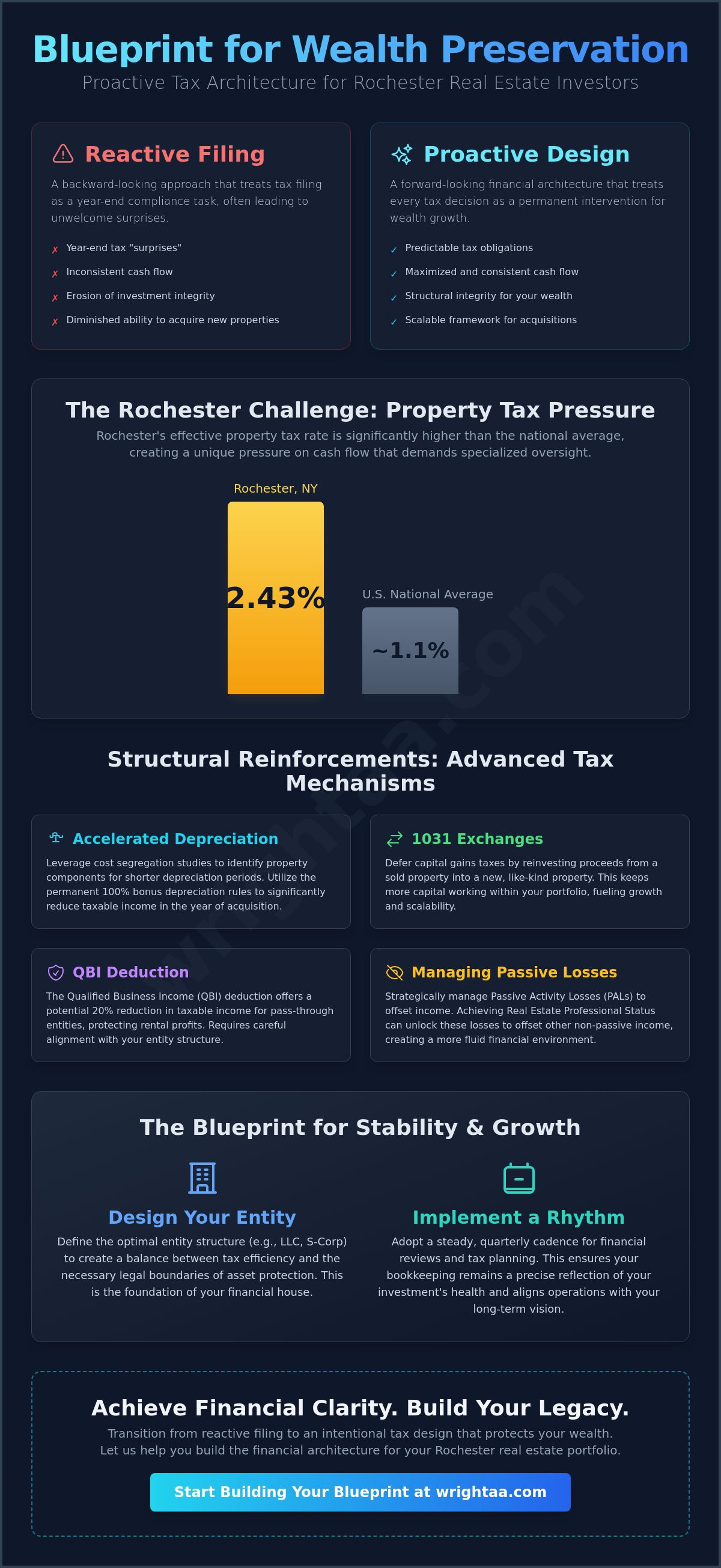
A real estate portfolio is more than a list of addresses. It's a living structure that requires a foundation of fiscal discipline to withstand the weight of New York’s complex regulatory environment. You likely recognize that Rochester's 2.43% effective property tax rate is a persistent force that can erode the integrity of your investment if it isn't managed with care. Many investors feel the pressure of reactive year-end surprises and the friction of inconsistent cash flow. It's a common burden, but it doesn't have to be your reality.
We believe that tax planning for real estate investors Rochester should be as intentional as the architecture of the buildings themselves. By shifting from a reactive stance to a proactive strategy, you can transform your holdings into a legacy of wealth preservation and financial clarity. This article explores how to achieve predictable tax obligations and maximize your cash flow through advanced depreciation methods. We will look at the permanent 100% bonus depreciation rules and the specific frameworks needed to scale your Rochester acquisitions with quiet, disciplined confidence.
Key Takeaways
- Transition from reactive year-end filing to an intentional tax design that protects the structural integrity of your wealth.
- Leverage advanced mechanisms like cost segregation and 1031 exchanges to accelerate depreciation and defer gains, keeping more capital within your portfolio.
- Define the optimal entity structure to create balance between tax efficiency and the necessary boundaries of asset protection.
- Adopt a steady, quarterly cadence for financial reviews to ensure your bookkeeping remains a precise reflection of your investment's health.
- Learn how tax planning for real estate investors Rochester serves as a permanent intervention, aligning your daily operations with a long-term vision of financial clarity.
The Foundation of Wealth: Proactive Tax Planning for Rochester Real Estate
Wealth is not merely a collection of assets. It's a structure that requires a deliberate foundation. For many, real estate in Monroe County serves as that foundation. However, without a precise framework, even the most robust portfolio can become unstable. Effective tax planning for real estate investors Rochester is a proactive design process. It's the difference between reacting to a finished year and intentionally shaping the financial future of your holdings. A compliance-only mindset looks backward at what has already occurred. A strategic approach looks forward, treating every tax decision as a permanent intervention in the growth of your wealth.
The relationship between tax efficiency and scalability is direct. When capital is lost to inefficient planning, the ability to acquire new property is diminished. We view tax strategy as a form of financial architecture. It provides the structural stability needed to weather economic shifts while ensuring that cash flow remains consistent. By integrating tax considerations into the very beginning of the investment cycle, you create a scalable framework that supports long-term preservation.
Why Rochester Investors Require Specialized Oversight
Rochester presents a unique environment for the real estate professional. The median home value sits at $183,700, yet the effective property tax rate of 2.43% is significantly higher than the national average. This duality creates a specific pressure on monthly cash flow that requires careful navigation. Generic online tax software often treats every property as a static number. It fails to capture the intersection of local property tax deadlines and the nuances of the Modified Accelerated Cost Recovery System (MACRS) as it applies to Western New York assets. Specialized oversight ensures that your strategy accounts for both the site-specific details of Monroe County and the broader state-level incentives available to New York owners.
The Shift from Reactive to Proactive Thinking
A "tax surprise" at the end of the year is more than an inconvenience. It's a symptom of a weak design. It suggests that the financial structure was built without a clear blueprint. We believe the role of a CPA is that of a visionary partner. They shouldn't just record history; they should help you design the path forward. This shift from reactive filing to proactive tax planning for real estate investors Rochester brings a sense of calm to the investment process. It allows you to focus on the built environment while the financial mechanics operate with precision in the background. True financial clarity mirrors the clean lines of a well-drawn architectural plan. It's intentional, transparent, and built to endure.
Structural Integrity: Advanced Tax Mechanisms for NY Property Owners
Advanced tax mechanisms are the steel reinforcements of a financial plan. They provide the necessary strength to withstand the weight of New York's tax burden while allowing for upward growth. For those engaged in tax planning for real estate investors Rochester, the Qualified Business Income (QBI) deduction offers a significant reduction in taxable income for pass-through entities. This 20% deduction requires careful alignment with your specific entity structure to ensure every dollar of rental profit is protected. Likewise, managing Passive Activity Losses ensures that the natural cycles of rental expenses don't go to waste. These losses, as detailed in IRS Publication 527, allow you to offset income within the same activity, preserving capital for future acquisition.
Structural stability also depends on how you handle the intersection of income and expenses. Passive activity loss limitations can often feel like a barrier; however, they're merely a design constraint. By understanding the nuances of real estate professional status, investors can unlock these losses to offset other forms of income. This creates a more fluid financial environment where capital moves freely between projects. It's about creating a cohesive system where every mechanism works in harmony with the site and the structure of your business.
Depreciation: The Silent Architect of Cash Flow
Depreciation is a non-cash expense that preserves physical capital. It's the silent architect of cash flow, working quietly in the background to reduce taxable income without requiring an actual outlay of funds. While the IRS mandates a 27.5-year life for residential property, cost segregation allows us to look closer at the materials. We identify components like specialized lighting, flooring, and landscaping that can be depreciated over much shorter periods. With 100% bonus depreciation permanently available for property acquired after January 19, 2025, the impact on your 2026 tax return is substantial. It allows for the immediate expensing of qualified property, providing an influx of liquidity that can be reinvested into the Rochester market. Integrating these tools into your tax strategy ensures your wealth remains unburdened by unnecessary friction.
1031 Exchanges and Strategic Reinvestment
A 1031 exchange is an intentional rebalancing of your portfolio. It follows the philosophy of "defer, defer, die," where capital gains taxes are postponed until the asset is passed to heirs at a stepped-up basis. In the Rochester market, where the median home value is $183,700, the timeline for these exchanges is strict. You have 45 days to identify a replacement property and 180 days to close. Failing to meet these deadlines or receiving "boot" can trigger immediate tax liabilities. Successful execution requires a disciplined approach to site selection and timing. It's a method of moving equity from one structure to another without the erosion of tax, ensuring the continuity of your investment narrative.
Designing the Entity: Selection and Structural Stability
The choice of a business entity is the structural frame upon which all other financial decisions rest. In a state where tax competitiveness is ranked 50th in the nation, the blueprint for your business must be precise. Effective tax planning for real estate investors Rochester requires a deep understanding of how New York State views different business forms. The goal is to balance the weight of administrative requirements against the benefits of limited liability and tax efficiency. Every entity is a container. Its design determines how much capital is preserved and how much is exposed to the elements of regulation.
New York imposes specific burdens on entity formation, including the often-overlooked publication requirements for LLCs and varying annual filing fees. While these represent an initial cost, they're the price of building a secure foundation. We look at the duality of tax benefit versus administrative complexity to ensure your structure doesn't become a burden itself. Reporting rental income correctly is vital, and IRS Publication 527 provides the essential guidelines for how these entities must document their activities to remain compliant with federal standards.
LLC vs. S-Corp: A New York State Comparison
Most buy-and-hold investors favor the Limited Liability Company (LLC) for its inherent flexibility. It allows for a seamless flow of income and losses directly to the individual, avoiding the double taxation often found in traditional corporate structures. However, for those engaged in high-volume fix-and-flip businesses, the S-Corp can be a more efficient tool. By characterizing a portion of income as salary rather than profit, active investors can sometimes reduce the impact of self-employment taxes. You can explore a deeper analysis of these choices in our guide on S-Corp vs. LLC: Tax Implications in New York State. The decision isn't static; it must evolve as your portfolio moves from acquisition to maturity.
Asset Protection and Multi-Entity Structures
Asset protection is the practice of ring-fencing liability. We believe that a single property's risk shouldn't threaten the integrity of an entire portfolio. Multi-entity structures create structural silos, ensuring that legal or financial issues at one site remain contained. This intersection of legal protection and tax reporting efficiency is where true financial architecture happens. While managing multiple entities increases the need for rigorous bookkeeping, it provides the necessary stability for long-term growth. Your entity structure should reflect your aspirations. It's a permanent intervention that protects the humanity of your daily life by securing the built environment of your wealth.
The Seasonal Rhythm: Implementing a Year-Round Tax Strategy
The financial health of a real estate portfolio relies on a steady, unhurried cadence. Much like the architectural process, tax planning for real estate investors Rochester is not a single act of construction but a continuous cycle of maintenance and refinement. Establishing a quarterly rhythm allows you to align your estimated tax payments with actual performance, preventing the friction of year-end surprises. This discipline ensures that your cash flow remains predictable, providing the liquidity needed for timely property acquisitions in the Monroe County market. When your financial strategy moves in harmony with the calendar, you avoid the structural stress of reactive decision making.
Quarterly Milestones for the Rochester Investor
Each quarter serves as a distinct phase in the financial lifecycle. Q1 is the period for reviewing the prior year’s results and adjusting the current year’s blueprint. It’s a time for reflection and calibration. During Q2 and Q3, the focus shifts to monitoring cash flow and executing mid-year capital improvements. These months are often the most active for renovation, making it essential to track every material expense in real-time. As the year draws to a close in Q4, the rhythm changes to finalizing harvest strategies. This might involve year-end gifting or strategic reinvestment to optimize your tax position before the calendar turns. This seasonal approach ensures that your tax planning for real estate investors Rochester remains a permanent, thoughtful intervention.
Bookkeeping as the Foundation of Data
High-quality data is the raw material of a successful tax strategy. Without precise records, even the most sophisticated plan lacks structural integrity. We often see the dangers of "shoebox accounting," where receipts and invoices are gathered without a clear system. This approach creates a fragile environment where opportunities for deduction are easily lost. Maintaining Small Business Accounting in Buffalo, NY: Designing Financial Clarity ensures that your financial records are a truthful reflection of your assets. Clean bookkeeping isn't just a compliance task; it's the disciplined practice of documenting your investment's history with precision and care.
Integrating these seasonal habits into your daily operations creates a sense of calm. The "Quiet Season" of summer provides a unique opportunity for deep strategic pivots when the pressure of filing deadlines is distant. By treating your financial life as a series of intentional milestones, you ensure that your wealth is built on a foundation of clarity. To begin designing your own year-round framework, consider exploring our comprehensive Tax Strategy services. This proactive approach turns the seasonal rhythm into a tool for long-term wealth preservation and growth.
Wright CPAs, LLC: Elevating Real Estate Through Financial Intentionality
At Wright CPAs, LLC, we view the financial landscape as a site to be carefully surveyed and thoughtfully developed. Our philosophy, The Architecture of Finance, treats your portfolio as a cohesive structure rather than a series of disconnected transactions. We believe that effective tax planning for real estate investors Rochester requires a deep awareness of the local environment. It's not enough to simply record what has happened. True financial design involves looking at the relationship between your assets and your long-term goals with quiet, disciplined confidence. We operate across the Buffalo-Rochester-Syracuse corridor, bringing a refined perspective to the unique challenges of the Western New York market.
Moving from a transactional mindset to a partnership model is a fundamental shift. It's the difference between a temporary repair and a permanent intervention. We invite our clients to step into a space where financial clarity is the priority. By focusing on quality over quantity and substance over spectacle, Wright CPAs, LLC helps you build a framework that is both visionary and grounded. This intentionality ensures that every decision contributes to the structural integrity of your wealth.
The Fixed-Fee Advisory Advantage
The traditional billable hour often creates a barrier to meaningful dialogue. It introduces a sense of friction that can prevent the deep listening required for excellent tax strategy. We've replaced this outdated model with fixed-fee monthly retainers. This approach eliminates billable hour anxiety and encourages open, strategic conversation whenever it's needed. When your costs are predictable, they align more naturally with your property’s operating budget. It also ensures that we're looking at your books every month. This continuous oversight allows Wright CPAs, LLC to identify opportunities for tax planning for real estate investors Rochester in real-time, rather than waiting for a year-end review that may be too late for meaningful change.
A Visionary Approach to Your Legacy
Scaling a real estate portfolio beyond the first few doors requires a higher level of structural stability. We provide CFO-level guidance that bridges the gap between modern technology and traditional, unhurried expertise. This isn't just about accounting; it's about the intersection of humanity and the built environment. We help you design a scalable financial framework that supports your growth while preserving the legacy you've worked to create. It's a committed partnership that prioritizes the improvement of your daily life through rigorous financial discipline. We invite you to schedule a consultation to design your tax strategy and begin the process of building a more intentional financial future.
Designing a Legacy of Financial Clarity
The architecture of wealth is built upon a foundation of intentionality. By moving from a reactive mindset to a proactive design, you protect the structural integrity of your real estate holdings. We've explored how advanced mechanisms and the rhythmic discipline of quarterly reviews create a scalable framework for growth. Through disciplined tax planning for real estate investors Rochester, you can transform a collection of assets into a lasting legacy. It's a permanent intervention that ensures your portfolio remains a source of strength rather than a burden of uncertainty.
Wright CPAs provides the specialized expertise in NY real estate tax law and CFO-level financial guidance needed to navigate the Western New York market. Our fixed-fee monthly retainers eliminate the friction of the billable hour, allowing for a deep, unhurried partnership focused on your long-term vision. We believe that financial clarity improves the quality of your daily life. It allows you to focus on the built environment while we maintain the precision of your financial blueprints. Your wealth deserves a structure that is both visionary and grounded.
Begin Designing Your Strategic Tax Plan with Wright CPAs
Frequently Asked Questions
Is real estate tax planning in Rochester different from the rest of New York?
Yes, because Rochester’s effective property tax rate of 2.43% is significantly higher than the state median of 1.90%, requiring a more aggressive approach to cash flow management. While state-level income tax remains consistent, the specific deadlines for Monroe County property tax exemptions, such as the February 2 filing date, demand local precision. Tax planning for real estate investors Rochester must account for these site-specific pressures to ensure the portfolio's structural stability.
How much can a real estate investor save through cost segregation?
An investor can typically reclassify 20% to 30% of a building's cost into shorter-lived categories, which accelerates depreciation and significantly reduces immediate taxable income. For a property valued at Rochester’s median of $183,700, this reclassification can create a substantial non-cash expense that preserves capital for future acquisitions. The exact savings depend on the building's materials and the timing of the acquisition relative to current bonus depreciation rules.
What are the most overlooked tax deductions for Rochester landlords?
Landlords often overlook the deduction for home office space used exclusively for administrative tasks and the specific costs associated with property management software. In the Western New York climate, the expenses for snow removal and seasonal landscaping are also vital deductions that preserve the physical integrity of the site. Documenting these smaller, tactile expenses ensures that every dollar spent on maintenance contributes to your overall tax efficiency.
Do I need a separate LLC for every rental property in Monroe County?
No, you don't necessarily need a separate LLC for every property, but doing so provides the highest level of asset protection by creating structural silos between investments. Many investors choose to group properties within a single entity to simplify administrative requirements and reduce New York’s filing fees. The decision depends on your risk tolerance and the total equity held within each specific container.
Can I deduct travel expenses to visit my Rochester investment properties?
You can deduct travel expenses if the primary purpose of the trip is the management or maintenance of your rental properties. This includes mileage for local trips to properties in Monroe County or airfare and lodging if you're traveling from outside the region. It's essential to maintain a precise log of these journeys to demonstrate the business necessity of the travel to the IRS.
How does the New York State pass-through entity tax (PTET) affect real estate investors?
The PTET allows eligible partnerships and S-corporations to pay tax at the entity level, effectively bypassing the federal $10,000 cap on state and local tax deductions. For real estate investors with significant income, this optional tax can lead to substantial federal savings by converting a personal tax burden into a deductible business expense. It requires an annual election and careful coordination with your overall tax planning for real estate investors Rochester.
What is the difference between a tax preparer and a strategic tax planner?
A tax preparer records historical data to ensure compliance with existing laws, while a strategic tax planner designs a forward-looking blueprint to minimize future liability. Preparers look at what has already occurred; planners intervene in the process to shape what will happen. This visionary approach treats your finances as a built environment that requires constant, intentional refinement rather than just a year-end filing.
How often should I meet with my CPA to discuss my real estate portfolio?
You should meet with your CPA at least quarterly to ensure your financial strategy remains aligned with your portfolio's performance. These regular milestones allow for the adjustment of estimated payments and the execution of mid-year capital improvements before the quiet season ends. A steady, unhurried cadence of communication creates a sense of trust and ensures that your financial architecture remains resilient throughout the year.


