

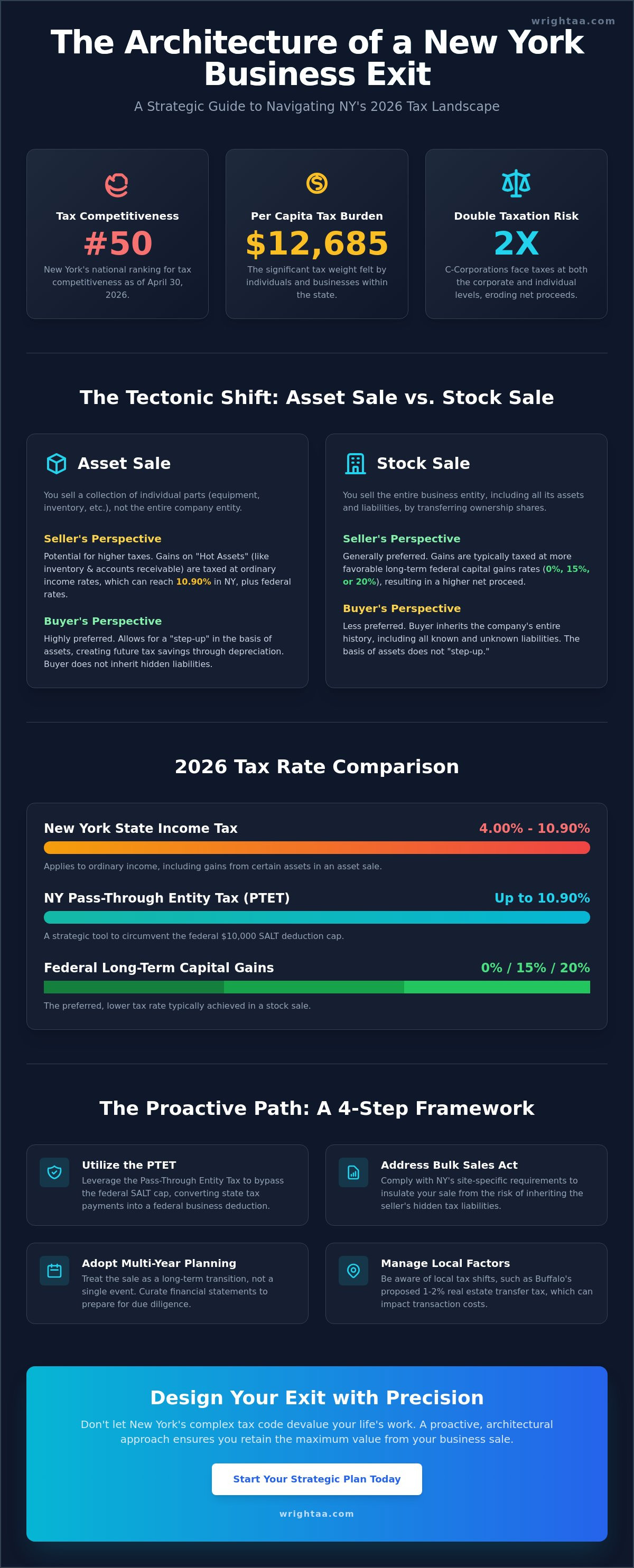
What if the true value of your legacy isn't the number on the final contract, but the structural integrity of the exit itself? In a state ranked 50th for tax competitiveness as of April 30, 2026, the transition of ownership requires the same intentionality as the initial build. You likely feel the weight of New York's $12,685 per capita tax burden, wondering how much of your life's work will remain after the final signature. Understanding the tax implications of selling a business NY is not merely a compliance exercise. It's a site-specific strategy to protect your net proceeds from double taxation and the friction of complex state audits.
We provide a clear framework to navigate these complexities with the precision of a master craftsman. You'll learn how to choose between stock and asset sales to minimize exposure and how the Pass-Through Entity Tax (PTET) rates, ranging up to 10.90% in 2026, can be integrated into your plan. We also examine local shifts, such as Buffalo's proposed 1-2% real estate transfer tax from February 2026. This guide explores the dialogue between federal capital gains and local obligations, offering a proactive path to elevate your financial outcome and ensure your business sale is a thoughtful, permanent intervention.
Key Takeaways
- Discern the tectonic differences between asset and stock sales to align your personal capital gains goals with the buyer's structural requirements.
- Utilize the New York Pass-Through Entity Tax (PTET) as an intentional design element to circumvent the federal SALT cap and elevate your final net proceeds.
- Address the site-specific requirements of the New York Bulk Sales Act to insulate your transition from the structural risk of hidden tax liabilities.
- Adopt a rhythmic, multi-year planning approach to ensure the tax implications of selling a business NY are managed through proactive craft rather than reactive crisis.
Navigating the Structural Complexity of a New York Business Sale
The sale of a business is a structural transformation, not just a financial transaction. In 2026, the tax implications of selling a business NY demand a strategy that is as site-specific as a building’s foundation. The intersection of federal capital gains, which remain at 0%, 15%, or 20% for 2026, and New York’s top income tax rate of 10.90% creates a tectonic tension for the seller. Success requires an intentional dialogue between your current entity structure and your future goals. We view this as the "Architecture of Finance," a discipline where every decision must be measured against the final net proceeds.
Design precedes construction. A successful exit begins with a precise business valuation, which serves as the architectural drawing for your tax strategy. Without this clarity, the complexity of New York’s residency rules can lead to unexpected exit taxes if you choose to relocate after the sale. New York often views the gain as sourced within the state, regardless of where you hold your primary residence on the day of closing. Viewing the sale as a multi-year transition allows you to curate your financial statements for the due diligence walkthrough, ensuring every detail reflects the true craft of your operation.
The Intentional Foundation: Entity Type and Tax Nexus
Your entity type dictates the materiality of your tax burden. C-Corporations face the shadow of double taxation, while S-Corporations and LLCs allow for a more integrated flow of proceeds. When selling a Buffalo or Rochester firm to an out-of-state entity, the concept of tax nexus becomes critical. New York’s reach is long; the state examines where your services were performed and where your clients are located to determine your final filing obligations. This local vernacular matters because it defines the boundaries of your state-level exposure.
The 2026 NY Tax Landscape for Business Owners
For 2026, the New York tax landscape remains rigorous, with the Tax Foundation ranking the state 50th for competitiveness as of April 30, 2026. While the Metropolitan Commuter Transportation District (MCTD) tax primarily affects downstate, Upstate sellers in Syracuse or Buffalo must still navigate the high state-level brackets that range from 4.00% to 10.90%. Proactive planning is the only disciplined defense against over-taxation. It's the difference between a structure that withstands the elements and one that yields to the weight of the state’s top rate. When you understand the tax implications of selling a business NY, you gain the confidence to move forward with a plan that prioritizes value retention.
The Tectonic Shift: Asset Sales vs. Stock Sales in the NY Tax Landscape
The structure of a transaction is a tectonic choice. It determines how value is distributed and how much of your craft remains in your hands after the close. In New York, the distinction between selling the "shell" of a corporation and the "contents" of its assets is the primary driver of your final tax bill. This choice creates a natural dialogue between buyer and seller; while you seek the serenity of long-term capital gains, the buyer often pursues the immediate utility of depreciation. Understanding the federal Sale of a Business is only the first layer. The tax implications of selling a business NY add a secondary, more complex strata of state-level obligations that can shift the ground beneath your feet.
Negotiation is an exercise in balance. Buyers prefer asset sales to "step-up" the basis of the property they acquire, allowing them to lower their own future taxes through depreciation. As the seller, this preference often clashes with your desire for the lower 15% or 20% federal capital gains rates. When you sell assets, you may fall into the "Hot Asset" trap. Accounts receivable and inventory are taxed at ordinary income rates, which in New York can reach 10.90% for high-value transactions in 2026. This disparity requires a disciplined approach to the purchase price allocation before the first draft of the contract is even signed.
Asset Sales: The Materiality of Allocation
An asset sale is a granular exercise. You aren't selling a business; you are selling a collection of individual parts. IRS Form 8594 acts as the blueprint for this allocation, dividing the purchase price into seven distinct classes. The materiality of this document is absolute. For a Buffalo manufacturer, allocating significant value to equipment can trigger "recapture" taxes. This means the IRS and New York State tax previously depreciated equipment as ordinary income rather than capital gains. Allocating value to a non-compete agreement produces a similar result, while value placed on goodwill typically enjoys the more favorable capital gains treatment. It's a delicate integration of competing interests.
Stock Sales: The Clean Lines of Capital Gains
A stock sale offers a more curated exit. By selling the entity itself, you generally achieve a single level of taxation at federal capital gains rates plus the New York state overlay. It represents a cleaner line. However, in Rochester or Syracuse markets, buyers often resist this structure because they inherit all historical liabilities and lose the step-up in basis. To bridge this gap, sophisticated sellers may negotiate a 338(h)(10) election. This allows the transaction to be treated as a stock sale for legal purposes but an asset sale for tax purposes. Designing this bridge requires a deep tax strategy to ensure the premium paid by the buyer justifies the increased tax burden you might shoulder.
Leveraging the New York Pass-Through Entity Tax (PTET) in a Transaction
Architecture is often about navigating constraints. The $10,000 federal cap on state and local tax (SALT) deductions remains a significant constraint for New York business owners in 2026. The New York Pass-Through Entity Tax (PTET) serves as an intentional workaround, a structural bridge that allows the entity to pay the tax directly at the source. This shift effectively converts what would be a non-deductible personal expense into a deductible business expense, reducing federal taxable income before it ever reaches the individual level. For those evaluating the tax implications of selling a business NY, the PTET is a primary tool to elevate net proceeds for S-Corp and Partnership owners.
Timing is everything in design. For calendar-year entities, the annual election to opt into the PTET for the 2026 tax year must be made by March 15, 2026. If your transaction is slated for the second half of the year, missing this spring deadline could leave significant value on the table. It is a dialogue between the entity’s tax year and the date of the closing. Proactive planning ensures that the state-level credits and federal deductions are integrated seamlessly during the sale year, protecting the craft of your life's work from unnecessary erosion.
Calculating the PTET Benefit for Sellers
The PTET functions as an optional tax paid at the entity level that provides a corresponding, non-refundable credit to the individual partners or shareholders to offset their New York income tax. Consider a $5 million sale of a Syracuse-based partnership. Without the PTET election, the state tax on that gain is largely lost as a federal deduction due to the SALT cap. By electing PTET, the partnership pays the tax at rates ranging from 4.00% to 10.90% for 2026. On a $5 million gain, this could result in federal tax savings exceeding $150,000, depending on the owners' federal brackets. This represents the materiality of a site-specific tax strategy.
Common Pitfalls in PTET Planning
Estimated payments must be handled with surgical precision to avoid the friction of penalties. The 2026 installment deadlines are rigid: March 15, June 15, September 15, and January 15, 2027. Failing to align these payments with the actual timing of the business sale can lead to significant underpayment interest. There is also a risk of "over-electing" when a sale price is contingent on earn-outs. If the anticipated revenue doesn't materialize, the entity may have overpaid into a system where refunds are slow to arrive. Ensuring your small business accounting in Buffalo, NY is ready for PTET scrutiny is a prerequisite for this level of planning. It provides the clean data needed to navigate the tax implications of selling a business NY with visionary clarity.
Local Considerations for Buffalo, Rochester, and Syracuse Business Exits
A business is inextricably linked to its place. The vernacular of Western New York commerce defines the dialogue between buyer and seller, requiring a strategy that respects both regional heritage and state mandate. While federal rates provide the broad strokes, the tax implications of selling a business NY are often refined by local compliance mandates and regional incentives. In cities like Buffalo and Rochester, the transition of a manufacturing firm or a family-owned legacy requires an understanding of site-specific exemptions. For instance, the "casual sale" exemption is a critical structural element for manufacturing exits, ensuring that the one-time transfer of production machinery doesn't trigger unnecessary sales tax friction.
Intentionality extends to local incentives. If your firm has utilized START-UP NY benefits or Industrial Development Agency (IDA) credits, these must be integrated into the final valuation. These benefits are not merely historical data; they are part of the building's financial envelope. Failing to address the recapture of local credits can lead to a sudden erosion of value at closing. A disciplined exit plan accounts for these regional nuances, ensuring the transition is as serene as the architecture of the deal itself.
The Buffalo and Rochester "Bulk Sale" Requirement
The NY Bulk Sales Act is a tectonic requirement that protects the buyer from the seller’s existing tax liabilities. Filing Form AU-196.10, the Notice of Sale, Transfer, or Assignment in Bulk, is a mandatory step that must be taken at least 10 days before the closing. In the Syracuse market, neglecting this notice can derail a transaction, as the buyer becomes personally liable for the seller’s unpaid sales taxes. Crafting a precise escrow agreement is the only way to satisfy state tax auditors while allowing the closing to proceed. This escrow acts as a temporary structure, holding a portion of the proceeds until the Department of Taxation issues a Release of Claim.
Succession Planning in the WNY Landscape
Preparing a firm for acquisition is an exercise in craft. Utilizing outsourced CFO services in Buffalo allows owners to clean the lines of their financial statements, making the business more attractive to local and out-of-state buyers alike. This is particularly vital for family-owned businesses in Rochester, where the cultural materiality of the brand is often its greatest asset. In certain Economically Distressed areas across Upstate New York, specific tax credits may be available to the buyer, which can be leveraged to increase the purchase price. To ensure your exit is designed for maximum value retention, schedule a tax strategy session to review your local obligations and opportunities.
Designing Your Exit: Proactive Tax Strategy with Wright CPAs
Design is a process of subtraction as much as addition. In the final stage of business ownership, clarity is the most valuable asset you can possess. We don't view tax strategy as a seasonal chore; we see it as the permanent framework of your legacy. Our fixed-fee monthly advisory model eschews the billable hour in favor of an ongoing dialogue. This structure allows us to refine your financial materiality long before a buyer enters the room. By the time you're ready to close, the tax implications of selling a business NY have already been integrated into a cohesive, intentional plan that protects your net proceeds.
We act as the architects of your transaction. Every line of your tax strategy is placed with purpose, ensuring the dialogue between your entity type and the 2026 tax landscape is productive. Our approach blends technical rigor with a visionary perspective, allowing us to see the structural opportunities others might overlook. We guide you through the walkthrough of due diligence with a quiet, grounded authority. This disciplined preparation transforms a complex, often stressful exit into a serene transition that honors the craft you've poured into your company.
The Wright CPAs Difference
Our work is rooted in strategic business tax planning in Buffalo. We specialize in serving businesses with $1M to $20M in revenue, providing the CFO-level guidance necessary to navigate high-value sales. We bridge the gap between traditional accounting craft and modern financial technology. This integration ensures your records aren't just accurate; they're evocative of a well-managed, site-specific enterprise. We prioritize substance over spectacle, focusing on the elemental details that drive long-term value retention.
Schedule Your Exit Strategy Consultation
The most significant tectonic shifts happen slowly. Starting your exit dialogue 18 months before a planned sale provides the spatial room needed to restructure entities or maximize PTET elections. In your initial Financial Clarity session, we'll walkthrough your current structure and identify where the tax implications of selling a business NY might create friction. We listen deeply to your goals before placing a single strategy on paper. It's time to move from the uncertainty of complex forms to the calm of a disciplined, purposeful plan. Design your exit with Wright CPAs today.
Elevating Your Financial Legacy through Intentional Design
A business sale is a permanent intervention in your financial landscape. In a state ranked 50th for tax competitiveness as of April 30, 2026, success requires a strategy that respects the tectonic shifts of the current environment. By prioritizing the materiality of your asset allocation and leveraging the New York PTET before the March 15, 2026 election deadline, you protect the value you've built. Navigating the tax implications of selling a business NY doesn't have to be a process of friction. It's an opportunity to apply the same craft to your exit that you applied to your growth.
Success in the Buffalo, Rochester, and Syracuse markets depends on proactive integration. Our Architecture of Finance approach ensures that every detail, from local sales tax exemptions to federal capital gains, is placed with purpose. We specialize in NY PTET optimization and site-specific valuation strategies that elevate the human experience of the transaction. Elevate your exit strategy with a consultation at Wright CPAs. Your legacy is a structure worth protecting, and with the right design, your transition will be both serene and rewarding.
Frequently Asked Questions
What is the NY State tax rate on the sale of a business in 2026?
For 2026, New York State taxes the gain from a business sale as ordinary income, with rates ranging from 4.00% to 10.90%. This differs from the federal approach where long-term gains enjoy preferential rates of 0%, 15%, or 20%. High-income earners may also face the 3.8% Net Investment Income Tax at the federal level. Understanding the tax implications of selling a business NY requires calculating how these state-level brackets intersect with your total annual income.
Do I have to pay NY sales tax when I sell my business assets?
Most one-time transfers of business assets qualify for the "casual sale" exemption, meaning you don't collect sales tax from the buyer. This exemption typically covers office furniture and machinery, though it doesn't apply to inventory held for resale or motor vehicles. While the sale itself might be exempt, you must still comply with the Bulk Sales notification requirements to ensure the Department of Taxation doesn't place a lien on the transaction proceeds.
What is the difference between a stock sale and an asset sale in New York?
A stock sale involves transferring the entire legal entity, which typically results in a single layer of capital gains tax for the seller. In contrast, an asset sale treats the business as a collection of individual parts, such as equipment, inventory, and goodwill. Asset sales often trigger ordinary income rates on "recapture" items like depreciated machinery, while stock sales provide a cleaner, more curated exit with fewer immediate tax hurdles for the owner.
How does the New York Pass-Through Entity Tax (PTET) help a seller?
The PTET serves as an intentional workaround for the $10,000 federal SALT deduction cap by allowing the business to pay state taxes at the entity level. This shift makes the state tax a deductible business expense, which reduces the owner's federal taxable income. For a transaction in 2026, the election must be made by March 15 to ensure these benefits are integrated into the final proceeds of your sale.
What is the NY Bulk Sales Act and how does it affect my closing?
The NY Bulk Sales Act requires the buyer to notify the state of the impending sale at least 10 days before closing using Form AU-196.10. This regulation protects the buyer from inheriting the seller's unpaid sales tax liabilities. If the notice isn't filed, the buyer can be held personally liable for the seller's debts. It's a tectonic requirement that often necessitates an escrow account to hold funds until the state issues a formal release.
Is goodwill taxable as capital gains or ordinary income in New York?
Goodwill is categorized as a Class VII asset and is generally taxed at favorable capital gains rates rather than ordinary income rates. In the vernacular of a New York sale, maximizing the allocation to goodwill is a primary strategy for value retention. This contrasts with "hot assets" like accounts receivable or inventory, which are taxed at the state's top income rates, reaching up to 10.90% for high-value exits in 2026.
Do I need a Buffalo-based CPA if my buyer is from out of state?
Local expertise is essential because New York's tax system was ranked 50th for competitiveness by the Tax Foundation on April 30, 2026. A Buffalo-based CPA understands the site-specific nuances of the region, such as the City of Buffalo's proposed 1-2% real estate transfer tax. Even with an out-of-state buyer, the gain is sourced to New York, requiring a disciplined dialogue with the state's specific filing and nexus regulations.
How can I avoid double taxation when selling my NY S-Corp?
Avoiding double taxation in an S-Corp sale usually involves structuring the deal as a stock sale or utilizing a 338(h)(10) election. While S-Corps are pass-through entities, an asset sale can sometimes trigger complex tax consequences if the corporation was formerly a C-Corp with "built-in gains." Navigating the tax implications of selling a business NY requires a site-specific strategy to ensure the proceeds flow directly to you with minimal erosion from entity-level obligations.


