

The $10,000 SALT cap is not an immovable ceiling. It's a structural limitation that your business can actively transcend through intentional design. You likely feel the weight of this federal restriction each year, watching as significant state tax payments fail to provide the federal relief they once did. Seeking professional NYS pass-through entity tax (PTET) advice is the first step toward restoring the financial harmony of your firm. This isn't just about compliance; it's about a proactive shift in your firm's tax architecture.
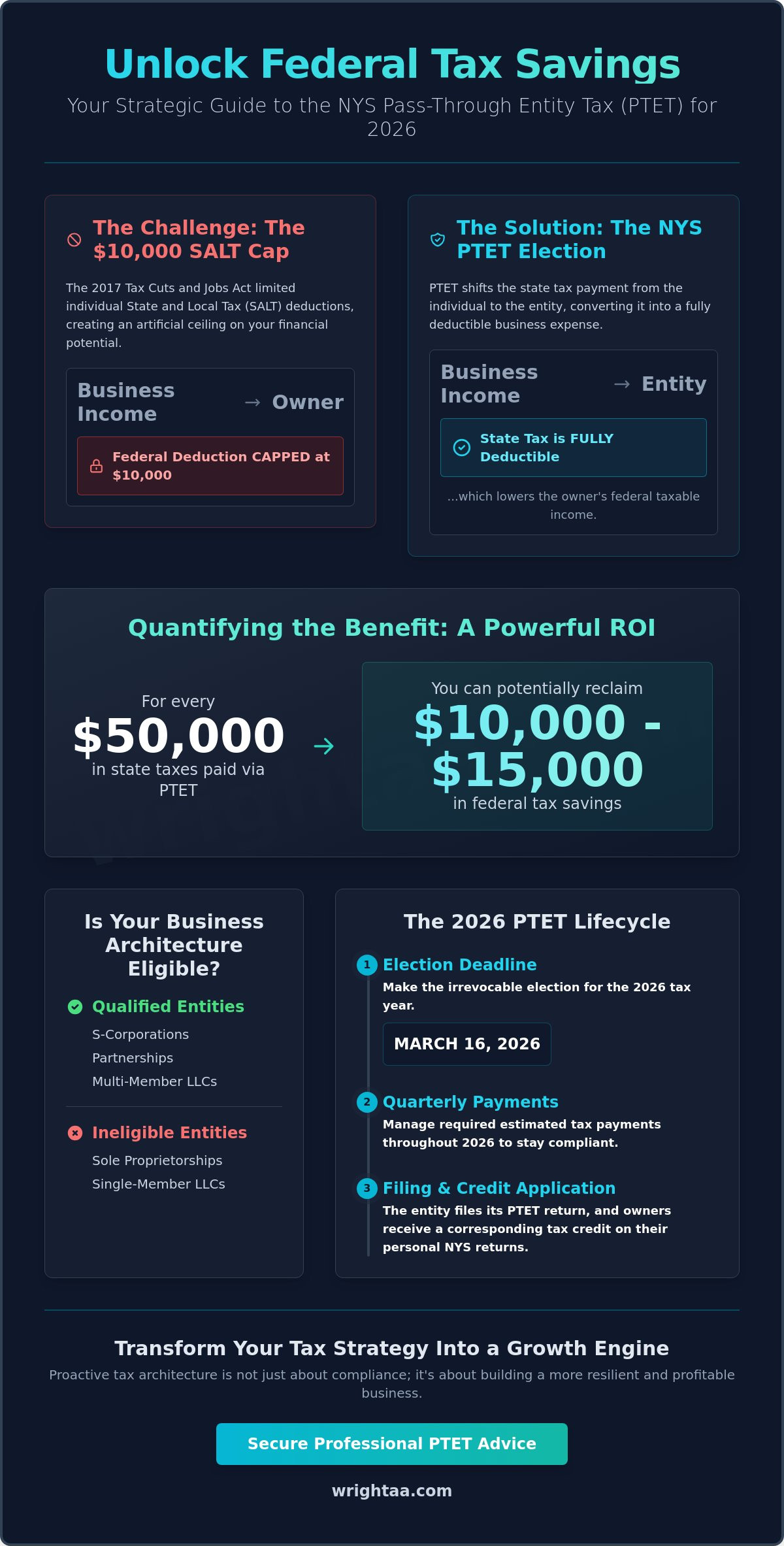
This guide provides a sophisticated framework to navigate the 2026 election with confidence and precision. You'll discover how to leverage this entity level deduction to bypass the individual cap, potentially reclaiming $10,000 to $15,000 in federal savings for every $50,000 in state taxes paid. We'll walk through the essential March 16, 2026, deadline and the strategic integration of NYC PTET elections to ensure your tax strategy is as resilient as the business you've built.
Key Takeaways
- Understand how the PTET functions as a structural intervention to restore federal tax parity and bypass the $10,000 SALT cap.
- Identify whether your firm's architecture, such as an S-corporation or multi-member LLC, qualifies for this strategic election.
- Gain expert NYS pass-through entity tax (PTET) advice to calculate potential federal savings and optimize your firm's cash flow.
- Secure your position by meeting the irrevocable March 16, 2026, election deadline and managing the quarterly payment schedule.
- Transform your approach to tax planning by aligning entity-level deductions with your broader vision for business growth.
Restoring Parity: The SALT Cap and the Genesis of NYS PTET
The 2017 Tax Cuts and Jobs Act introduced a fundamental shift in how business owners perceive their fiscal environment. Central to this change was the State and Local Tax (SALT) deduction cap, which limited individual deductions to $10,000. For New York professionals, this felt like an artificial ceiling on their financial potential. The state responded with Article 24-A, establishing a mechanism to bypass this limitation. This legislation allows partnerships and S-corporations to pay income tax at the entity level rather than passing the entire burden to the individual. By shifting the obligation to the firm, the tax becomes a deductible business expense for federal purposes. It's a structural restoration of balance.
Seeking NYS pass-through entity tax (PTET) advice is about more than just filing a form. It's an exercise in intentional design. New York implemented this workaround specifically to protect small business owners from the disproportionate weight of federal tax changes. It moves the tax payment from the personal return to the business return, effectively lowering the owner's federal taxable income. This shift from individual-level deductions to entity-level tax payments creates a more favorable landscape for those operating in high-tax jurisdictions.
The Structural Impact on New York Taxpayers
The SALT cap doesn't impact every region equally. For professionals in Buffalo and Rochester, where state tax liabilities often exceed the $10,000 limit, the restriction created a significant gap in parity. C-corporations maintained their ability to deduct state taxes in full, while pass-through entities were left constrained. At Wright CPAs, LLC, we view tax strategy as a form of proactive architecture. We believe a firm's financial structure should be as carefully considered as its physical workspace. Restoring parity means ensuring your business form doesn't dictate an unfair tax burden.
Is PTET Right for Your Business?
Deciding to elect into the PTET requires a clear view of your firm's profitability. The election becomes financially advantageous when the entity's state tax liability significantly exceeds the individual's SALT cap. It's a delicate interplay between federal savings and state-level credits. A "set it and forget it" approach is dangerous here. Rules evolve, and your business's income fluctuates. Regular NYS pass-through entity tax (PTET) advice ensures that the election continues to serve your long-term goals rather than becoming a static administrative burden. The goal is a strategy that breathes with your business and responds to the nuances of your growth.
Eligibility and the Architecture of the PTET Election
Choosing a business structure is much like selecting the foundation for a permanent site. It dictates what can be built above it and how the structure interacts with its environment. For the NYS Pass-Through Entity Tax (PTET), only certain foundational forms qualify. Partnerships, multi-member LLCs, and S-corporations are the primary candidates. These structures allow for the collective payment of taxes at the entity level, bypassing the limitations placed on individuals. Conversely, single-member LLCs and sole proprietorships remain outside this specific framework. They don't possess the multi-tiered internal relationships required to facilitate the shift from personal to entity-level taxation.
The act of electing into this system is a formal declaration of intent. It must be executed by an authorized person, typically an officer, member, or partner with the legal standing to bind the entity. It's a deliberate, thoughtful act. Once the first payment is made for the year, the election becomes irrevocable. This permanence underscores the necessity of securing precise NYS pass-through entity tax (PTET) advice before the deadline. A firm's fiscal architecture isn't something to be altered on a whim; it requires a disciplined commitment to a chosen path.
Nuances for Buffalo Law Firms and Professional Practices
Professional practices in Western New York often operate as partnerships, a structure particularly well-suited for this tax intervention. A CPA for law firms Buffalo NY can help navigate how these credits are distributed among managing partners and associates. It's about ensuring each member of the practice benefits from the collective tax architecture. This approach creates a unified financial front, allowing the firm to protect its earnings while maintaining the internal parity essential for a harmonious partnership.
S-Corporation Specifics in New York State
S-corporations face a different set of requirements that demand technical precision. New York distinguishes between resident and non-resident S-corp election types, which changes how the taxable income is defined. If a firm is 100% resident-owned, a specific certification is required to capture the full scope of the benefit. The calculation of the PTET credit for S-corp shareholders depends heavily on these residency nuances. It's a sensory detail in the tax code that can significantly alter the final outcome of your strategy. For those seeking a more intentional approach to their firm's fiscal health, our business consulting services provide the clarity needed to make these structural decisions with confidence.
Securing expert NYS pass-through entity tax (PTET) advice ensures that these eligibility requirements aren't just met, but are leveraged to their fullest potential. Every detail, from residency status to the authority of the signer, contributes to the overall integrity of your firm's financial design.
Calculating the Value: Strategic Benefits of the SALT Workaround
The true value of the PTET lies in its ability to reframe a state obligation as a federal opportunity. By paying state income tax at the entity level, a partnership or S-corporation transforms what was once a limited personal deduction into a full business expense. This reduces the taxable income reported on each owner’s K-1. It is a fundamental shift in the firm’s financial landscape. Effective NYS pass-through entity tax (PTET) advice focuses on this relationship between entity-level payments and individual credits. The goal is to ensure that the tax paid by the firm flows back to the owners as a dollar-for-dollar credit on their New York State personal returns.
A common misconception is that this process creates a double tax burden. In reality, the system is designed for parity. While the entity pays the tax upfront, the individual shareholders or partners receive a corresponding credit that offsets their personal New York income tax liability. This mechanism also lowers the individual’s Adjusted Gross Income (AGI). A lower AGI can unlock secondary benefits, such as reducing the impact of various federal tax phase-outs or limitations that trigger at higher income levels. For more technical details on these mechanics, the New York State Pass-Through Entity Tax (PTET) Information page provides the underlying regulatory framework.
Federal Savings vs. State Credits
The primary driver of this strategy is the federal tax savings. Consider a profitable firm paying $50,000 in New York state taxes. Under the standard SALT cap, the owners would only see a fraction of that as a federal deduction. By electing into the PTET, the full $50,000 becomes deductible at the federal level. This can result in federal tax savings ranging from $10,000 to $15,000 for the owners. New York requires an "add-back" of this tax on the state return, meaning the benefit doesn't reduce state-level taxes. Instead, it creates a significant federal windfall that would otherwise be lost to the $10,000 cap.
The Resident Tax Credit Interaction
For businesses in Western New York, the strategy must account for the geographic context of its partners. Many firms in the Buffalo area have members who reside in neighboring states. The interaction between the NYS PTET credit and taxes paid to other jurisdictions requires careful calibration. It's vital to maintain clear financial reporting to ensure all members understand how the entity-level payment affects their specific tax position. Providing transparent NYS pass-through entity tax (PTET) advice to every partner helps maintain the internal harmony of the firm’s leadership. This clarity ensures the tax architecture supports the collective goals of the practice.
Implementation and Compliance: The Lifecycle of PTET in 2026
The lifecycle of the PTET is a steady, year-long progression. It begins with a decisive act. For the 2026 tax year, the annual election must be made through the entity's Business Online Services account by March 16, 2026. This date is firm. Missing it means the opportunity for federal tax parity is lost for the entire calendar year. Once the election is made, the rhythm shifts to quarterly estimated payments. These are due on March 15, June 15, September 15, and December 15. This cadence requires a disciplined approach to financial monitoring.
Securing professional NYS pass-through entity tax (PTET) advice ensures your firm doesn't fall into common pitfalls. Late payments or incorrect reporting can attract underpayment penalties that quickly erode the tax benefits you've worked to secure. The process concludes with the filing of the annual PTET return, Form PTET-ST, by March 15 of the following year. It's a full cycle of compliance that mirrors the seasonal changes in the New York landscape. It requires patience and a commitment to the details.
The Importance of Accurate Quarterly Projections
Precision in your quarterly projections is essential. If your entity fails to pay at least 90% of the current year's liability, or 100% of the prior year's liability, penalties may apply. Aligning these payments with your cash flow management ensures that the tax obligation doesn't disrupt your firm's operational liquidity. Many firms utilize our CFO services to provide the high-level oversight needed for these mid-year adjustments. This proactive stance allows for a strategy that is both flexible and resilient.
Reporting Information to Partners and Shareholders
The final stage of the lifecycle is the distribution of information. Each partner or shareholder must receive a K-1 that clearly outlines their share of the PTET credit. For individual claimants, Form IT-653 is the vehicle used to claim the credit on their personal New York returns. Transparency is the cornerstone of this process. In closely held businesses, clear communication regarding these credits prevents confusion and ensures every member understands the value being created at the entity level.
Effective NYS pass-through entity tax (PTET) advice provides the roadmap for this journey. It transforms a complex regulatory requirement into a predictable, manageable part of your business's annual narrative. By staying ahead of the deadlines and maintaining accurate records, you protect the integrity of your firm's tax architecture and the financial well-being of its owners.
Beyond Compliance: Integrating PTET into a Visionary Tax Strategy
Taxation is often viewed as a heavy, static weight on a business. However, when approached with intentionality, it becomes a structural element that supports the firm’s broader ambitions. The PTET is not merely a box to check on an annual return. It is a vital component in what we call the Architecture of Finance. By integrating this election into a year-round strategy, you transform a reactive obligation into a proactive tool for wealth preservation. This shift allows you to move beyond the limitations of traditional filing toward a more resilient financial design. Every dollar reclaimed from the federal government through expert NYS pass-through entity tax (PTET) advice represents a tangible resource for reinvestment. It might fund a new project, a key hire, or the expansion of your physical workspace.
A visionary strategy requires a departure from the hurried pace of tax season. It demands a steady, contemplative rhythm where decisions are made well in advance of deadlines. Transitioning to a fixed-fee advisory model facilitates this environment. It removes the friction of hourly billing and encourages the deep, contextual conversations necessary for sophisticated planning. This approach ensures that complex elections like the PTET are managed with precision and care, rather than as an afterthought. It creates a sense of calm and purpose, knowing that your firm’s tax architecture is monitored and adjusted as your business evolves.
Designing Financial Clarity in Buffalo and Rochester
For business owners in Buffalo and Rochester, the intersection of business tax planning and personal wealth is where true financial clarity is found. At Wright CPAs, LLC, we believe that a curated approach to tax beats a generic compliance checklist every time. We support local owners by navigating the full PTET lifecycle, ensuring that the benefits at the entity level are perfectly aligned with your personal financial goals. It's about creating a seamless connection between the business you've built and the life you wish to lead. Our focus remains on quality and substance, providing the high-level guidance that professional practices in Western New York require.
Next Steps for the 2026 Tax Year
The path toward a more optimized tax structure begins with a quiet assessment of your current landscape. As you look toward 2026, consider these foundational steps:
- Conduct a feasibility study to quantify the exact federal savings your 2026 PTET election could generate.
- Review your current entity structure to ensure it remains the most effective vessel for your income and growth.
- Schedule a strategy session to refine your firm’s financial narrative and align your tax obligations with your long-term vision.
Securing NYS pass-through entity tax (PTET) advice early in the year allows for a more patient and methodical implementation. By taking these steps now, you protect your firm’s earnings and ensure that your financial architecture is as thoughtful and disciplined as the rest of your practice.
Harmonizing Structure and Prosperity
The transition from a restricted tax environment to one of federal parity is not merely a technical adjustment. It's a fundamental reimagining of your firm's relationship with its fiscal landscape. By moving beyond the $10,000 SALT cap through the PTET, you restore the financial equilibrium that your hard work deserves. This journey requires a commitment to detail, from the initial March election to the final distribution of credits. Seeking expert NYS pass-through entity tax (PTET) advice ensures that every structural choice you make today serves as a foundation for your firm's future growth.
At Wright CPAs, LLC, we offer more than just compliance; we provide a curated advisory experience. Our fixed-fee monthly retainers and CFO-level oversight are designed to remove the friction from your financial life, allowing you to focus on the practice you love. For Buffalo law firms and professional practices, this proactive approach creates a lasting sense of calm and clarity. We invite you to step away from reactive filing and toward a visionary strategy built on precision and deep intentionality.
Design Your Proactive Tax Strategy with Wright CPAs, LLC
Your business is a permanent intervention in the world; your tax strategy should be equally enduring and thoughtful.
Frequently Asked Questions
What is the deadline for the 2026 NYS PTET election?
The deadline to make the election for the 2026 tax year is March 16, 2026. This date is firm for all calendar-year entities and requires an online filing through the business's official state account. Securing early NYS pass-through entity tax (PTET) advice ensures your firm's architecture is prepared well before this irrevocable cutoff.
Is the NYS pass-through entity tax mandatory for all businesses?
The PTET is an optional election rather than a mandatory requirement. It's a strategic choice for partnerships and S-corporations that want to bypass the $10,000 federal SALT deduction limit. Each firm should evaluate its profitability annually to decide if the federal tax savings justify the administrative commitment.
Can a single-member LLC elect to pay the NYS PTET?
Single-member LLCs and sole proprietorships are excluded from this specific tax framework. The legislation is designed for entities that file a partnership or S-corporation return. If your practice operates as a single-member LLC, you'd need to consider a structural shift, such as electing S-corp status, to access these benefits.
How do I claim the PTET credit on my personal New York income tax return?
You claim the credit by filing Form IT-653 alongside your personal New York income tax return. This form allows you to report your share of the taxes already paid by the entity, as documented on your K-1. It's a precise mechanism that ensures the entity-level payment offsets your individual tax liability dollar-for-dollar.
What happens if I miss a quarterly PTET estimated payment?
Missing a quarterly payment typically triggers underpayment penalties and interest charges. To avoid these costs, entities must generally pay at least 90% of the current year’s tax or 100% of the tax from the prior year. Consistent cash flow management is vital to maintaining the integrity of this tax strategy throughout the year.
Do non-resident partners benefit from the NYS PTET election?
Non-resident partners often find significant value in the election because it reduces their federal taxable income. While they must still account for New York source income, the credit helps mitigate the tax burden on that income. Professional NYS pass-through entity tax (PTET) advice is essential to navigate how these credits interact with the tax codes of other states.
Is the PTET election irrevocable once it is made?
The election is irrevocable for the tax year once the March 16 deadline passes or the first payment is submitted. You can't undo the choice mid-year if your financial situation changes. This permanence underscores why your firm's tax architecture must be designed with foresight and precision during the initial planning phase.
How does the PTET affect my federal self-employment tax?
The PTET election doesn't reduce your federal self-employment tax. It acts as a deduction against your federal income tax by lowering the ordinary income reported on your K-1. While it effectively reduces your income tax burden, the underlying earnings subject to self-employment tax remain unchanged by this specific state-level workaround.


