

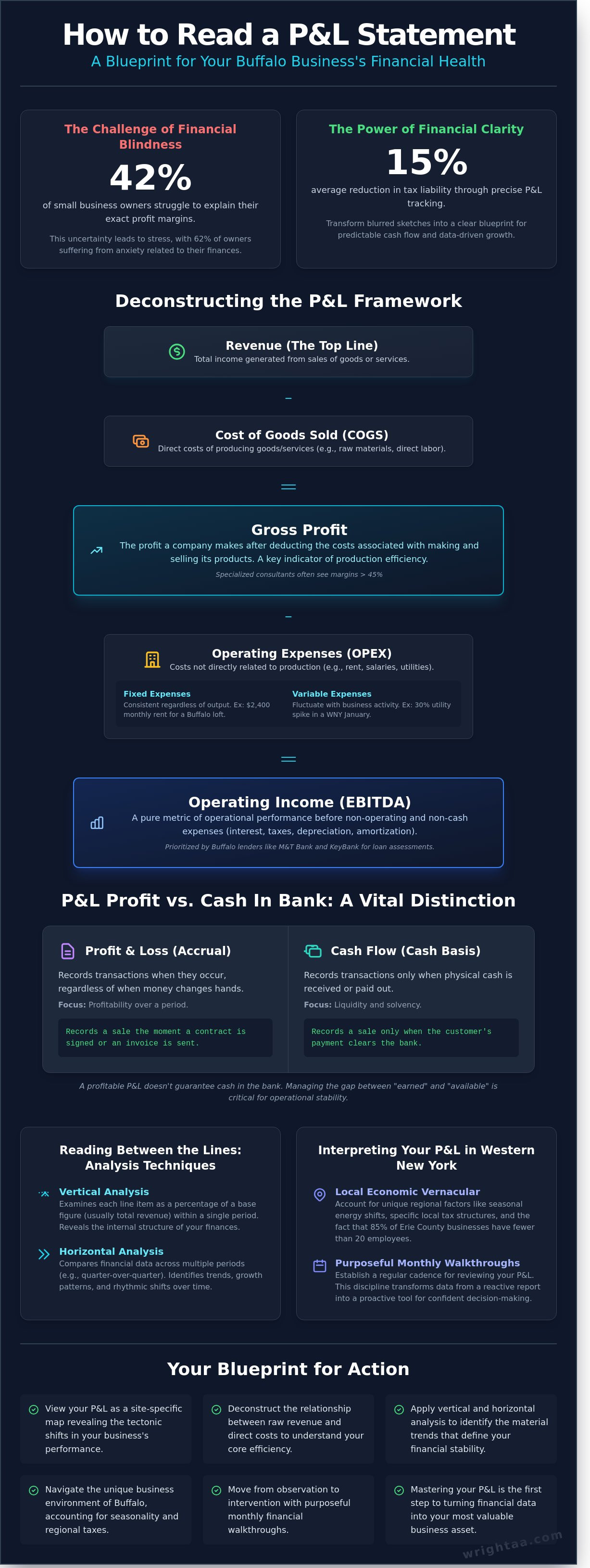
What if the most vital structure in your Buffalo business isn't the physical storefront on Main Street, but the invisible framework of your financial data? Many Western New York owners see strong sales figures, yet 42% of small businesses still struggle to explain their exact profit margins to stakeholders. Learning how to read a p&l statement is the first step toward clarity, transforming a blurred financial sketch into a site-specific blueprint for growth.
It's difficult to feel grounded when you're operating with a sense of blindness despite your daily craft. By mastering this architectural framework, you can identify hidden inefficiencies and lower your tax liability by an average of 15% through more precise tracking. We will explore the materiality of your revenue and expenses, providing you with the tools to build predictable cash flow and make intentional, data-driven decisions for your future.
Key Takeaways
- View your financial records as a site-specific map, revealing the tectonic shifts in your Western New York business’s performance.
- Master how to read a p&l statement by deconstructing the relationship between your raw revenue and the essential craft of your direct investments.
- Apply vertical and horizontal analysis to identify the rhythmic patterns and material trends that define your long-term financial stability.
- Navigate the unique environmental vernacular of Buffalo, accounting for seasonal energy shifts and specific regional tax structures.
- Move from observation to intervention by identifying the three critical metrics required for a purposeful monthly financial walkthrough.
The Architecture of Profit: What a P&L Statement Reveals About Your Buffalo Business
Learning how to read a p&l statement is the first step in mastering the tectonic forces of your enterprise. To a Buffalo business owner, this document acts as a rhythmic record of revenue and craft. It isn't merely a list of numbers; it's a site-specific map of financial performance that details how resources flow through your organization over a specific duration. This statement captures the movement of capital, providing a narrative of your business's ability to transform effort into value.
While a Balance Sheet provides a snapshot of a single point in time, the Profit and Loss statement, often called the Statement of Operations, tells the story of a period. It tracks the trajectory of your firm from the start of a quarter to its conclusion. Western New York entrepreneurs must look beyond the bottom line to understand the spatial health of their companies. In the Erie County market, where 85% of businesses employ fewer than 20 people, this clarity defines the boundary between survival and meaningful growth. You're looking for the structural integrity of your margins, not just the final sum.
The Intentionality of Financial Reporting
Financial clarity is a primary tool for elevating the human experience. When reporting is precise, it reduces the visceral stress that many owners carry daily. A 2023 study indicated that 62% of small business owners suffer from anxiety related to financial uncertainty. Clear reporting leads to visionary interventions. By establishing a monthly or quarterly cadence, you create a steady rhythm for decision-making. This discipline allows you to see the vernacular of your business before a crisis forces your hand, turning data into a quiet, confident authority.
P&L vs. Cash Flow: A Vital Distinction
A profitable P&L statement doesn't always mean there is cash in the bank. This distinction is vital for maintaining the structural integrity of your firm. Consider the difference between accrual and cash accounting through a tactile lens. Accrual accounting records the moment a contract is signed; cash accounting records the moment the physical check clears. Wright CPAs manages this dialogue for Buffalo clients, ensuring the gap between "earned" and "available" doesn't compromise your operations. We focus on the materiality of your finances, helping you master how to read a p&l statement so your vision remains grounded in reality.
Deconstructing the Framework: The Primary Components of an Income Statement
Understanding how to read a p&l statement begins with recognizing that financial data is a structural material. Just as a site dictates the possibilities of a building, your Gross Revenue, often called the top line, represents the raw material available to your enterprise. It's the total volume of resources flowing into the firm before any shaping or refinement occurs. Without this initial mass, the structure cannot exist.
Revenue and Cost of Goods Sold
Gross Sales for a Buffalo service firm might include total billable hours or fixed project fees. In manufacturing, Cost of Goods Sold (COGS) involves the physical materiality of raw inputs like steel or timber. For service providers, COGS is often the direct labor required to deliver the craft. Gross Profit emerges as the first indicator of structural efficiency; it reveals how much value remains after the primary work is done. A healthy Gross Profit margin, which often exceeds 45% for specialized consultants, suggests a firm with strong pricing power and disciplined execution.
Operating Expenses and the Cost of Doing Business
Operating Expenses (OPEX) function as the supporting structure that allows the business to inhabit its space. These costs are often divided by their behavior. Fixed expenses, such as a $2,400 monthly rent in a renovated Buffalo loft, remain steady regardless of project volume. Variable expenses fluctuate, often seen in the 30% spike in utility costs during a typical Western New York January. For professional firms like law practices, materiality often resides in specialized research software or case management tools that can cost $550 per user each month. Focusing on these high-impact line items ensures the enterprise remains lean and resilient.
The Significance of EBITDA
Earnings Before Interest, Taxes, Depreciation, and Amortization (EBITDA) serves as a pure metric of operational performance. It strips away non-cash elements to show the tectonic strength of the business. Buffalo lenders, such as M&T Bank or KeyBank, prioritize EBITDA when calculating debt service coverage for commercial loans. Depreciation acts as a silent structural element; it acknowledges that assets like heavy machinery or office interiors lose value over time, even if no cash leaves the bank. This perspective allows owners to view their business as a living entity that requires constant maintenance. To ensure your financial structure remains sound, consider integrating professional design principles into your broader operational strategy. Net income is the final, refined result of this discipline, representing the true profit available for growth or distribution.
Reading Between the Lines: Analyzing Financial Materiality and Performance
Understanding how to read a p&l statement is like examining the structural integrity of a building. It requires looking beyond the surface to the materiality of the numbers. A single figure is a static point; the relationship between figures creates the narrative. By observing the dialogue between revenue and expenses, you can identify tectonic shifts in your business's foundation. For example, a 12% increase in cost of goods sold while revenue remains flat indicates a structural weakness that requires intervention before it compromises the entire project. This analytical process reveals whether your business is standing on solid ground or shifting sand.
Vertical Analysis: The Power of Percentages
Vertical analysis is a tool for proportional clarity that expresses every line item as a percentage of total revenue. This method creates what's known as a common-size statement, allowing you to view your Buffalo business through the lens of pure ratio. When you see your labor costs as 38% of total sales rather than a raw dollar amount, you can accurately compare your performance to the 2023 RMA Annual Statement Studies for your specific industry. Identifying bloated expense categories becomes intuitive. If a local manufacturing firm sees its "Other Expenses" rise to 15% of revenue while the industry standard is 4%, a lack of spatial discipline in the budget is likely at fault. These percentages highlight the craft of your financial management.
Horizontal Analysis: Tracking the Trajectory
Horizontal analysis tracks the trajectory of your business across the dimension of time. You'll compare this month's performance to the previous month and to the same period in 2023 to find the true rhythm of your operations. Western New York businesses must account for the specific vernacular of our local economy. A 25% spike in heating costs during a Buffalo January is often a seasonal blip, a temporary reaction to the environment. However, a 4% steady climb in administrative overhead across six consecutive months suggests a structural trend that won't resolve itself. Distinguishing between these movements is vital for long-term integration. You're looking for the following markers:
- Year-over-Year (YoY) Growth: Comparing June 2024 to June 2023 to account for seasonal cycles.
- Sequential Growth: Comparing March to February to measure immediate momentum.
- Structural Deviations: Identifying when an expense category breaks its historical relationship with revenue.
It's not enough to see the numbers; you must hear the dialogue they're having. When revenue grows by 10% but shipping costs grow by 22%, the statement is telling you that your current scale is inefficient. Mastery of how to read a p&l statement allows you to design a more resilient future, ensuring every material resource is placed with intention and purpose.
Local Nuance: Interpreting Your P&L Within the Western New York Economy
A financial statement is a document of a business's relationship with its environment. In Buffalo, the physical and economic landscape dictates the rhythm of your expenses. Understanding how to read a p&l statement requires an appreciation for the site-specific variables that define our region. From the tectonic shifts in utility costs to the unique materiality of New York tax law, your bottom line reflects your place in the Western New York economy. It's a dialogue between your internal operations and the external forces of the Great Lakes region.
New York State Tax Materiality
The New York burden is a tangible presence on any local income statement. You'll see this reflected in the 6.5% corporate franchise tax rate or the specific layers of payroll taxes that fund state programs. These aren't just administrative hurdles; they're structural elements of your business model. Proactive tax planning helps integrate these costs into your strategy rather than letting them become a disruptive force at year-end. Utilizing Wright CPAs tax planning services allows you to design a fiscal framework that anticipates these obligations with precision and intent.
Benchmarking Against the WNY Market
Success looks different in the 14222 zip code than it does in Manhattan. A healthy net profit margin for a Buffalo small business often sits between 7% and 12%, depending on the sector. Your operating expenses are heavily influenced by the specific vernacular of local real estate. For instance, commercial rents in the Elmwood Village might command $25 per square foot, while Amherst office spaces often hover around $18 per square foot. These spatial costs must be balanced against the seasonal fluctuations of our climate. Heating costs in January can be 400% higher than cooling costs in July, creating a distinct seasonal curve in your utility line items.
Your projections shouldn't exist in a vacuum. The economic dialogue between Buffalo, Rochester, and Syracuse is constant. When projects like the Micron expansion in Syracuse bring 9,000 jobs to the region, the ripple effect reaches Buffalo's labor market and supply chains. Learning how to read a p&l statement involves tracking these external shifts and adjusting your payroll expectations to match the rising cost of local talent. If you want to ensure your business is built on a solid foundation, schedule a consultation to review your financial structure.
From Observation to Intervention: Using P&L Insights for Proactive Strategy
Mastering how to read a p&l statement is the first step in moving from a passive observer to a deliberate architect of your business. A financial statement is not merely a record of past transactions; it's the site upon which you build your future. To transition from observation to intervention, you must focus on three specific markers: your gross profit margin, your net income percentage, and your operating expense ratio. These metrics provide the structural integrity your business requires to withstand shifts in the Western New York market.
Establish a monthly financial walkthrough with your CPA. This practice ensures your strategy remains site-specific and responsive. During a review in October 2023, one local firm identified a 14% leak in their supply chain costs. By addressing this immediately, they preserved their year-end liquidity. This shift in perspective turns the P&L from a history book into a design tool. It allows you to fuel proactive tax strategies and CFO-level growth plans that align with your long-term intentions. You're no longer just recording what happened; you're designing what comes next.
The Role of a Fractional CFO
When a Buffalo business reaches the $1.2M annual revenue mark, the dialogue between bookkeeping and strategy must evolve. A fractional CFO acts as a master builder, translating raw data into actionable pivots. They look beyond the surface to understand the materiality of your cash flow and how it impacts your spatial growth. This high-level guidance ensures that every financial decision integrates seamlessly with your broader operational goals. It's about finding the balance between current stability and future expansion, ensuring your business craft remains disciplined as it scales.
Designing Your Financial Future
Your budget should reflect your vision, not just your expenses. Setting a target net margin of 18% or 22% provides the clarity needed to justify significant moves. Whether you're planning a new hire in the second quarter of 2024 or scouting a Buffalo office expansion in the Northtowns, P&L insights offer the necessary proof of concept. Precise financial data allows you to build with confidence and intent. To begin crafting your financial architecture, schedule a consultation with Wright CPAs and start designing a future that's both profitable and purposeful.
Refining the Financial Architecture of Your Buffalo Enterprise
Mastering the nuances of your income statement transforms raw data into a site-specific strategy. It’s about recognizing the materiality of your costs and the tectonic shifts in the Western New York economy. Understanding how to read a p&l statement is more than a technical requirement; it's the foundation of a disciplined business. This clarity allows you to identify which components of your operation are performing and which require a more thoughtful intervention. When your financial framework is sound, your path forward becomes clear.
Since 2012, Wright CPAs has helped Buffalo business owners integrate these financial insights into a cohesive vision. We specialize in law firm accounting and proactive tax strategies that ensure strict NYS compliance. You deserve a partner who values craft and precision in every ledger line. Elevate your business with proactive tax strategy and CFO-level guidance from Wright CPAs.
Your business is a permanent fixture in our local landscape. By applying these insights today, you're building a legacy that will endure for years to come.
Frequently Asked Questions
What is the most important line on a P&L statement for a Buffalo business owner?
Net income is the most vital line on your statement because it represents the final residue of your efforts after all costs are stripped away. For a Buffalo business, this figure determines your ability to reinvest in local craft or weather a harsh 4 month winter. It's the foundation of your financial structure. This single number tells you if your business model is sustainable or if the structural integrity of your finances requires immediate attention.
How often should I review my profit and loss statement?
You should review your statement every 30 days to maintain a clear dialogue with your business's health. Monthly reviews allow you to spot trends before they become structural failures. If you only look at your finances during the April 15 tax season, you miss 11 months of opportunities to adjust your trajectory. Consistent observation ensures your business remains site-specific and responsive to the shifting economic climate of Western New York.
Can a P&L statement help me get a business loan in Western New York?
Yes, local lenders like M&T Bank or Northwest Bank require 3 years of P&L statements to assess your creditworthiness. They look for a debt service coverage ratio of 1.25 or higher to ensure you can handle repayments. Understanding how to read a p&l statement allows you to present a clear, rhythmic narrative of growth to a loan officer. It transforms raw data into a compelling argument for your firm's future.
What is the difference between an income statement and a P&L?
There's no difference between an income statement and a profit and loss statement; they're two names for the same financial document. Think of it like the relationship between a building's blueprint and its floor plan. Both terms describe the document that tracks your revenue and expenses over a specific duration. Whether you call it a P&L or an income statement, the goal is to map the flow of capital through your organization.
Why does my P&L show a profit when I have no cash in my bank account?
Your statement shows a profit despite an empty bank account because of the 30 day or 60 day lag in accrual accounting. Profit measures earned revenue, while your bank account measures tangible cash. You might have $50,000 in accounts receivable that hasn't arrived yet. This distinction is crucial when learning how to read a p&l statement because it prevents you from mistaking paper gains for liquid resources.
How can I use my P&L to reduce my New York State tax liability?
You can reduce your liability by identifying 100% deductible expenses like the Section 179 depreciation for equipment purchased before December 31. Analyzing your P&L helps you find spatial room for tax-advantaged investments in your business's infrastructure. By tracking your 6.5% New York State corporate tax obligations against your actual net income, you can make intentional decisions about year end spending that lower your total burden.
What are common mistakes business owners make when reading their P&L?
One common mistake is misclassifying 15% of operating expenses as Cost of Goods Sold, which distorts your gross margin. Business owners often overlook the rhythm of seasonal fluctuations in Buffalo, leading to panic during slow cycles. Another error is failing to reconcile the statement against bank records every month. These lapses create a fractured view of your business's reality, making it difficult to build a lasting financial legacy.
Do law firms need a special type of P&L statement?
Law firms require a specific P&L structure that separates 100% of client trust funds from firm revenue. In New York, IOLA accounts must be handled with precise care to ensure ethical compliance with state bar rules. A legal P&L focuses heavily on billable hour realization and the materiality of overhead costs. It functions as a specialized tool, designed to reflect the unique craft and regulatory environment of the legal profession.


