

A business is only as resilient as the foundation it rests upon. In Western New York, that foundation isn't built on vision alone; it's built on the steady rhythm of liquidity. For a local owner, the difference between a thriving storefront and a quiet winter can depend entirely on effective cash flow management for small business. According to a 2023 study by U.S. Bank, 82% of small firms fail because they lack a clear understanding of their incoming and outgoing capital. You know the weight of this reality when the lake effect snow begins to fall and the foot traffic slows down.
You understand that running a company in Buffalo or Syracuse requires a certain grit and a deep respect for seasonal shifts. It's difficult to focus on the craft of your work when unexpected NYS tax obligations or payroll demands during a growth phase create unnecessary friction. This guide provides the structural blueprint you need to master cash flow forecasting and ensure your operations remain fluid through every season. By implementing these site-specific strategies, you'll secure predictable bank balances and the capital necessary to fund your next expansion into the Rochester market. We will examine the tectonic shifts of local revenue cycles and how to build a financial framework that stands the test of time.
Key Takeaways
- Distinguish between the theoretical concept of profit and the tangible materiality of capital to ensure your business remains grounded and liquid.
- Build a resilient financial architecture by aligning historical data with the tectonic seasonal shifts unique to the Western New York market.
- Master cash flow management for small business by refining the dialogue between receivables and payables to ensure a rhythmic movement of capital.
- Identify and overcome common barriers like over-trading to ensure your growth never outpaces the structural support of your available cash.
- Elevate your operations from reactive bookkeeping to a proactive financial craft that offers the clarity and foresight of CFO-level guidance.
Understanding the Materiality of Cash Flow in Western New York
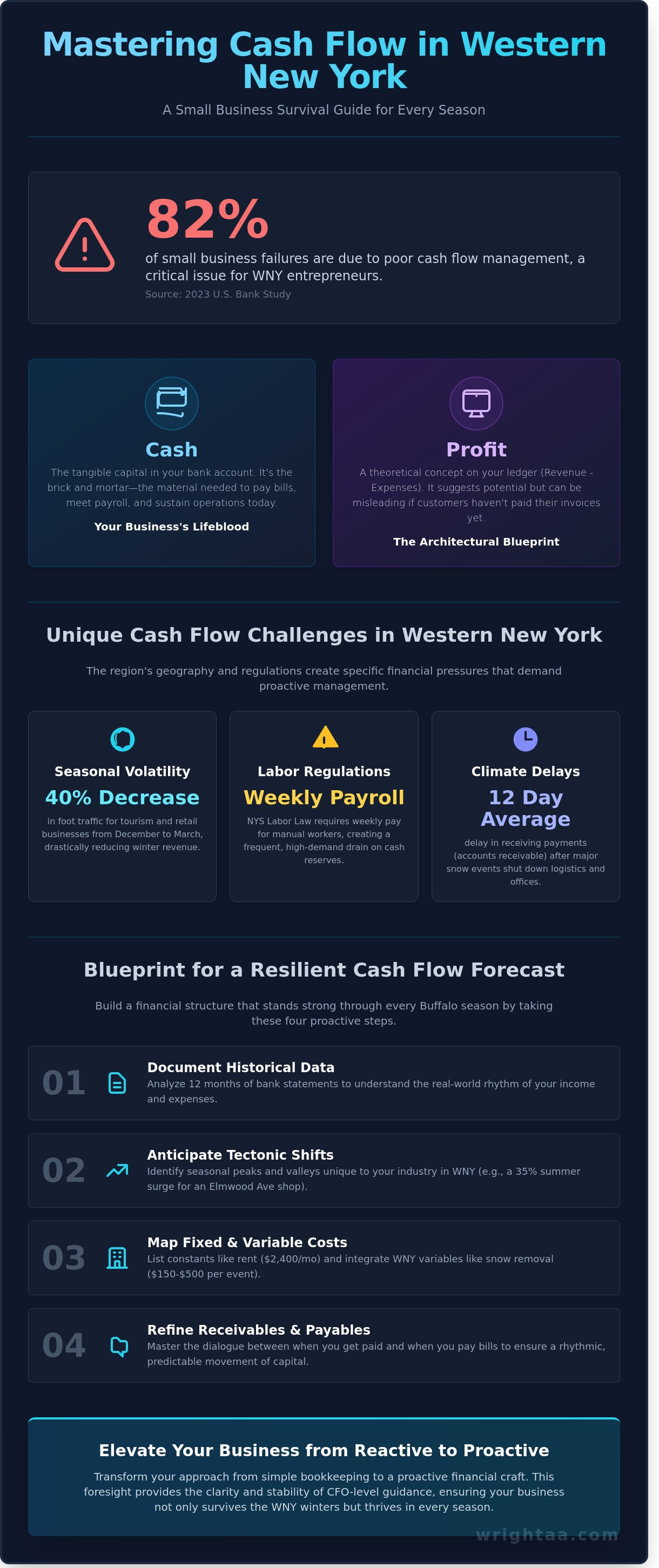
Cash flow is the rhythmic movement of capital through a business. It behaves like light in a room; it defines the boundaries of what is possible and reveals the true form of an enterprise. While many owners focus on the height of their sales, the actual health of a company rests in the steady, tectonic shift of liquidity. In the context of cash flow management for small business, we must view capital not as a static number, but as a material that must be shaped and directed with intention.
The movement of capital is not an abstract exercise. It is a site-specific reality. In Buffalo and the surrounding Western New York region, the environment dictates the flow. Businesses here don't just exist in a market; they exist in a landscape with specific seasonal cycles and regulatory textures. According to the 2023 Small Business Credit Survey, 54% of firms in the Northeast reported significant challenges meeting operating expenses. This figure underscores the necessity of understanding cash flow as a tangible material rather than a theoretical goal.
The Difference Between Cash and Profit
Profit is a theoretical concept, a design on paper that suggests a structure's potential. Cash is the actual brick and mortar. A business can appear profitable on a ledger while its bank account remains empty. This discrepancy arises from the timing gap between the delivery of craft and the receipt of payment. For example, a contractor in North Buffalo might purchase $15,000 in premium materials for a restoration project in April. If the final invoice isn't settled until late June, the business must sustain its operations for 60 days without that liquidity. This dialogue between expense and income is where many firms falter, as paper profits cannot satisfy the immediate demands of a payroll schedule.
Why WNY Businesses Face Unique Flow Challenges
The geography of Western New York imposes its own vernacular on financial cycles. Our location requires a deep integration of environmental awareness into business planning. The Great Lakes winter is not merely a weather event; it's a financial catalyst that affects logistics and accounts receivable timing. Consider these regional factors:
- Seasonal Volatility: Retailers in the Canalside district or tourism-heavy areas of Niagara Falls often experience a 40% decrease in foot traffic between December and March.
- Labor Regulations: NYS Labor Law Section 191 requires weekly pay for manual workers, creating a rigorous, frequent demand on cash reserves that differs from other states.
- Climate Delays: Major snow events, such as those in January 2024, can delay local accounts receivable cycles by an average of 12 days as administrative offices close and mail slows.
Successful cash flow management for small business in our region requires an appreciation for these local rhythms. It asks the owner to be a thoughtful maker, balancing the delicate craft of their trade with the disciplined movement of the capital that sustains it.
The Architecture of a Cash Flow Forecast: Planning for Buffalo Seasons
Financial planning is a site-specific endeavor. To build a resilient forecast, you must first document the materiality of your past year by reviewing 12 months of bank statements. This historical data acts as the foundation, showing where capital actually flows rather than where you imagine it goes. Effective cash flow management for small business requires a blueprint that respects the local rhythm of Western New York.
- Document historical materiality: Analyze the last 12 months to identify recurring patterns in your spending and receipts.
- Anticipate tectonic shifts: Identify when the Buffalo market peaks for your specific craft. A retail shop on Elmwood Avenue might see a 35 percent surge during the summer festival season.
- Map fixed costs: Secure the structural integrity of your budget by listing constants, such as a $2,400 monthly rent for a 1,200 square foot office in downtown Buffalo or Rochester.
- Integrate variable climate costs: Account for the WNY environment. Budget for $150 to $500 per snow removal event and fluctuating heating bills that peak in January.
- Refine the dialogue: Review your forecast every 30 days to ensure your financial projections remain in harmony with reality.
For those seeking a disciplined framework, the FDIC Money Smart for Small Business curriculum provides a structured module on managing these cycles. It’s a helpful tool for establishing a rigorous financial vernacular.
Short-Term vs. Long-Term Forecasting
The 13-week forecast is your tactical walkthrough. It focuses on the immediate movement of light and shadow in your bank account, ensuring you can meet payroll and vendor obligations. In contrast, the 12-month forecast is a visionary blueprint. It allows you to plan for growth and major capital investments. You must adjust these plans when unexpected weather events, like a sudden supply chain disruption, alter your financial landscape.
Identifying Your Break-Even Point
Knowing the exact dollar amount needed to keep your Buffalo shop operational is essential. It’s the point where revenue meets the sum of your fixed and variable obligations. Mastering cash flow management for small business allows for a sense of spatial breathing room. When you understand this number, the stress of ownership dissipates; it’s replaced by a quiet confidence. Aim for a safety margin of at least 20 percent to maintain stability in the fluctuating WNY economy. This intentional approach to your numbers is as vital as intentional business design in creating a lasting legacy.
Refining the Dialogue Between Receivables and Payables
Effective cash flow management for small business resembles a well-structured building; it requires a balance between the weight of what we owe and the support of what we earn. This dialogue isn't merely a ledger entry. It's a craft. In Western New York, where economic seasons shift like the weather over Lake Erie, the materiality of your inventory and the timing of your supply chain dictate the stability of your foundation. You must treat your supply chain as a deliberate composition. Over-stocking is a spatial waste that traps capital in the shadows, while under-stocking disrupts the rhythm of your service.
Integration of technology serves as the light that reveals the structure of your finances. By early 2024, 73% of firms reported that real-time visibility into their accounts was the primary driver of their financial stability. Without this clarity, decisions become reactive rather than intentional. Using cloud-based tools allows for a seamless connection between your bank feeds and your project costs. This digital integration ensures that every dollar is accounted for as it moves through the site of your business.
Accelerating Your Accounts Receivable
Friction slows momentum. Traditional paper checks often add 5 to 7 days of transit time. Transitioning to electronic payment options creates a smoother passage for capital. For Buffalo-based clients, site-specific terms are essential. A firm but polite follow-up is a poetic necessity. A 2023 study by the Association for Financial Professionals showed that businesses using automated reminders reduced their average collection period by 12 days.
Optimizing Accounts Payable
Manage outflows to protect your reputation among WNY vendors. Negotiate terms that align with your revenue peaks. Use early-payment discounts, such as a 2% reduction for paying within 10 days, to keep more cash in-house. This represents an 36.5% annualized return. Prioritize tectonic payments like payroll and NYS taxes, which are often due by the 20th of the month. These are the immovable supports of your enterprise.
Refining these movements requires a disciplined approach to cash flow management for small business. When the inflow and outflow are in harmony, the business gains the spatial breathing room needed to grow. It allows an owner to move from a state of constant survival to one of purposeful design.
Navigating Economic Vernacular: Overcoming Common Cash Flow Barriers
Many owners believe they're too small to require a CFO-level strategy. This is a structural fallacy. A 1,000-square-foot studio requires the same foundational integrity as a 50-story tower. Effective cash flow management for small business isn't a luxury for the corporate elite; it's the tectonic plate upon which your daily operations rest. Without a plan, you aren't building; you're merely surviving the weather.
Growth often masks underlying instability. In 2023, approximately 20% of small businesses failed because they expanded faster than their liquid capital could support. This "over-trading" creates a hollow core where revenue looks impressive on a ledger but remains absent from the bank account. You must ensure your foundation is cured before adding the next floor.
Consider your line of credit as an architectural support beam. It's designed to manage tension and load during transitions, not to serve as the permanent ground. When a business relies on credit for basic materiality—like payroll or rent—the structure becomes precarious. True cash flow management for small business uses credit to bridge the gap between effort and payment, maintaining the rhythm of the work without compromising the firm's health.
New York State's tax landscape adds another layer of complexity. Deadlines on April 15, June 15, September 15, and January 15 act as sudden shifts in the landscape. For Buffalo firms, these dates often arrive just as seasonal shifts impact local spending. Preparing for these 15% to 25% hits to liquidity requires a disciplined, site-specific approach to saving.
Managing Growth Without Breaking the Flow
Expanding a brand into Rochester or Syracuse demands more than new territory. It requires "human materiality." Hiring new staff 45 days before their billable revenue arrives creates a temporary vacuum in your accounts. To scale your craft sustainably, follow this discipline:
- Maintain a 3:1 ratio of liquid reserves to new monthly payroll obligations.
- Secure 30% to 50% deposits on all regional contracts before work begins.
- Stagger project start dates by 14 days to prevent simultaneous resource drain.
The Buffalo "Winter Buffer": Preparing for Lulls
The WNY economy follows the light. The vibrancy of the summer months must be harvested to sustain the quiet of the lake-effect season. Successful makers set aside 12% of peak-season revenue into a dedicated reserve. This "Winter Buffer" allows you to use slow periods for strategic planning and material improvements. Instead of panicked cost-cutting, use the January lull to refine your business craft. Reducing your burn rate by even 8% during the cold months preserves the integrity of your long-term vision.
Build a business that stands the test of time and season. Explore our approach to structural integrity and design.
Elevating Your Business Through Proactive Financial Craft
True financial stability is not found in the rear-view mirror of monthly bookkeeping. It lives in the intentional design of your future. For the Buffalo entrepreneur, cash flow management for small business requires more than just recording transactions; it demands a tectonic shift from reactive data entry to proactive financial craft. We view your balance sheet as a structural blueprint. Just as a building must respond to the specific wind loads of Lake Erie, your capital must be resilient enough to weather the unique economic cycles of Western New York. This transition from history to prophecy is where a business finds its true strength.
The Wright CPAs approach centers on a fixed-fee monthly advisory model. This structure provides a predictable flow for your own expenses while ensuring constant access to strategic insight. We move beyond the transactional nature of traditional accounting to create a permanent dialogue about your business architecture. In the first quarter of 2024, local firms utilizing integrated cash strategies saw a 15% increase in liquid reserves compared to those relying solely on year-end tax preparation. We focus on the materiality of your margins, ensuring every dollar serves a specific purpose in the larger structure of your enterprise. This site-specific strategy ensures that your financial growth feels organic to the Buffalo landscape.
The Role of an Outsourced CFO in Buffalo
A sophisticated financial strategy acts as the integration point where tax planning and operational liquidity meet. Having a thoughtful maker examine your numbers every thirty days transforms your data into a visionary tool. This oversight ensures that site-specific opportunities in the WNY vernacular, such as regional tax credits or local expansion grants, are never missed. It's about moving beyond the compliance of tax prep to achieve true spatial breathing room within your budget. A 2023 study by U.S. Bank indicated that 82% of small business failures stem from poor cash flow management for small business; professional CFO oversight is the structural reinforcement that prevents such collapse.
Starting Your Financial Walkthrough
The path to financial clarity begins with a single, deliberate step. A curated professional relationship offers the peace of mind necessary to focus on your own creative output. When your financial foundation is solid, you gain the freedom to lead with purpose rather than reacting to scarcity. This is the difference between surviving in the market and designing a legacy. We invite you to schedule a consultation with Wright CPAs to refine your cash flow and begin the process of elevating your business through disciplined, visionary leadership. Let's build a financial structure that reflects the quality and craft of the work you do every day.
Designing a Resilient Financial Future in Western New York
Financial stability isn't a static state; it's a deliberate practice of integration and foresight. Mastering cash flow management for small business requires a deep understanding of the Buffalo seasonal rhythm and the specific economic vernacular of our region. By refining the dialogue between your receivables and payables, you create a sustainable structure that respects the materiality of your liquid capital. This intentional approach ensures your business remains grounded through every shift in the local landscape.
Since 2012, Wright CPAs has provided site-specific financial guidance to Western New York owners who value substance over spectacle. Our fixed-fee monthly advisory model eliminates the uncertainty of hourly billing, providing predictable costs for specialized CFO-level expertise. We view your balance sheet as a tectonic foundation that supports your broader vision. It's time to move beyond reactive habits and embrace a disciplined, artistic approach to your financial architecture. Your business deserves a framework that is as enduring as the city we call home.
Elevate your financial craft with Wright CPAs, Schedule your Buffalo consultation today
Frequently Asked Questions
What is the most common cash flow mistake for small businesses in Buffalo?
The most common mistake for Buffalo businesses is failing to account for the 30% revenue drop typically seen during the January to March lake-effect season. Owners often project linear growth, forgetting that our local climate dictates a specific economic rhythm. Effective cash flow management for small business requires a site-specific approach that respects these regional fluctuations. This foresight prevents the sudden depletion of capital when foot traffic slows and the city settles into its winter quiet.
How much cash reserve should a WNY business keep for the winter months?
A Western New York business should maintain a cash reserve equal to at least 90 days of operating expenses to navigate the winter months safely. This capital acts as a structural foundation, providing the spatial breathing room needed when lake-effect snow disrupts 15% of scheduled service days. It's a deliberate safeguard. This reserve ensures that the craft of your business continues without interruption, regardless of the harsh environment outside your door.
Can I manage my cash flow using only my bookkeeping software?
Bookkeeping software provides a useful frame, but it can't replace the intentional dialogue of human analysis. While 75% of Buffalo firms use automated tools, these systems often fail to account for the unique materiality of local vendor relationships or custom payment terms. Software's a tool, not a strategy. You must curate your data to reflect the actual movement of currency within your specific professional landscape to ensure true financial health.
Is negative cash flow always a sign that my business is failing?
Negative cash flow isn't an inherent sign of failure; it often indicates a period of intentional expansion or tectonic investment. Statistics show that 40% of profitable firms experience negative cash flow during phases of significant capital improvement or inventory builds. It represents a transition. As long as the deficit's planned and temporary, it serves as the necessary groundwork for future stability and the eventual elevation of your enterprise.
How does New York State tax planning affect my monthly cash flow?
New York State tax obligations, particularly the Pass-Through Entity Tax (PTET), create specific rhythmic pressures on your monthly liquidity. Payments due on the 15th of April, June, September, and January require disciplined planning to avoid a 10% late-payment penalty. Integrating these dates into your cash flow management for small business strategy is essential. It transforms a complex regulatory burden into a predictable, manageable element of your financial architecture.
What is the difference between a cash flow statement and a P&L?
A profit and loss statement measures the theoretical success of your business, while a cash flow statement tracks the actual materiality of your liquid assets. Your P&L might show a $50,000 gain on paper, but your cash flow statement reveals if that money's actually in the bank. This distinction is vital. One represents the vision of your earnings; the other represents the grounded reality of your current spending power and immediate survival.
How often should a Buffalo business owner review their cash flow forecast?
You should review your cash flow forecast every 14 days to maintain a clear perspective on your financial trajectory. This bi-weekly cadence allows you to identify subtle shifts in your accounts receivable before they become structural issues. In the Buffalo market, where 25% of B2B invoices are paid after 30 days, this frequent observation is necessary. It ensures your business remains responsive to the immediate needs of the local economy.
When should I consider hiring a CFO for cash flow management?
Consider hiring a fractional or full-time CFO once your annual revenue surpasses the $1.5 million threshold or your operational complexity exceeds your internal capacity. At this scale, the integration of financial strategy becomes a specialized craft that requires dedicated expertise. A CFO brings a refined perspective to your operations. They move beyond simple recording to help you design a more resilient and visionary financial future for your organization.


