

What if your business budget wasn't a list of restrictions, but the very foundation that allows your vision to breathe? For many, the financial ledger feels like a heavy weight rather than a tool for liberation. You likely find it stressful to manage payroll when cash flow feels inconsistent, or you worry about the 8% combined sales tax in Monroe County catching you off guard. Seeking professional business budgeting help Rochester can provide the clarity you need to determine which expenses actually drive your long term success.
You deserve a financial structure that feels as intentional as the services you provide. This guide will show you how to transform a static document into a strategic architectural framework for growth. We'll show you how to move from reactive survival to a state of quiet, confident authority over your capital. We'll explore how to align every dollar with your firm's core purpose, ensuring that your trajectory is both sustainable and deeply rooted in the local economic landscape.
Key Takeaways
- Transform your budget from a restrictive document into a dynamic architectural framework that supports intentional professional growth.
- Establish a dedicated tax reserve as a foundational structural element to maintain stability during New York’s fiscal transitions.
- Secure business budgeting help Rochester to navigate local economic variables like utility trends and evolving labor market regulations.
- Move beyond simple revenue projections by auditing historical data to identify the specific expenses that drive your firm's return on investment.
- Cultivate a serene financial environment through consistent bookkeeping and advisory services that emphasize long-term clarity.
Beyond the Spreadsheet: Why Rochester Businesses Need Strategic Budgeting Help
A budget is more than a ledger of past decisions. It's a living framework, an intentional design for the distribution of your firm's energy and resources. Understanding what is a business budget requires looking beyond the static rows of a spreadsheet to the strategic architecture beneath. In Rochester, where the economy has shifted from the shadow of industrial monoliths to a vibrant cluster of photonics, healthcare, and precision manufacturing, your financial plan must be equally agile. Professional business budgeting help Rochester ensures your foundation is built for this specific climate.
Many owners fall into the trap of reactive checkbook accounting. This is like repairing a roof only after it leaks. You make decisions based on the current balance rather than the long term structural integrity of the business. Proactive financial architecture anticipates the weight of the coming season. It accounts for the 8% sales tax in Monroe County and the $16.00 minimum wage with quiet precision. This level of detail provides financial clarity in Western New York, allowing you to move with purpose rather than anxiety.
The Difference Between a Forecast and a Budget
A forecast is the horizon. It represents where you believe the market is taking you. A budget is the vessel. It defines how you deploy capital to reach that destination. Alignment between these two elements is essential. Without it, your vision remains a sketch without a blueprint. A fractional CFO acts as the master builder here; for example, PCFO provides professional CFO services on an outsourced basis to bridge the gap between your aspirations and resource allocation, ensuring every dollar spent is an investment in your legacy.
Signs Your Rochester Business Has Outgrown DIY Budgeting
There is a threshold where complexity demands more than a simple spreadsheet. You might notice that cash flow projections feel increasingly unreliable. Perhaps you feel a sense of dread regarding upcoming tax cycles or struggle to understand where your profit is disappearing. These are red flags. Stagnant profit margins often signal a lack of structural depth in your planning. For growing firms, outsourced CFO services in Buffalo and Rochester provide the sophisticated oversight necessary to navigate more intricate regulatory environments.
When you outgrow DIY methods, you aren't just looking for someone to enter numbers. You're looking for a partner to help you design a more resilient future. For business owners and investors exploring wealth management, KHT Accounting & Wealth provides a helpful resource for achieving better financial performance through strategic oversight. The goal is to move from a state of constant reaction to a state of deliberate, unhurried growth.
The Architecture of a Resilient Business Budget
A building's strength lies in its proportions. A business budget is no different. It rests on four primary pillars that define its structural integrity: Revenue, Cost of Goods Sold (COGS), Operating Expenses, and Net Profit. Revenue represents the intake of light and energy into the firm. COGS are the raw materials consumed to create value. Operating expenses are the internal systems that keep the environment habitable. Net profit is the measure of the structure's endurance. Effective small business financial management requires these pillars to be perfectly aligned. If one is out of balance, the entire foundation risks a slow, quiet subsidence.
For modern professional service firms, the concept of zero-based budgeting offers a refined approach to resource allocation. Rather than simply carrying over last year's figures, every expense is justified for the current period. This ensures that capital isn't wasted on legacy systems that no longer serve the firm's vision. Seeking business budgeting help Rochester allows you to implement these rigorous standards with ease. By designing financial clarity through an organized chart of accounts, you create a transparent environment where every dollar has a clear, documented purpose.
The tax reserve is a non-negotiable architectural element in this framework. It isn't an afterthought or a surplus to be tapped for emergencies. It's a dedicated portion of your foundation, set aside to meet obligations without disturbing the rest of the structure. If you're ready to refine your firm's foundation, consider how professional bookkeeping services can provide the steady oversight you need.
Categorising Expenses with Intention
Precision in categorization is the difference between a cluttered ledger and a clear blueprint. You must distinguish between fixed costs, like your base payroll, and variable costs that fluctuate with client volume. In a law firm context, this requires even deeper nuance. You must account for client-reimbursable expenses and the specific requirements of IOLTA accounts. Understanding the rhythm of these recurring expenses prevents cash flow bottlenecks, ensuring that your firm's daily operations remain as serene as a well-designed gallery. This foresight should extend to all aspects of facility care, and you can visit Mosquito Assassin Pest Control LLC to discover how professional pest management fits into a well-designed operational budget.
Integrating Tax Strategy into Your Monthly Spend
A budget without business tax planning in Buffalo and Rochester is an incomplete design. It leaves you vulnerable to the sudden weight of quarterly estimated payments and potential New York State penalties. Integrating tax strategy into your monthly spend allows for proactive tax mitigation. By planning capital expenditures and utilizing tax-efficient strategies throughout the year, you ensure that your year-end results are a cause for celebration rather than a source of stress. This intentionality is what separates a growing professional firm from one that is merely surviving.
Navigating the Rochester Economy: Local Factors in Financial Planning
The economy of Rochester is no longer defined by a few monolithic structures. It has evolved into a diverse ecosystem of photonics, healthcare, and precision manufacturing. This shift requires a more nuanced approach to financial planning. Seeking business budgeting help Rochester allows a firm to align its internal growth with the external realities of the Genesee Valley. When your financial blueprint reflects the specific geographic context of your business, it becomes a more resilient tool for long-term success.
Labor is often the most significant line item in a professional budget. With the New York State minimum wage reaching $16.00 per hour in 2026, payroll budgeting must be executed with precision. In a market where healthcare and information technology sectors compete for talent, benefit packages are a strategic investment in your firm's human capital. Understanding how to prepare a business budget within this competitive landscape ensures your firm remains a desirable place for professionals to build their careers.
Fixed overhead in Monroe County carries its own specific weight. Utility costs and local real estate trends, such as the 16.8% office vacancy rate recorded at the close of 2025, influence where and how you ground your operations. Additionally, the City of Rochester's proposed property tax levy increase for the 2026-2027 fiscal year signals a need for greater liquidity and foresight. For those starting a business in Buffalo or Rochester, partnering with a local expert who understands these geographic nuances is vital to maintaining a grounded perspective.
Rochester-Specific Compliance and Payroll
New York State maintains a rigorous regulatory environment that demands intentionality. Your budget must account for specific mandates like disability insurance and the state's Paid Family Leave (PFL) requirements. Beyond these local mandates, businesses can explore Construction Insurance to see how Paterson Insurance Brokers provides the specialized risk management necessary to protect a firm's long-term stability. Navigating these local compliance standards effectively preserves the essential margin between your gross revenue and your net profit.
Leveraging Local Economic Rhythm
The Western New York winter is more than a weather pattern; it's an economic variable. It impacts everything from HVAC utility spikes to shifts in client foot traffic and logistics—including specialized needs where you might explore Prestige & Classic Car Transport to ensure high-value assets are handled with professional care. A budget that ignores the seasonal ebb and flow of the Rochester-Syracuse corridor is a fragile one. By planning for these inevitable shifts, you ensure your cash flow management remains steady even when the external climate is harsh. A CPA who understands the local geography can help you build a financial blueprint that accounts for these unique environmental pressures.
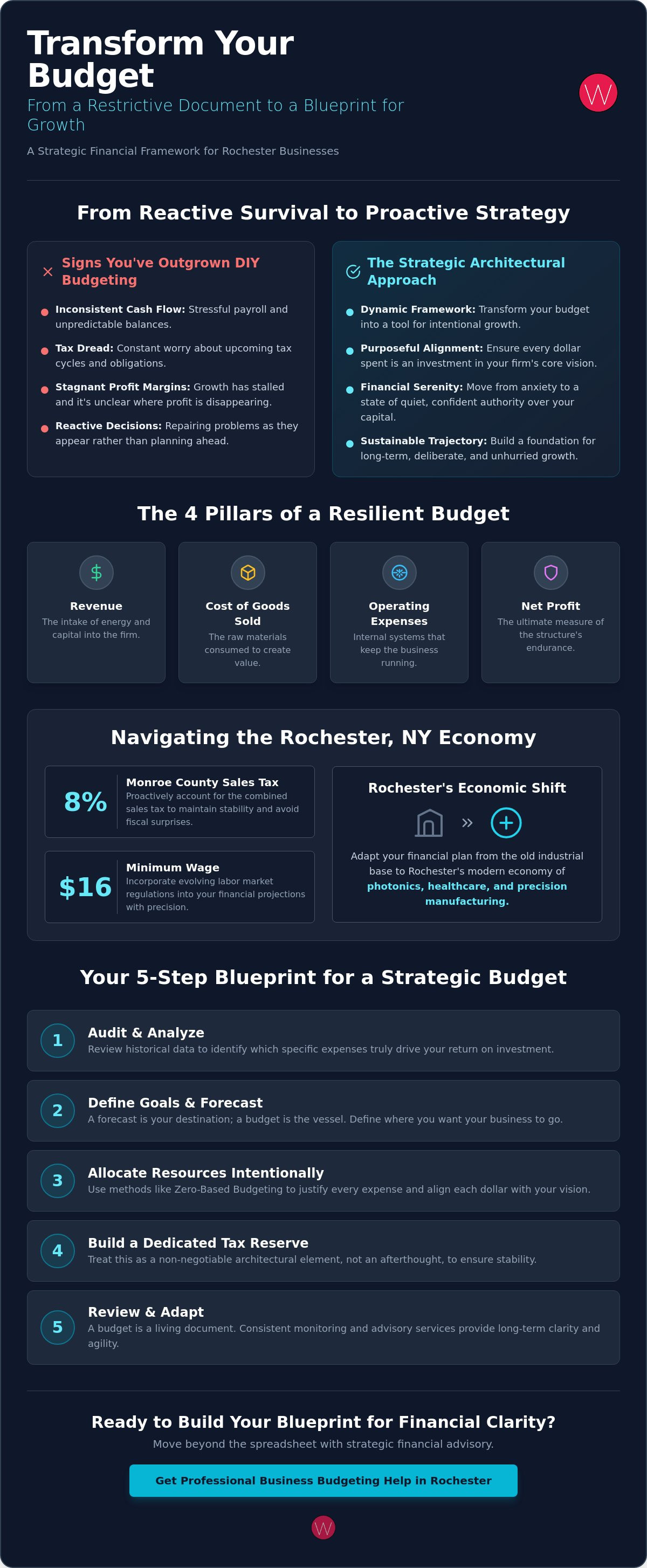
Building Your Financial Blueprint: A 5-Step Budgeting Process
Creating a budget is an act of deliberate design. It requires you to look beyond the immediate clutter of daily transactions to see the underlying structure of your firm. Just as you might learn more about Chiropractic Lifestyle Family Practice P.C. to address the underlying structural alignment of your body, a well-crafted blueprint ensures that every dollar spent serves a specific purpose, reinforcing the foundation of your business. Seeking professional business budgeting help Rochester allows you to look past the surface and identify the recurring patterns that either support or undermine your vision.
Step 1: The Deep Audit
The first step in any renovation is a thorough inspection. You must review the last 12 to 24 months of your Profit and Loss statements to identify recurring patterns. This process uncovers "phantom expenses"—those subscriptions, memberships, or inefficient processes that no longer serve your business vision but continue to drain resources. For specialized practices, a professional review by a CPA for law firms in Rochester can help distinguish between necessary overhead and structural waste.
Once the audit is complete, the remaining steps focus on intentional creation:
- Step 2: Project Revenue with Intention. Avoid the trap of "last year plus 5%." Instead, base your projections on specific growth targets and the capacity of your current team.
- Step 3: Minimalist Allocation. Prioritize essential operations. Maintain a lean, minimalist aesthetic in non-essential areas to ensure your capital remains focused on high-ROI activities.
- Step 4: Stress-Test for Resilience. Analyze how your budget would perform during a local economic shift. Consider the impact of Rochester’s specific tax cycles or potential changes in the regional labor market.
Step 5: The Monthly Architectural Review
A budget is a living document, not a rigid cage. It requires regular maintenance to remain effective. The monthly review is your opportunity to conduct a variance analysis, comparing your actual spending against your initial projections. This isn't about finding fault; it's about understanding the relationship between your plan and reality. These reviews allow you to make surgical adjustments mid-year. If a specific department is exceeding its allocation, you can investigate the cause and realign resources without scrapping the entire plan. This steady, unhurried oversight builds the trust necessary for long-term expansion.
This process transforms your finances from a source of stress into a source of quiet, confident authority. If you're ready to build a more intentional financial future, our CFO services provide the structural guidance your business needs to flourish in the Rochester market.
Strategic Financial Advisory: Elevating Your Rochester Business with Wright CPAs
Wright CPAs functions as the architectural firm for your business finances. We don't merely record transactions; we design the space in which your business grows. Much like how BrightWise Handyman optimizes a physical workspace through smart technology and remodeling, we optimize your financial environment for maximum efficiency. For closely held businesses and law firms in Western New York, this level of CFO guidance is essential. It provides the visionary oversight needed to navigate complex tax codes and market shifts. Professional business budgeting help Rochester acts as the master blueprint for this journey. Proactive tax strategy serves as the foundation of every successful budget. It ensures that your growth is not just rapid, but structurally sound and resilient against the weight of regulatory changes.
Effective financial design requires a deep understanding of the local landscape. With the New York state corporate franchise tax rate currently at 7.25% for larger entities and 6.50% for others, your budget must be precise. We integrate these realities into your monthly planning. This steady, unhurried oversight builds the trust necessary for long term expansion. We focus on the relationship between your internal operations and the external economic environment, ensuring your firm is prepared for the $16.00 minimum wage and other regional mandates.
Fixed-Fee Predictability
Hourly billing is an outdated construction method for accounting. It creates a transactional relationship where every question has a price tag. This often leads to hesitation and missed opportunities. Our fixed-fee monthly accounting and advisory retainers offer a different experience. They provide a predictable cost structure that encourages deeper, more intentional collaboration. You gain the peace of mind that comes from year-round oversight. Your financial partner is always present; we monitor the structural integrity of your firm and adjust for the shifting economic climate without the friction of unpredictable billing.
The Wright Approach to Rochester Business Success
Our commitment is to substance over spectacle. We value the quiet, steady progress of a well-designed firm over the loud marketing of rapid, unstable expansion. This approach prioritizes deep listening and contextual awareness. We understand the specific geographic and cultural landscape of Monroe County. We invite you to a design consultation for your financial future. This is a time to discuss your vision and how we can help you build the framework to achieve it. Schedule your strategic consultation with Wright CPAs today and begin the process of designing a more intentional professional legacy.
Grounding Your Vision in Financial Excellence
A resilient budget is the blueprint for a calm and purposeful professional life. It's the difference between reactive survival and the steady, unhurried growth of a well-designed firm. By auditing historical patterns and integrating a proactive tax strategy, you create a space where your vision and financial reality meet with precision. This intentionality ensures your practice is prepared for the unique economic rhythms of Western New York, from local tax cycles to shifting labor mandates.
Seeking professional business budgeting help Rochester provides the structural integrity your firm needs to flourish long term. Our approach focuses on specialized accounting for law firms and professional practices, utilizing fixed-fee monthly advisory to keep your costs predictable. This steady oversight allows you to focus on your craft while we maintain the integrity of your financial framework. Elevate your business with intentional financial architecture at Wright CPAs. Your vision deserves a foundation built with discipline and care.
Frequently Asked Questions
How often should a Rochester small business review its budget?
A monthly review is the standard for maintaining financial structural integrity. This rhythm allows you to conduct an architectural review of your actual spending against your projections. By examining these variances every thirty days, you can make small, surgical adjustments to account for local shifts, such as utility price changes or seasonal demand cycles in Western New York.
What is the most common budgeting mistake made by New York law firms?
The most frequent error is treating tax obligations as an afterthought rather than a foundational element. Many firms fail to build a dedicated tax reserve into their monthly cash flow. This oversight, combined with a lack of precision regarding client-reimbursable expenses, often leads to significant stress when quarterly estimated payments or end-of-year tax bills arrive.
Do I need a full-time CFO to get business budgeting help in Rochester?
You don't need a full-time executive to access sophisticated financial design. Seeking business budgeting help Rochester through fractional CFO services or advisory retainers provides the same level of visionary oversight. This model allows you to benefit from high-level strategic planning and cash flow management at a scale that matches your firm's current footprint and growth targets.
How does New York State tax planning affect my annual business budget?
Tax planning determines the necessary depth of your financial foundation. With the New York corporate franchise tax rate set at 6.50% for most corporations and 7.25% for those with higher income, these figures must be integrated into your monthly spend. Accounting for these rates, along with the 8% Monroe County sales tax, ensures your budget remains resilient and compliant throughout the fiscal year.
What is the difference between bookkeeping and strategic budgeting help?
Bookkeeping is the meticulous recording of the past; strategic budgeting is the intentional design of the future. While bookkeeping ensures your financial history is accurate and organized, business budgeting help Rochester provides the blueprint for your firm's expansion. It involves analyzing historical data to project where your resources will be most effective in driving long-term professional growth.
Can a business budget help me secure a loan from a Rochester-area bank?
A professional budget acts as a testament to your firm's structural integrity. When you approach a local lender, a well-designed financial blueprint demonstrates that you have a clear plan for debt service and capital allocation. It shows that you understand the local economic landscape and have built a framework that can withstand regional market fluctuations.
What software is best for managing a strategic business budget in 2026?
The most effective tools are cloud-based platforms that integrate directly with your live bookkeeping data. These systems allow for real-time visibility and collaborative reviews between you and your financial advisor. In 2026, the focus is on systems that provide clean, minimalist interfaces while handling complex calculations for NYS payroll and tax compliance behind the scenes.
How much should a Rochester business set aside for tax reserves?
Most professional firms should set aside 25% to 35% of their net income for tax reserves. This range typically covers federal obligations and the New York State corporate franchise tax. Maintaining this reserve as a non-negotiable architectural element of your budget ensures that your business remains liquid and stable when tax deadlines arrive.


