

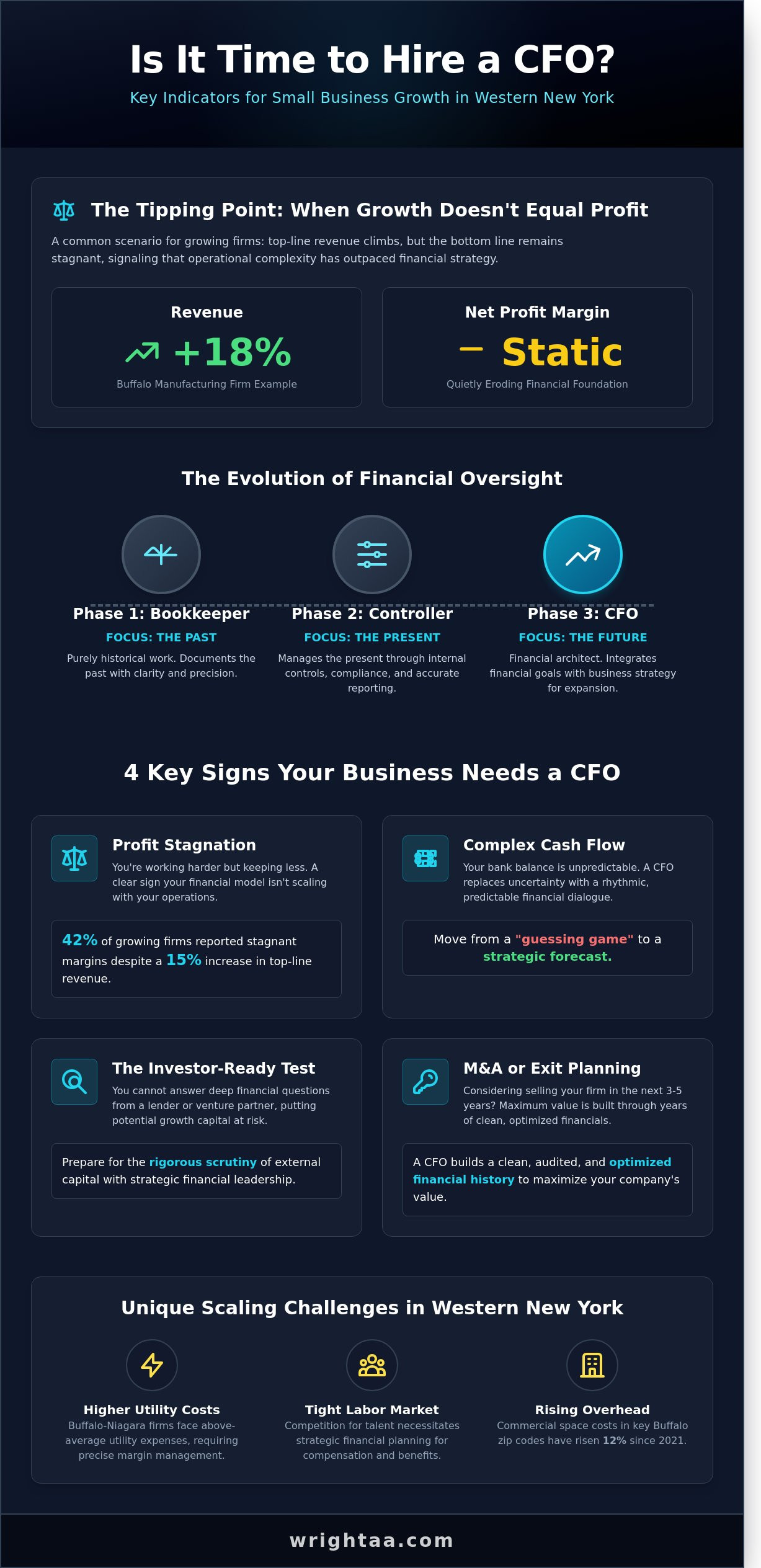
In November 2023, a Buffalo manufacturing firm realized that while their revenue climbed by 18 percent, their net profit margin remained as static as a Lake Erie horizon in mid-winter. It's a quiet, unsettling realization many Western New York founders face. You've crafted a business with integrity and purpose, yet the financial foundation that supported your early growth now feels thin. When your bank requests a three year forecast and you find yourself reacting to New York state tax liabilities rather than planning for them, the structural integrity of your operation is at risk.
Understanding exactly when to hire a cfo for small business growth is about recognizing when the complexity of your work has outpaced your internal systems. It's time to move from the tactile day to day bookkeeping to a more intentional, strategic dialogue with your capital. You'll gain a clear decision framework to identify your specific needs and learn how the right leadership can elevate your company's performance. We'll examine the ROI of this investment and weigh the clarity of the fractional model against a full time hire to ensure your business remains both visionary and grounded.
Key Takeaways
- Recognize the transition from retrospective bookkeeping to the forward-looking vision required of a true financial architect.
- Identify the specific indicators, such as profit stagnation and complex cash flow, that signal exactly when to hire a cfo for small business growth.
- Distinguish between the unique crafts of a CPA, Controller, and CFO to ensure your financial foundation is built with precision and structural clarity.
- Evaluate the materiality of your leadership investment by comparing the strategic advantages of a fractional CFO against the costs of a full-time executive.
- Discover how integrating proactive tax planning with day-to-day guidance can elevate the human experience of navigating your business’s financial future.
The Tipping Point: Moving Beyond Basic Bookkeeping in WNY
In Western New York, the growth of a firm mirrors the construction of a building. It begins with a solid foundation, but eventually, the structure requires a more complex blueprint to reach its full height. Many local owners find themselves at a crossroads where basic bookkeeping no longer sustains their vision. This transition represents the moment the Chief Financial Officer role shifts from a luxury to a necessity. While a bookkeeper looks through the rear-view mirror to record what has passed, a CFO acts as a financial architect. They design the future by analyzing the tectonic shifts in your market and the internal materiality of your cash flow.
Buffalo businesses often encounter a distinct ceiling between $1 million and $3 million in annual revenue. At this threshold, the owner's intuition reaches its limit. Data from the 2023 Small Business Administration profiles suggests that firms in the Buffalo-Niagara region face higher-than-average utility costs and a tight labor market, making precision essential. Understanding when to hire a cfo for small business depends on recognizing when financial materiality starts to impact daily decisions. It's the point where a 2% margin fluctuation determines whether you can break ground on a new project or remain stagnant.
The Evolution of Financial Oversight
- Phase 1: The Bookkeeper. Their work is purely historical. They ensure the past is documented with clarity and precision.
- Phase 2: The Controller. This phase focuses on managing the present through internal controls, compliance, and accurate reporting.
- Phase 3: The CFO. The architect of the future. They integrate your financial goals with your broader business strategy, creating a site-specific plan for expansion.
Why Buffalo Businesses Face Unique Scaling Challenges
Scaling in Western New York requires a deep understanding of the local vernacular. The shift from owner-operated to process-driven leadership is often the hardest hurdle for firms in Erie and Niagara counties. In the 14201 and 14202 zip codes, overhead costs for commercial space have risen by 12% since 2021. A CFO provides the proactive tax strategy needed to navigate New York's complex regulatory environment. They ensure your growth isn't just a reaction to the market, but a deliberate, intentional expansion. Knowing when to hire a cfo for small business allows you to move beyond survival and toward true excellence in your industry.
The 10-Point Checklist: Signs Your Small Business Needs a CFO
Recognizing when to hire a cfo for small business is an exercise in structural integrity. It's about moving from a reactive posture to a curated, intentional strategy. Just as a building requires a foundation that accounts for the specific soil of its site, a business in Western New York needs a financial framework that respects local economic shifts. When the complexity of your operations begins to obscure your vision, it's time to introduce a new level of craft to your leadership team.
- Revenue Growth vs. Profit Stagnation: You're working harder but keeping less. In 2023, data indicated that 42% of growing firms reported stagnant margins despite a 15% increase in top-line revenue.
- Complex Cash Flow: Your bank balance feels like a guessing game every Friday. A CFO replaces this uncertainty with a rhythmic, predictable dialogue between accounts receivable and payable.
- The Investor Ready Test: You cannot answer deep financial questions from a lender or venture partner. Understanding the strategic value of a CFO helps you prepare for the rigorous scrutiny of external capital.
- M&A or Exit Planning: You're considering selling your Buffalo-based firm in the next 3 to 5 years. Value is built through years of clean, audited, and optimized financial history.
Operational Red Flags
The daily mechanics of your business should be seamless. When reporting takes 14 days or more to produce, the information is already a relic of the past. This delay prevents you from making site-specific adjustments to your strategy. Inefficient pricing that doesn't reflect the 3.4% inflation rate seen in WNY throughout early 2024 can erode your capital quietly. Without a five-year financial forecast or "Scenario B" planning, you're building on unstable ground.
Strategic Red Flags
Strategy requires a long view. If tax liabilities are a surprise at year-end, your current accounting lacks the necessary integration. Making major equipment purchases or hiring decisions based on a gut feeling rather than data is a risk to your firm's tectonic stability. As you expand into Rochester or Syracuse, a lack of a tax nexus strategy can lead to unforeseen liabilities. A CFO ensures the financial materiality of your firm is as resilient as its physical output. Decisions become disciplined, and growth becomes a deliberate act of design.
CFO vs. Controller vs. CPA: Differentiating the Roles
Architecture requires a clear understanding of site-specific constraints; business finance demands the same level of rigor. Each financial role serves a distinct craft. A frequent error among Buffalo business owners is viewing these positions as interchangeable. They are not. Understanding these nuances prevents expensive hiring mistakes and ensures your business foundation remains stable. A healthy organization functions like a well-designed building, where every structural element supports a specific load.
The Strategic Divide
The Controller manages the internal data. They ensure your records are accurate and your internal controls are resilient. The CFO looks toward the horizon. They translate raw data into a site-specific strategy for growth. A tax preparer or CPA firm typically focuses on historical compliance. They ensure your filings meet the 2024 New York State Department of Taxation and Finance requirements. This perspective is vital; however, it often represents only 10% of your financial materiality. It's a view of where you've been, not where you're going.
Asking a bookkeeper to perform CFO-level analysis is like asking a mason to draft a master plan. The skill sets are fundamentally different. Deciding when to hire a cfo for small business involves recognizing this strategic gap. A CFO doesn't just record history; they create the framework for your future. They analyze how light and shadow—or in this case, risk and capital—affect the longevity of your firm.
Building Your Financial Team in Buffalo
A healthy business ecosystem relies on the integration of these roles. They must exist in a constant dialogue to protect your margins. For New York law firms, this integration is essential for managing IOLA accounts and navigating the 2023 updates to the LLC Transparency Act. These specific legal requirements demand more than just basic math. They require a sophisticated understanding of the local regulatory environment. In Buffalo, where the 2024 economic climate remains nuanced, having a team that understands the local vernacular is a competitive advantage.
- The CPA: Focuses on the 2024 tax code and annual compliance.
- The Controller: Maintains the integrity of the daily ledger and financial reporting.
- The CFO: Directs capital allocation and long-term financial health.
The most effective way to scale is to layer these services. You might start with a solid bookkeeper. As your revenue approaches the $1.5 million mark, the need for a Controller becomes clear. You should evaluate when to hire a cfo for small business once your decisions involve complex debt structures or significant market expansion. This phased approach allows your financial team to grow in proportion to your complexity. You can learn more about building this foundation in our guide to Small Business Accounting Buffalo NY.
Full-Time vs. Fractional CFO: A Western New York Cost Analysis
The decision of when to hire a cfo for small business growth involves a careful study of materiality. In the Buffalo and Rochester markets, a full-time CFO commands a base salary between $175,000 and $225,000. When you add the weight of benefits, bonuses, and payroll taxes, the total investment often exceeds $280,000 annually. For a business generating $3 million in revenue, this single hire consumes nearly 10% of gross earnings. This creates a structural imbalance that few growing firms can sustain without sacrificing their operational craft.
Fractional CFO services offer a different geometry. Instead of a permanent overhead fixture, you integrate expertise as a variable component. Most Western New York firms with revenues between $2 million and $20 million find their needs met through a monthly retainer. These retainers typically range from $3,000 to $7,000 per month. This model allows the business to access high-level strategy without the heavy footprint of a full-time executive salary.
The Fractional Model Explained
The fractional model functions like a modular design. It provides high-level expertise on a fixed-fee monthly retainer, ensuring there are no surprises in your cash flow. This structure provides the spatial breathing room small businesses need to scale. You gain the clarity of a veteran financial officer who understands the specific vernacular of the Buffalo economy. Whether you require project-based consulting for a new business formation or ongoing oversight, the flexibility ensures the service scales with your site-specific needs.
Local Benchmarks for WNY
The ROI of a CFO hire is often found in the refinement of existing systems. In our experience across Erie and Monroe counties, a professional financial review identifies between 5% and 10% in hidden margin. This often comes from optimizing supply chains or restructuring debt. Wright CPAs utilizes modern technology to provide CFO-level guidance at scale, ensuring your financial foundation is both lean and resilient. You can explore our specific Outsourced CFO pricing Buffalo guide to see how these benchmarks apply to your current revenue tier.
Pricing in the Western New York market remains more accessible than in downstate hubs. This regional advantage allows local owners to secure sophisticated talent at a fraction of the cost found in Manhattan or Boston. If your current accounting feels like a series of disconnected rooms, it's time to consider a more integrated approach. A part-time expert isn't a compromise; it's a precise application of resources where they matter most.
Elevating the Human Experience: The Wright Approach to CFO Services
At Wright CPAs, we view financial advisory as a form of craftsmanship. We aren't just processors of data; we're the thoughtful makers of your financial future. For Buffalo law firms and closely held businesses, the decision regarding when to hire a cfo for small business often arises when the complexity of the site exceeds the strength of the foundation. We provide the structural integrity needed to support your vision. Our work is rooted in the belief that financial clarity is a prerequisite for meaningful growth.
Our approach integrates proactive tax planning with day to day CFO guidance. This isn't a fragmented service. It's a holistic dialogue between your current cash flow and your long term goals. In 2023, we helped a local professional services firm identify 14% in tax savings that were immediately reinvested into their scaling operations. We bring this same level of precision to every engagement; ensuring that every financial decision is an intentional step toward clarity. We look for the tectonic shifts in your industry to ensure your business remains resilient.
Our Methodology
We follow a deliberate, steady process of financial cleanup and strategic forecasting. This begins with understanding the specific vernacular of your industry. Whether it's the unique billing cycles of a Buffalo litigation firm or the inventory materiality of a WNY manufacturer, we speak your language. We value substance over hyperbole. Our process involves a rigorous 90 day assessment phase where we stabilize your data before building out three year predictive models. This shift from reactive accounting to proactive strategy allows you to see the light in your numbers.
The Path Forward
Moving from uncertainty to intentional growth requires a partner who understands your place in the market. We invite you to a consultation focused on your specific geographic and cultural context. Our goal is to help you move beyond the noise of daily transactions and into a space of strategic calm. By aligning your financial structure with your human values, we elevate your entire business experience. The transition from a small operation to a sophisticated enterprise is a pivotal moment. Knowing when to hire a cfo for small business is the first step in that evolution. Let's build something enduring together.
Next Step: Schedule a strategy session with Wright CPAs.
Architecting a Resilient Financial Structure
Financial clarity isn't just about balancing ledgers; it's about the intentional design of your firm's future. You've seen how our 10-point checklist identifies the precise moment operations outgrow basic bookkeeping. Deciding when to hire a cfo for small business requires a site-specific approach that considers the unique Buffalo market and your internal materiality. Whether you're navigating the nuances of New York State Article 22 tax codes or managing the complex compliance needs of a regional law firm, the right leadership acts as a structural anchor for your vision.
The choice between a full-time executive and a fractional model is a dialogue between your current resources and your long-term trajectory. We utilize fixed-fee models to ensure your growth remains predictable and grounded. Our team brings over 15 years of expertise to Buffalo law firm accounting, ensuring every financial decision is a deliberate step toward excellence. We focus on the craft of financial strategy to ensure your business remains resilient through every season. Elevate your financial strategy with Wright CPAs CFO Services and find the quiet confidence that comes with expert guidance. Your path to sustainable growth is ready to be built.
Frequently Asked Questions
What is the typical revenue threshold for hiring a CFO?
Most firms begin to evaluate when to hire a cfo for small business once annual revenue reaches the $2 million to $10 million range. At this scale, the financial materiality of the company requires a more sophisticated structure than a standard bookkeeper can provide. It's the point where simple accounting transitions into intentional financial architecture.
Can a fractional CFO help with Buffalo-specific tax planning?
A fractional CFO provides the site-specific expertise needed to navigate New York State incentives like the Excelsior Jobs Program. This program offers a 6.85 percent tax credit for new wages in the Buffalo region. They ensure your business stays in a productive dialogue with Erie County industrial development agencies to maximize local benefits and grants.
How does a CFO differ from my current tax accountant?
The distinction lies in the direction of the gaze. A tax accountant focuses on the historical record to ensure compliance with past obligations; they're the recorders of what has already transpired. A CFO acts as a financial architect, looking forward to design the spatial growth of your firm and craft long-term capital efficiency.
What should I look for in a CFO for a small law firm in WNY?
Legal practices require a professional who understands the tectonic shifts of IOLA trust accounting and partner distribution models. Look for a CFO who has successfully managed at least 12 legal entities in the Western New York area. They must integrate case cost financing with the firm’s broader fiscal health to ensure every billable hour contributes to structural integrity.
Will a CFO help me get a business loan from a local Buffalo bank?
A CFO builds the bridge between your vision and institutional capital by preparing the rigorous documentation required by lenders like M&T Bank or Five Star Bank. By maintaining a debt-to-equity ratio below 2.5, your CFO demonstrates the disciplined management that local loan officers prioritize. They speak the vernacular of the bank to secure more favorable interest rates.
How much does a fractional CFO cost in Rochester or Buffalo?
Fractional services offer a curated approach to executive talent without the burden of a full-time salary. In the Buffalo and Rochester corridor, monthly retainers typically range from $3,500 to $7,000 depending on the complexity of the engagement. This investment reflects the craft and precision required to manage your fiscal landscape for a fraction of a $190,000 annual executive hire.
What happens during the first 90 days of hiring a CFO?
The first 90 days are a period of deep observation and structural assessment. During the initial 30 days, the CFO audits existing systems to identify points of friction in your cash flow. By day 60, they implement a 13-week rolling forecast. The final 30 days focus on establishing five core performance indicators that guide the firm’s daily rhythm and future growth.
Do I need to clean up my bookkeeping before hiring a CFO?
You don't need to wait for perfect order to begin the conversation. A CFO often oversees the cleanup process to ensure the data aligns with future strategic goals. In 75 percent of cases, hiring the expert first prevents the need to redo work that lacks the necessary detail for high-level analysis. They bring the light needed to see the flaws in the current foundation.


