

The structural integrity of a tech startup is rarely found in the code alone. It is forged in the quiet, deliberate decisions made long before the first round of funding. For founders in Central New York, tax advisory for tech startups Syracuse is not merely a seasonal obligation but a vital architectural blueprint. It's the difference between a venture that collapses under its own growth and one that stands resilient against the complexities of New York's decoupling from federal R&D rules.
You likely feel the weight of the burn and scale model, where traditional accounting often feels too slow for your pace of innovation. It's common to worry that R&D credits are slipping through the cracks or that the nuances of founder equity might haunt your eventual exit. This guide explores how intentional tax strategy and proactive planning provide the financial clarity you need to scale with confidence.
We will examine how to maximize your cash runway through the latest tax credit updates, secure your long term capital gains through QSBS benefits, and find peace of mind with a predictable, fixed fee advisory model designed for the modern builder.
Key Takeaways
- View tax advisory for tech startups Syracuse as a structural blueprint rather than a seasonal compliance exercise.
- Identify how to transform technical research into immediate cash runway by capturing New York and federal R&D credits.
- Secure your future exit by correctly navigating the tiered holding periods and the $15 million QSBS gain exclusion.
- Integrate regional growth incentives, such as the Excelsior Jobs Program, into your startup's long-term financial architecture.
- Replace billing friction with the clarity of a fixed-fee model to support consistent, proactive advisory.
The Architecture of Finance: Why Syracuse Tech Startups Require Specialized Advisory
The foundation of a building determines how high it can rise. In the same way, the financial structure of a company dictates its capacity for growth. For founders in Central New York, tax advisory for tech startups Syracuse is more than a compliance checklist; it's a proactive, structural discipline. It functions as the architectural blueprint for innovation. It's the silent framework that supports every technical breakthrough and every hire.
Syracuse possesses a unique duality. There's a deep, historical grit found in our industrial roots, yet it now meets a visionary, global scalability through new tech corridors. This environment requires a specialized lens. Traditional, retroactive accounting often fails the modern startup because it focuses on the past. In a "burn and scale" model, looking backward is a luxury you can't afford. You need to look ahead. Financial clarity isn't just about balance sheets. It's about freeing the founder’s mind to focus on the creative act of building. When the technical debt of taxes is managed, the path to innovation becomes clear.
Navigating the Syracuse Innovation Ecosystem
Local incubators and accelerators provide the initial spark for many ventures in the region. However, a great idea needs a resilient tax strategy to survive the transition from a university-led project to an independent entity. Syracuse's geographic context offers specific state-level opportunities, but these require precise navigation. The path from a lab at Syracuse University to a high-growth C-Corp is paved with technical tax decisions. These choices determine how much of your capital remains available for research and development. Integrated tax advisory for tech startups Syracuse ensures that your business model remains aligned with both local incentives and federal requirements.
The Cost of Passive Compliance
Passive compliance is a hidden drain on resources. Waiting until tax season to discuss strategy is like trying to change a building's layout after the concrete has cured. Poor entity selection in the early stages creates structural debt that becomes expensive to fix later. For example, failing to structure correctly can disqualify founders from the benefits of Qualified Small Business Stock (QSBS). This federal incentive is a cornerstone for tech exits, potentially allowing for significant gain exclusions. A visionary partner understands that every technical detail in the tax code is an opportunity to reinforce your company's future. Without this foresight, you're merely reacting to the environment rather than shaping it.
Strategic Pillars: Maximizing Runway with R&D Credits and QSBS
Capital is the lifeblood of innovation, yet it's often treated as a finite reservoir. For founders, the goal is to extend the horizon of possibility. Effective tax advisory for tech startups Syracuse transforms the tax code from a regulatory burden into a strategic funding mechanism. It's about identifying the hidden value already present in your technical stack and ensuring it remains within your control.
The R&D Credit as a Funding Mechanism
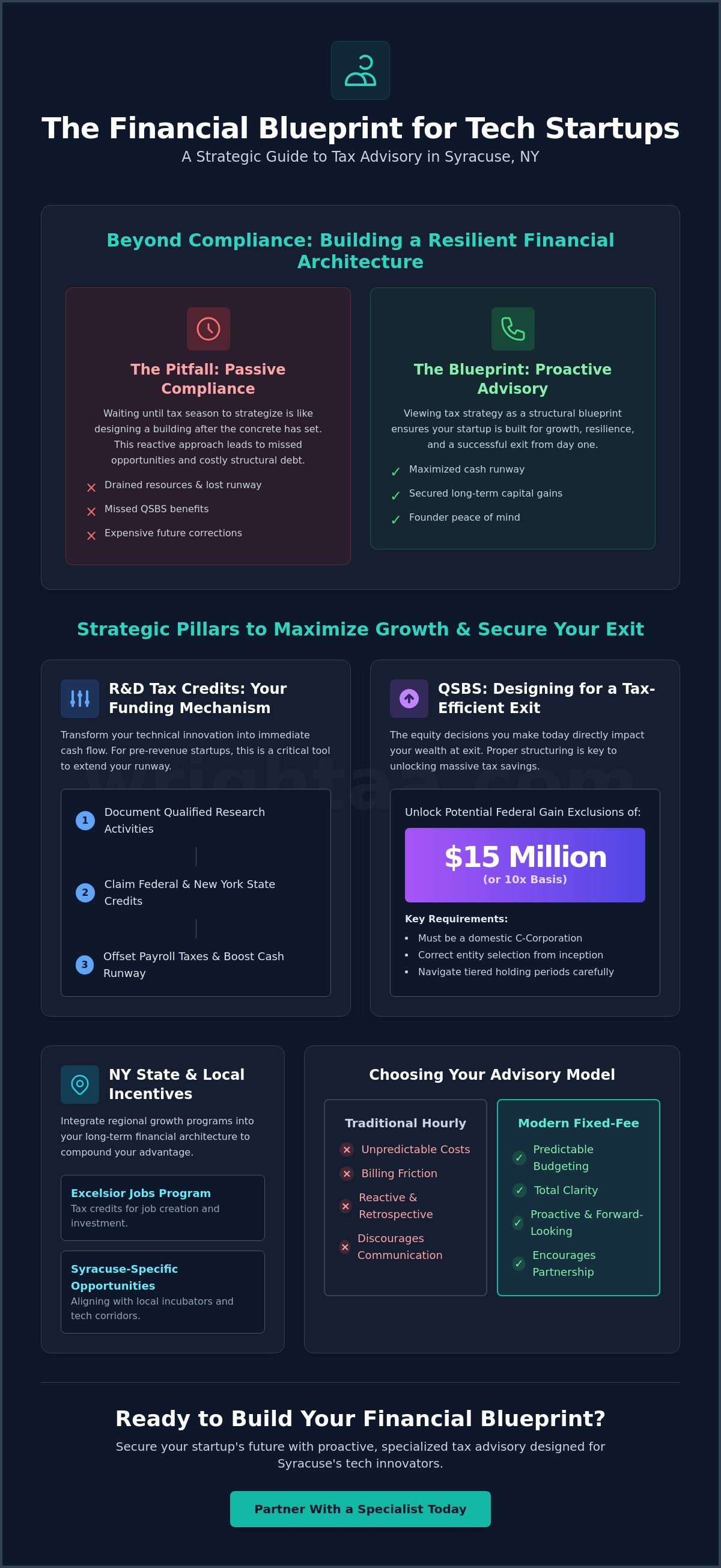
Technical innovation is expensive. It requires talent, iteration, and time. For tax years beginning after December 31, 2024, the federal landscape has shifted to allow immediate expensing for domestic research and experimental costs. This provides a significant boost to current year liquidity. For pre-revenue startups, the R&D payroll tax credit for startups remains a vital tool. It allows you to offset payroll taxes before you ever see a dollar of profit, effectively turning your development team into a source of immediate cash flow.
Success here depends on the quality of your documentation. You must define qualified research activities within your software or hardware stack with precision. It isn't enough to simply build; you must document the technical uncertainty you've sought to overcome. This rigorous approach creates a defensible position that protects your runway from future scrutiny. Balancing aggressive credit claims with these high standards is the hallmark of a disciplined financial architecture.
Designing for the Exit: The Power of QSBS
The true value of a startup is often realized at the exit. How you design your equity today determines what you keep tomorrow. For stock acquired after July 4, 2025, the landscape for Qualified Small Business Stock has evolved. The lifetime gain exclusion cap has increased to $15 million per taxpayer. This is a powerful incentive for those who build for the long term, but it requires a careful, intentional setup from the moment of formation.
Eligibility is not accidental. It requires strict adherence to the "original issue" rule and a vigilant monitoring of the gross assets test, which has been raised to $75 million for stock issued after July 4, 2025. Under the 2026 tiered system, holding your stock for at least five years unlocks the full 100% exclusion. In this landscape, managing the tax implications of SAFE notes and convertible debt is equally critical. These instruments must be structured to ensure they eventually convert into qualifying equity without triggering unintended liabilities. A thoughtful tax strategy ensures that when the time comes to sell, the structure you built remains intact and your gains are protected.
Navigating New York State: Incentives and Local Compliance
The geographic home of your startup carries profound tax implications. In Syracuse, the relationship between your physical presence and your financial structure is particularly nuanced. New York State has recently decoupled from federal regulations regarding research and development costs. While federal law allows for immediate expensing of these costs as of 2025, New York requires them to be amortized over five years. This divergence makes tax advisory for tech startups Syracuse essential for maintaining cash flow. It's the difference between a predictable trajectory and an unexpected tax liability.
Founders can find significant relief through the Excelsior Jobs Program, which has been extended through 2049. This program provides five refundable tax credits designed to support strategic industries. For a scaling tech firm, the Jobs Tax Credit offers up to 6.85% of wages per new employee. There's also a Research and Development Tax Credit, which provides 50% of the federal R&D credit attributable to New York activities, capped at 6% of state research expenses. These incentives aren't mere bonuses. They're the structural beams that support your regional growth.
Compliance also extends to the digital products you build. In New York, SaaS and prewritten software are often treated as tangible personal property for sales tax purposes. This creates a complex layer of obligation that founders frequently overlook. Identifying these requirements early prevents the accumulation of administrative debt. It ensures that your focus remains on the product rather than the cleanup of past oversights.
Central NY Regional Incentives
Syracuse is designated as an Innovation Hot Spot. This program allows early-stage tech companies to receive five years of tax benefits, including exemptions from the Corporation Franchise tax and Sales and Use tax. Leveraging these regional credits requires deep listening and coordination with local authorities. It's about aligning your business model with the city's vision for growth. When you establish operations in these designated zones, you're not just renting office space; you're integrating your venture into a supportive financial ecosystem.
Nexus and the Remote Workforce
As your Syracuse team expands, you may find talent beyond the borders of Central New York. Hiring your first remote employee in another state triggers a "nexus," which is a legal tax presence in that jurisdiction. This shift introduces new payroll tax obligations and apportionment rules. Designing a multi-state tax footprint is a core part of the architecture of finance. It requires a disciplined approach to state compliance, ensuring that a distributed workforce doesn't create a fragmented and costly tax profile. A visionary partner helps you build this foundation, allowing your team to grow without hindering your creative momentum.
Beyond the Hourly Rate: The Fixed-Fee Advisory Model
The friction of the billable hour is a subtle weight that often slows the momentum of a growing startup. When every phone call or email triggers a ticking clock, the natural impulse is to hesitate. This hesitation creates a barrier between the founder's vision and the advisor's expertise. In the fast paced environment of Central New York, tax advisory for tech startups Syracuse should function as an open channel of communication, not a series of transactional hurdles. A partnership built on time-based billing often prioritizes history over strategy. It looks backward at what was done rather than forward at what is possible.
Transitioning to a fixed-fee model removes this tension. It allows for a steady, unhurried rhythm of collaboration. For a startup managing a tight burn rate, predictable costs are essential for maintaining financial clarity. Fixed-fee retainers transform the relationship from a vendor-client dynamic into a shared commitment to the company's structural integrity. This approach ensures that high-level strategy is integrated into the daily fabric of the business, providing the spatial breathing room needed for thoughtful decision making.
Predictability in a Volatile Environment
A fixed-fee model aligns the interests of the CPA and the founder. When the cost of advisory is known and constant, the focus shifts entirely to the value of the insights provided. This alignment encourages year-round planning, which is the only way to eliminate the "surprise" tax bill that can derail a funding round. The fixed-fee model is a commitment to continuous financial design. It ensures that your tax position is always optimized, regardless of how many iterations your product undergoes or how quickly your team expands. By removing the fear of incremental costs, you gain a partner who is as invested in your efficiency as you are.
The Role of CFO-Level Guidance
Modern startups require more than a person to "keep the books." They need an architect who can design the future. CFO-level guidance moves beyond simple record keeping to provide a visionary perspective on cash flow management and business consulting. This proactive advisory is particularly crucial during due diligence. Investors look for a level of financial sophistication that suggests the company is ready to scale. Having a structured financial foundation demonstrates that your venture is built on substance rather than spectacle. You can explore how these high-level strategies apply across the region by reviewing our insights on Outsourced CFO Services in Buffalo, NY: Elevating Your Business Strategy.
As you move through different funding rounds, your needs will evolve. Your advisory service should be designed to scale alongside you, providing more intensive oversight as the complexity of your operation increases. This ensures that the financial clarity you have today remains a permanent feature of your growth. If you are ready to move toward a more intentional financial structure, consider how our tax strategy and planning services can provide the foundation your innovation requires.
Selecting Your Partner: The Wright CPAs, LLC Approach in Syracuse
Choosing a partner for your financial foundation is a decision of consequence. It requires more than technical proficiency; it demands a shared philosophy of excellence. At Wright CPAs, LLC, we approach tax advisory for tech startups Syracuse with a commitment to deep listening. We understand that every venture is a unique intervention in the market. Our role is to provide the quiet, confident authority that allows you to build with purpose. We value substance over spectacle, focusing on the quality of our insights rather than the volume of our marketing.
The intersection of modern technology and traditional professional discipline is where we find our rhythm. We utilize the latest tools to ensure your data is precise, yet we never lose sight of the human element. Startups in Syracuse require a partner who can bridge this gap. You need someone who understands the local grit of Central New York while maintaining a national perspective on tax strategy. This duality ensures that your venture is grounded in its community but ready for a global stage. We don't just manage your taxes; we curate a financial environment that supports your creative focus.
A Methodology Rooted in Clarity
Our process moves logically from broad strategy to meticulous material detail. It's a deliberate progression that mirrors the walkthrough of a well-designed building. We begin by understanding the context of your business, identifying the specific state and federal incentives that align with your goals. This regional awareness is vital. For early-stage founders just beginning to lay their foundation, we recommend reviewing our guide on Starting a Business in Buffalo, NY: A Checklist for Financial Intentionality. It provides a roadmap for those who value intentionality from day one.
Designing Your Financial Future
Taking the first step toward financial clarity should be an unhurried experience. During an initial strategy consultation, we don't rush toward a conclusion. Instead, we listen to your narrative. We examine your current structure, your funding trajectory, and your vision for an eventual exit. This unhurried flow creates a sense of trust and ensures that our advice is contextualized to your specific needs. The long-term benefits of this curated approach are clear: predictable cash flow, maximized credits, and a resilient equity structure.
A startup's financial health is not a technical exercise to be solved once a year. It's a permanent, thoughtful intervention that requires ongoing attention. By establishing this foundation early, you ensure that your daily life as a founder is improved by financial serenity rather than burdened by administrative anxiety. If you're ready to build your venture on a foundation of substance and clarity, we invite you to schedule a strategy session with Wright CPAs, LLC.
Establishing a Resilient Framework for Growth
The future of your venture is built on the decisions you make today. We've explored how intentional financial design transforms tax obligations into strategic opportunities. By focusing on specialized expertise in R&D and QSBS, you protect your gains and expand your runway. This approach relies on a fixed-fee advisory model that ensures your costs remain predictable as you scale. It's a method that prioritizes the long-term health of your business over short-term transactional needs.
Syracuse is a landscape of immense potential. Navigating its unique tax environment requires a partner with deep roots in the Western and Central NY business communities. Professional tax advisory for tech startups Syracuse provides the clarity needed to maintain your creative focus while building a structure that lasts. It's about moving from passive compliance to a visionary state of financial intentionality. When you're ready to solidify your foundation, we're here to guide the process with discipline and care.
Design your financial future with Wright CPAs, LLC.
Your innovation deserves a structure as thoughtful as the technology it supports. Build with confidence.
Frequently Asked Questions
What is the R&D tax credit, and does my Syracuse startup qualify?
The R&D tax credit is a federal and state incentive designed to reward companies that attempt to solve technical uncertainties through experimentation. Your Syracuse startup likely qualifies if you're developing software, hardware, or proprietary processes that involve iterative testing. While federal law allows immediate expensing as of 2025, remember that New York State requires these costs to be amortized over five years. This divergence makes precise documentation essential for your financial foundation.
How does QSBS benefit tech founders during an acquisition or IPO?
Qualified Small Business Stock (QSBS) provides a path to tax-free gains upon an acquisition or IPO. For stock acquired after July 4, 2025, you can potentially exclude up to $15 million in capital gains if you hold the shares for at least five years. This benefit requires your company to meet the $75 million gross asset test and maintain an active business status. It's a powerful incentive that rewards those who build with a long term perspective.
Should my tech startup be an LLC or an S-Corp for tax purposes in NY?
Choice of entity depends on your trajectory, but high-growth tech startups often favor C-Corporations over LLCs or S-Corps. While LLCs offer pass-through simplicity, a C-Corp is necessary to leverage QSBS benefits and attract institutional investment. In New York, the corporate tax rate is 6.5% for businesses with income at or below $5 million. This structure provides the sophisticated framework needed for global scalability.
What are the tax implications of issuing equity to early employees?
Issuing equity creates a taxable event for employees based on the fair market value of the shares. Founders and early hires should consider an 83(b) election within 30 days of receiving restricted stock. This election allows the recipient to pay taxes on the current value rather than the potentially higher value at the time the shares vest. It's a deliberate step that protects the individual's future gains from higher tax rates.
How do SAFE notes affect my startup's tax filings?
SAFE notes are generally treated as open transactions rather than debt or equity until they convert. They don't typically generate interest deductions or immediate tax liabilities. However, the timing of their conversion into equity is critical. It determines when the holding period begins for capital gains exclusions. Managing these instruments requires a disciplined approach to ensure they don't complicate your future tax profile.
What is the difference between a tax preparer and a tax advisor for startups?
A tax preparer documents the past, while tax advisory for tech startups Syracuse designs the future. Preparers focus on the accuracy of annual filings to ensure compliance. Advisors provide continuous, structural oversight. They focus on cash flow management, credit capture, and the architectural integrity of your cap table. This proactive relationship ensures that your financial structure supports your creative momentum year round.
How can I manage sales tax for my SaaS product in New York?
Managing sales tax for SaaS in New York requires recognizing that the state views prewritten software as taxable tangible personal property. You must determine the location of your users to collect and remit the appropriate tax rates. Implementing compliance tools early in your development prevents the accumulation of administrative debt. It ensures that your focus remains on the product rather than the cleanup of past oversights.
What Syracuse-specific tax incentives are available for tech companies?
Syracuse offers unique local benefits through the Innovation Hot Spot program, providing five years of exemptions from certain state taxes. Additionally, the GENIUS NY accelerator invests over $3 million annually in uncrewed systems companies. These local programs, combined with the state's Excelsior Jobs Program, create a multi-layered incentive structure. They reward founders for choosing to build their ventures within the Central New York ecosystem.


